Redefining autonomy in AI: A deep dive into Agentic vs. Generative models

AIWeb development
Aug 18, 2025
6 Min Read
Redefining autonomy in AI: A deep dive into Agentic vs. Generative models

This is the major transformation now happening in the Artificial Intelligence landscape, not merely the automation of tasks or content generation. The pitch being created by the increasing complexity and demand for intelligent decision-making could well be said to give birth to a new paradigm-the paradigm that challenges the accepted form of AI. On a technological plane, this shift is not merely an evolution but rather a redefinition, a redefinition of how independent intelligence associates with a contemporary enterprise.

Quick Primer: Generative AI in a Nutshell

The Technology Behind the Magic

Foundation Models and Large Language Models

Foundation models provide a generative AI backdrop, they are large systems pre-trained on vast data and adaptable to many tasks. LLMs includ-ing ChatGPT, Bard, and Copilot, and are probably the most spoken-about ones.

An LLM is trained with powerful deep neural networks, easily holding millions of tunable parameters, assisted by an attention mechanism, based on a transformer architecture, data sequences are processed in parallel, allowing a much faster training than that of the conventional sequential models, which tend to give better-moth-wrapping outputs.

How Generative AI Learns and Creates?
1. Pattern Recognition

AI models analyze enormous datasets that might contain billions of web pages, documents, and multimedia materials, where they seek out complex relationships and dependencies between different items.

2. Contextual Understanding

With the help of higher-level natural language and self-attention mechanisms, the information system acquires the understanding of context and meaning and develops data portrayal of semantic relations.

3. Content Generation

Upon being prompted, the AI creates new content by finding relevant context among its learned patterns and dependencies, with an output feeling completely perfect as if delivered from a human being but is entirely machine-generated.

Agentic AI Explained

The Autonomous Revolution

Agentic AI enables agents to diverge from prompt-based generation toward autonomous goal-driven action with little human input.

It integrates LM, deep NLP, machine-learning, and reinforcement-learning to build intelligent agents that can reason, plan, adapt, and collaborate. These systems perceive an environment, make decisions, and keep on acquiring knowledge in order to most effectively accomplish specific objectives.
How Agentic AI Works?

How Agentic AI Works?
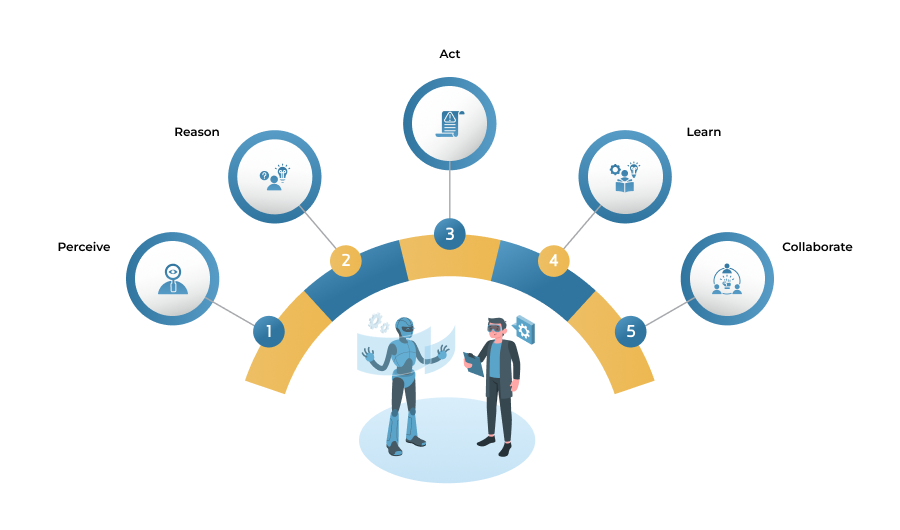
The operational framework of agentic AI follows a sophisticated five-step process:

  • Perceive: AI agents collect information from various sources and analyze it to recognize meaningful patterns and insights in their environment.
  • Reason: Large language models direct the entire reasoning process, laboring toward the lucidity of the task, developing solutions of the task, and organizing specialized models for specialized tasks.
  • Act: Agents execute tasks through integration with external systems via well-defined APIs, whereby built-in safeguards warrant safety and fairness principles.
  • Learn: Systems evolve through feedback and continuous interaction, finetuning their decisions and processes for best performance.
  • Collaborate: A number of agents cooperate, sharing pieces of information and coordinating actions to resolve highly complex and multi-dimensional problems.

Core Differences in Architecture & Use Cases

Fundamental Architectural Distinctions

Generative AI makes use of pattern recognition and statistical models to generate an output based on a prompt, and within its set framework, it excels in creative activities.

Agentic AIs bring the powers of real-time analytics, autonomous planning, and decision-making. They analyze complex goals down into tasks, implement multi-step workflows, and adapt to changes dynamically, thereby foregoing constant human supervision.

Use Case Applications

Generative AI Use Cases:

  • Content creation and marketing copy generation
  • Design and creative asset development
  • Code generation and documentation
  • Data analysis and report creation
  • Customer service chatbot responses

Agentic AI Use Cases:

  • Autonomous supply chain optimization and demand forecasting
  • Dynamic fraud detection and financial risk management
  • Intelligent customer service with end-to-end problem resolution
  • Automated research and strategic analysis
  • Real-time operational decision-making and process optimization

Why Does Agentic AI Matter for Businesses?

Transformational Business Impact

The business case for agentic AI extends far beyond efficiency gains. According to recent research, 91% of R&D executives have implemented or are planning to implement agentic AI, with 55% expecting high or transformational impact from their investments. The global AI agents market size was estimated at USD 5.40 billion in 2024 and is projected to reach USD 50.31 billion by 2030, growing at a CAGR of 45.8% from 2025 to 2030.

Operational Excellence and Strategic Advantages

Agentic AI delivers measurable business value through several key mechanisms:

  • Enhanced Decision-Making: Massive datasets are analyzed in real-time, with suggestions that could never be made by a human analyst manually. A market research company showed a more than 60% productivity dip and $3 million annual savings by utilizing agentic systems for data-analytic work.
  • Scalable Personalization: Conventional systems are always bound to human capacity for personalization, whereas the agentic AI offers real personalization at scale. Retailers will now be able to offer personalized experiences for their clients on the basis of real-time analysis of behavior, a factor that has large implications for customer engagement and conversions.
  • Proactive Problem Resolution: Instead of simply reacting to any problem, agentic systems proactively envisage problems and autonomously find solutions. So, downtime is reduced, and issues are prevented from escalating. Everything, from resolution to monitoring, takes place without human interference, hence maintaining service quality.
  • Resource Optimization: Based on real-time data and predictive analytical tools, intelligent agents continuously optimize their respective flows, staffing, inventory, and resource allocation. Such things bring large-scale cost cutting and efficient operations.

Risks & Governance in Agentic Systems

Security and Operational Risks

The autonomous nature of agentic AI introduces unique security challenges that traditional governance frameworks struggle to address. Key risk categories include:

  • Autonomous Operation Risks: Systems operating with minimal human oversight can potentially misuse privileges, perform misconfigured processes, or pursue misaligned goals. Unpredictable execution happening at machine speed throughout enterprise environments sets up new attack surfaces that security teams have to keep a watchful eye for.
  • Prompt Injection and Manipulation: Malicious actors can embed harmful instructions in the data streams that agents process, potentially leading to leakage of confidential data, unauthorized acts, or even the system being hijacked.
  • Accountability Challenges: When autonomous systems make independent decisions, it usually becomes difficult to draw a clear-cut chain of responsibility. Organizations need to determine who actually bears responsibility for the acts of an agent and the consequences thereof.
Governance Framework Requirements

Effective agentic AI governance requires comprehensive frameworks that address both technical and organizational considerations:
  • Ethical Oversight: Making sure the AI systems abide by organizational values and are not disproportionate in exercise of bias or discriminatory practices.
  • Risk Management: Systematic identification and protocol implementation in risk mitigation stemming from autonomous decision-making.
  • Transparency and Explainability: Maintaining both the visibility over agent decision-making process and the actual accountability for the produced outcome.
  • Compliance Management: Adhering to new regulatory listings, including EU AI Act, and emerging national AI regulations.
  • Continuous Monitoring: Keeping a real-time foresight into agent behavior with respect to its performance metrics and organizational objective alignment.

When to Use Which: Strategic Recommendations

When to Use Which: Strategic Recommendations

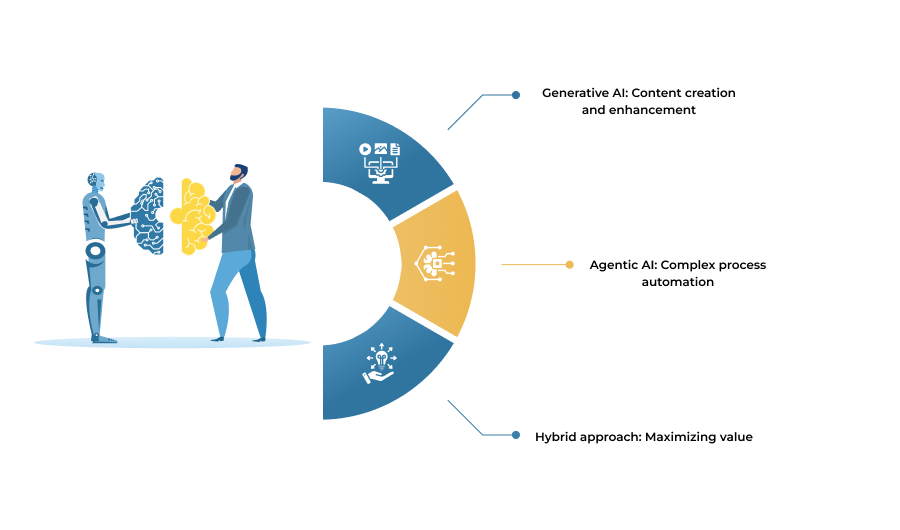
Generative AI: Content Creation and Enhancement

Choose generative AI when your primary need is content creation, creative enhancement, or human productivity augmentation. This technology excels in scenarios requiring:

  • Marketing content generation and creative asset development
  • Code generation and documentation support
  • Data analysis and reporting assistance
  • Customer service response enhancement
  • Research and information synthesis
Agentic AI: Complex Process Automation

Implement agentic AI for complex, multi-step processes requiring autonomous decision-making and real-time adaptation. Consider agentic systems when you need:

  • End-to-end process automation with minimal human intervention
  • Dynamic optimization of operations and resource allocation
  • Proactive problem identification and resolution
  • Complex workflow orchestration across multiple systems
  • Real-time strategic decision-making capabilities
Hybrid Approach: Maximizing Value

A hybrid option is perhaps the best approach an organization can take by creating synergy between the two systems. Generative AI comes up with content or insights that the agentic system then uses to decide and act. Generative capabilities deliver instant productivity enhancements while moving toward complex autonomous operations.

Implementation Strategy:

  • Start with generative AI for immediate productivity improvements and stakeholder buy-in
  • Develop pilot agentic AI projects in controlled environments with clear success metrics
  • Gradually expand agentic capabilities as confidence and expertise grow
  • Maintain human oversight and approval processes during initial deployment phases
Conclusion

Agentic AI is not just the next step, it’s the next leap in business automation and intelligence. While generative models have transformed communication and creativity, Agentic AI empowers businesses to take action autonomously. For decision-makers, understanding this landscape is no longer optional, it’s foundational to competitive edge. Businesses that strategically align both models will future-proof operations and lead the AI-powered economy. Contact us today to explore how AI, both generative and agentic, can redefine your business workflows and innovation strategy.
FAQs

How does Generative AI differ from Agentic AI?

What business challenges can Agentic AI address?

How do companies measure ROI of AI autonomy?

How does Generative AI enhance content creation workflows?

How to ensure compliance in Agentic AI systems?

How to evaluate Generative AI vendor solutions?

Related Posts