The healthcare frustration nobody talks...
05 Oct 2026

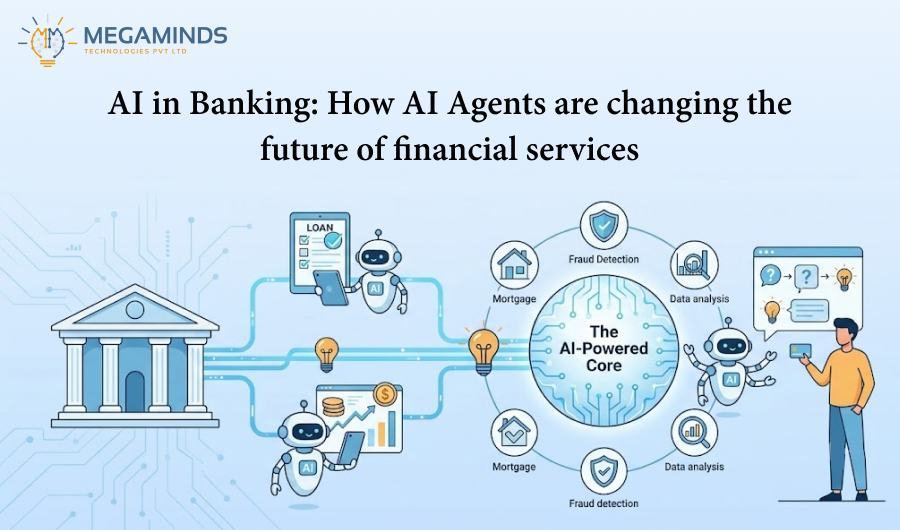
AI has begun to revolutionize banking through automation of repetitive work, better fraud detection, and more personalized customer services, and providing means to facilitate more rapid financial decisions.
The next large evolution will likely be the use of AI Agents: intelligent systems capable of understanding goals, and analyses of information to enable the execution of a series of tasks with considerable automation of human interaction.
An example of an AI Agent could be reviewing a customer request, checking account data, and suggesting the next best action all within a single processing run without employees toggling between different systems.
This is no longer a forecast. In NVIDIA’s State of AI in Financial Services: 2026 Trends survey of more than 800 financial services professionals, 65% said their company is actively using AI up from 45% a year earlier and 42% said they are using or evaluating agentic AI, with 21% reporting they have already deployed AI agents.
At a high level, AI is moving banks and financial services toward intelligent, automated, customer focused financial services.
Automation is changing the banking process. AI can help speed up banking operations by becoming a data-decision-action layer.
Existing types of AI assist banks in fraud detection, reviews, scoring, customer segmentation, risk analysis, and document processing. Even more advanced banking AI, like Generative AI and Agent AI, will move banking beyond what has been adopted.
Imagine an AI agent beyond the basic fraud detection model. This example AI agent is able to analyze a customer purchase and explain the findings and decision to the appropriate banking team.
Banks need to speed up their operations to be able to handle more customer requests more quickly. That’s where automation with AI is able to help banking systems and processes scale more efficiently.
As stated by McKinsey & Company, banking agent AI will transform interaction and service offerings, but banks must first consider the value that these AI changes will bring to their business.
The future of AI and banking is the integration of AI and banking where AI can automate and streamline banking and other financial services.
Banking AI has progressed beyond basic chatbots and is now able to understand, reason and act. 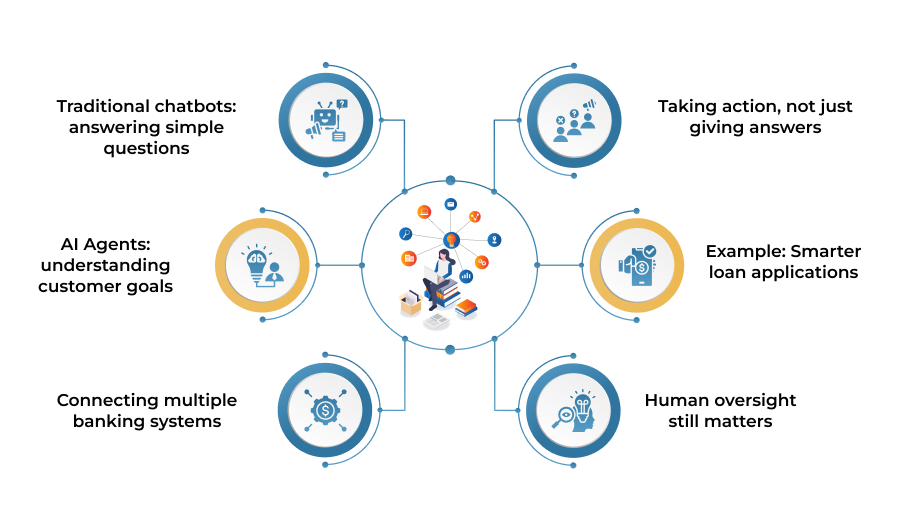
1. Traditional Chatbots: Answering Simple Questions
Banking chatbots are designed to respond to a set of predefined queries, including balance checks, transaction searches, answers to frequently asked questions, and other account-related information.
2. AI Agents: Understanding Customer Goals
AI Agents know what the customer needs and the actions that need to be done to achieve that.
3. Connecting Multiple Banking Systems
AI Agents draw information from various systems, analyze customer data and are able to respond in detail.
4. Taking Action, Not Just Giving Answers
Unlike chatbots, AI Agents can execute tasks that are approved, and suggest what tasks can be done next and in what order, thus easing the workflow.
5. Example: Smarter Loan Applications
A loan application could be guided by an AI Agent. The agent could also determine missing documentation, suggest required documentation, and prepare the application all on its own.
6. Human Oversight Still Matters
AS AI gains more and more autonomy, banks need to have robust security, compliance, and human oversight to make responsible decisions.
Scale check: Bank of America’s virtual assistant Erica passed 3 billion client interactions in August 2025, has served nearly 50 million users since its 2018 launch, and now averages more than 58 million interactions per month. Clients have received over 1.7 billion proactive, personalized insights through it.
How people use banks is changing. Quick answers and around the clock digital services are now the norm. Being able to offer tailored services and solutions at the exact moment they are needed is also critical.
Thankfully, AI offers banks a way to meet these needs without requiring employees to work around the clock.
AI based services can offer:
The true opportunity will not be seen by replacing human service with AI. The opportunity will be offering AI speed and human service judgment.
According to Deloitte, recent research has shown simple and safe requests will usher in the age of AI self-service, while complex or high-impact requests will remain in human control in the realm of banking customer service.
For businesses, this presents a pragmatic future: AI for scale, people for thoughtful service and emotional support.
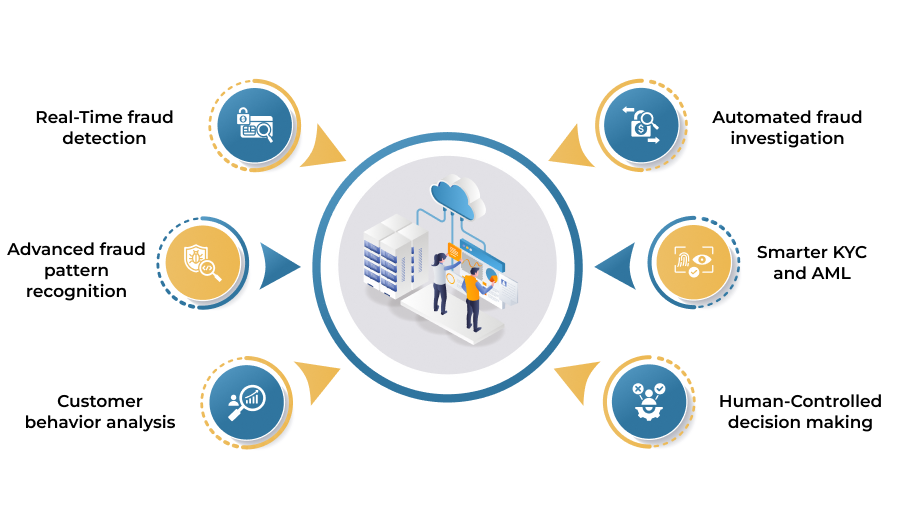
AI-powered automation reduces the time and cost of repetitive credit checks and manual verifications. AI-based loan processors extract financial data and verify client information. They create client loan profiles at a fraction of the time it takes a human.
AI is capable of analyzing client’s income, transactions, credit behavior, and financial activities to identify clients’ financial risk profiles. It is also capable of maximizing banks’ credit decisions.
According to Deloitte, using AI to develop credit risk models enables banks to perform better risk assessments and gain insights into more complex data for better lending decisions.
AI can also automate the more repetitive eligibility and policy checks and can, therefore, free up credit officers to focus on more complex and subjective cases.
Responsible AI must be pursued. Fairness, transparency, data security, compliance, and oversight must be ensured at all stages of the lending process.
AI would be an ally to the credit manager, helping them make quicker and informed decisions pertaining to loans.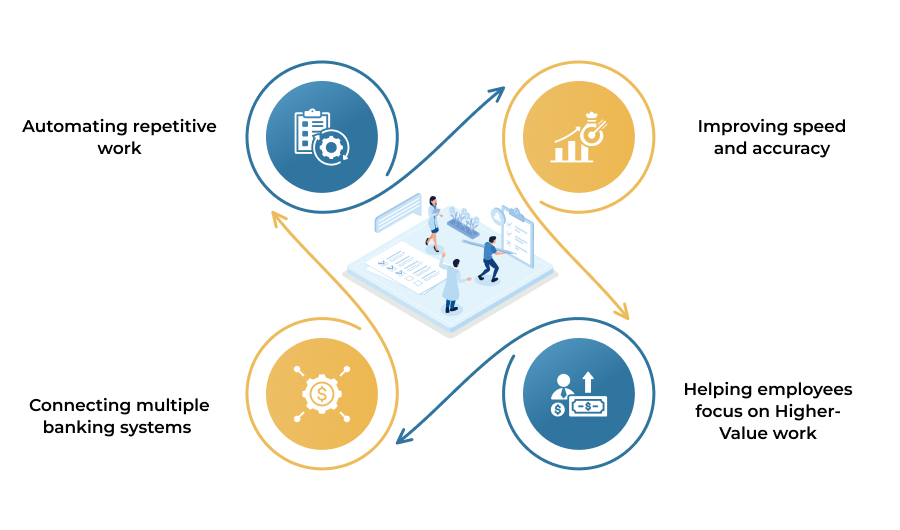
1 Automating Repetitive Work
AI can now take care of routine tasks like processing and entering data, updating customer records, preparing reports and even processing internal support requests, thus alleviating employees from tedious work.
2 Connecting Multiple Banking Systems
AI agents can traverse different banking systems to find and connect relevant information. AI can even move tasks to the appropriate workflows. This minimizes the number of redundant tasks and increases overall coordination.
3 Increasing Speed and Accuracy
AI’s unique ability to process large amounts of data in a short amount of time, and at a consistent pace, means it dramatically reduces human error. Banks that use AI will have the ability to complete their business operations faster and with greater efficiency as a result.
4 Focusing Employees on More Meaningful Work
With AI able to complete repetitive operational tasks, employees are able to shift their focus on more corporate level objectives and operational tasks that require more thought and problem solving.
Does it pay off? NVIDIA’s earlier 2025 State of AI in Financial Services report found that nearly 70% of respondents said AI drove a revenue increase of 5% or more, and more than 60% said AI helped reduce annual costs by 5% or more. The 2026 edition found that nearly 100% of respondents expected their AI budgets to stay flat or grow in the year ahead.
Despite its potential, AI adoption in banking is not straightforward.
Banks operate in highly regulated environments where errors can create financial, legal, operational, and reputational consequences.
Major challenges include:
BIS highlights model risk, data privacy, governance, third-party dependencies, and AI-specific issues such as hallucinations as important considerations for financial institutions.
The future of AI-assisted banking relies on customer trust Bank customers may become more accepting of AI for certain services in the future, but they will need more trust and control for services such as banking loans, fraud detection, and banking investments.
Financial data has to be safe and secured. This can be accomplished by maintaining high privacy standards and security and controlled access. Additionally, the performance of the AI models should be tested for accuracy, fairness, and reliability.
AI can analyze data and recommend on lots of things, but humans will always have the responsibility and responsibility for important and big decisions in banking and finance.
Deloitte has indicated that banks that have implement of agentic AI have to control some important factors, including risk, access, privacy, ethical, and models.
The success of AI banking will rely on security, transparency and trust, more than just intelligence.
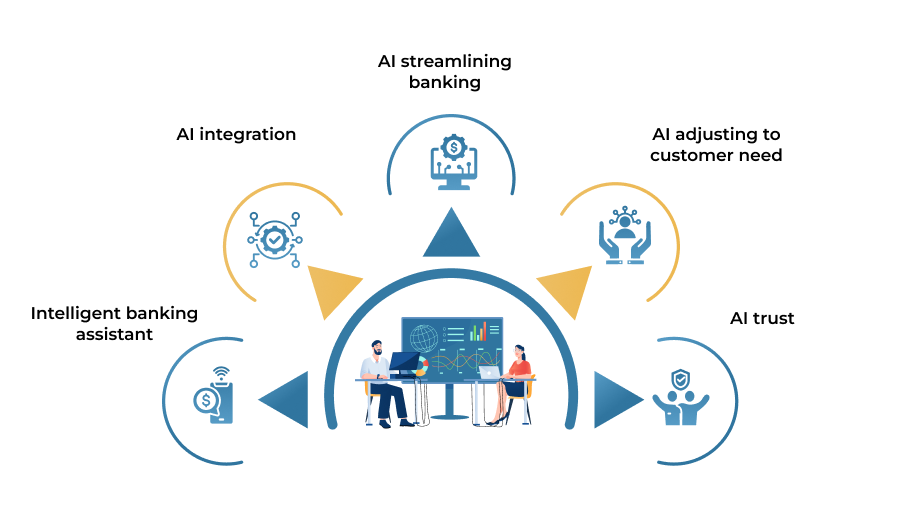
1. Intelligent Banking Assistant
Banking customers have the advantage of a virtual assistants to understand your individual banking requirements, answer questions, and personalize banking services.
2. AI Integration
Specialized AI can move your customer service, fraud detection, risk management, compliance and documentation tasks to integrated banking operations.
3. AI Streamlining Banking
After answering questions, AI can automate workflows, take the banking instructions, and speed up the banking processes that banking employees have approved.
4. AI Adjusting to Customer Need
AI can identify customer behavior, banking data, and financial data to provide banking products, services, and banking advice your customer banking portfolio needs.
5. AI Trust
Banks will gain customers’ trust with AI in conjunction with trusted data, secure infrastructure, good governance, and human oversight.
AI can quickly analyze vast amounts of data within a fraction of the time it takes a human. Traditionally, banking software was built to help humans quickly execute tasks. Now, banking software is incorporating AI to allow banks to think, decide, and act in unexpected ways.
Fraud detection, customer service, and operations can all be improved with the implementation of AI. Many banking processes become automatic and require less physical work. Instead, banking processes and procedures focus on providing tailored banking services to individual clients.
Economies of scale will not reward banking firms who simply adopt AI. AI, when paired with trusted AI and research, strong security, and responsible leadership, can create a significant advantage over the competition.
The future of banking belongs to the firms who incorporate AI in banking services in a way that is valuable for themselves and their clients.
05 Oct 2026
01 Oct 2026
28 Sep 2026