How AI and Smart Manufacturing...
19 Oct 2026

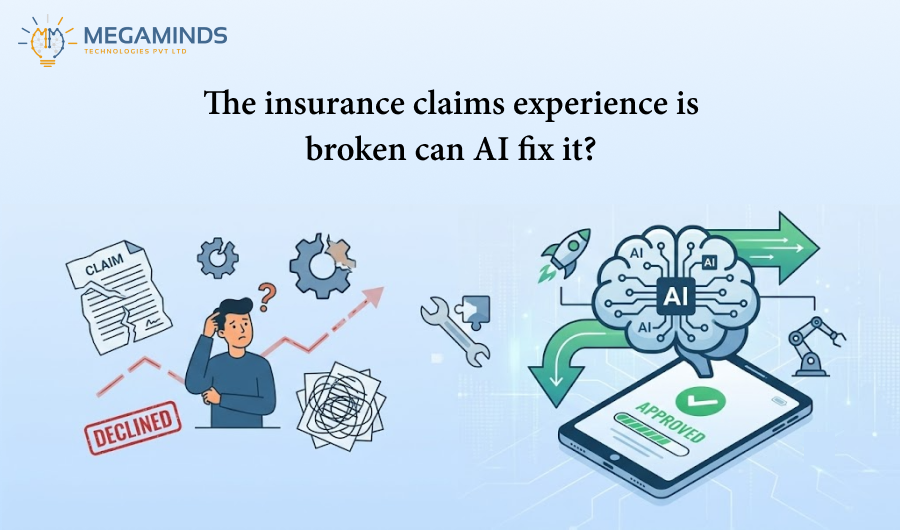
AI can improve the insurance claims experience by automating routine tasks, accelerating damage assessments, detecting potential fraud, and providing real-time updates. This helps insurers process claims faster, reduce operational delays, and deliver a smoother, more transparent customer journey.
Insurance is built around a promise: when something goes wrong, the insurer will help customers recover. That promise becomes real during the claims process.
Customers judge insurers by how easily they can report a loss, how quickly their claim moves forward, whether decisions feel fair, and how clearly the insurer communicates. Even an accurate claims process can create dissatisfaction when customers do not understand what is happening or where their claim stands.
According to the J.D. Power 2025 U.S. Claims Digital Experience Study, 22% of customers still rely on multiple channels to find answers to the same question, highlighting gaps in the claims journey. The study also found that proactive digital updates are a major driver of satisfaction, yet insurers provide adequate updates only 22% of the time.
For insurers, this means claims are no longer simply an operational function. They have become a critical customer experience, retention, and trust function.
The insurance claims journey can involve customers, adjusters, repair providers, investigators, and multiple internal systems. When these interactions are not connected, even simple claims can become slow and frustrating.
Here are 6 major friction points customers experience: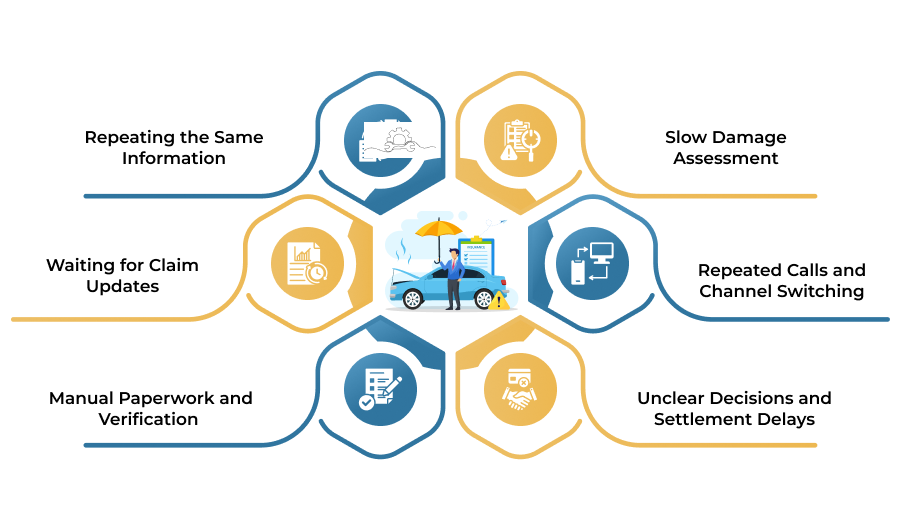
1. Repeating the Same Information
Customers may have to submit the same policy, accident, or damage details through different forms, calls, and channels. This creates unnecessary effort and delays.
2. Waiting for Claim Updates
After filing a claim, customers want to know what is happening. Limited status visibility can leave them uncertain about the next step.
3. Manual Paperwork and Verification
Document collection, data entry, and verification can consume significant time when claims teams rely heavily on manual processes.
4. Slow Damage Assessment
Property and auto claims may require inspections, photographs, estimates, and expert reviews before a decision can be made, extending resolution times.
5. Repeated Calls and Channel Switching
When digital channels do not provide complete information, customers may switch between apps, websites, emails, and phone calls to get answers.
6. Unclear Decisions and Settlement Delays
Customers can become frustrated when settlement calculations, required documents, or reasons for delays are not clearly communicated.
According to J.D. Power’s 2025 U.S. Claims Digital Experience Study, 22% of customers still use multiple channels to find answers to the same question, while insurers provide adequate proactive digital updates only 22% of the time.
Deloitte’s 2026 analysis of nearly 4,000 insurance customer responses also found that customers continue to experience complex, fragmented, and unclear claims processes, creating opportunities for AI to reduce friction and improve communication.
The real challenge isn’t just making claims faster—it’s making every step clearer, simpler, and easier for customers to navigate.
AI can transform claims by turning fragmented manual workflows into intelligent, automated processes.
At first notice of loss, AI can capture information, classify the claim, identify missing documentation, extract relevant details, and determine the appropriate next step.
For example, an AI-powered claims system could automatically:
McKinsey describes AI-enabled claims segmentation as a way to identify claims suitable for digital self-service while routing complex or high-risk cases to claims professionals.
This approach can reduce administrative workloads while allowing adjusters to focus on exceptions, negotiations, investigations, and customer conversations.
Damage assessment is one of the areas where AI can make insurance claims faster, smarter, and more consistent.
Instead of relying entirely on physical inspections, customers can submit photos or videos through a digital claims platform. AI-powered computer vision can analyze visible damage, identify affected components, estimate severity, and support an initial repair estimate. McKinsey identifies image recognition and customer-submitted photos as important applications of AI in digital claims processing.
AI can also combine damage images, policy details, previous claims, repair information, telematics, and external data to give adjusters a more complete picture before making a decision. This can reduce repetitive manual work while helping insurers accelerate straightforward claims and focus human expertise on more complex cases.
In simple terms: AI turns “send a photo and wait” into “send a photo, analyze the damage, and move the claim forward.”
AI can help insurers detect potential fraud earlier while allowing legitimate claims to move through the process with less friction.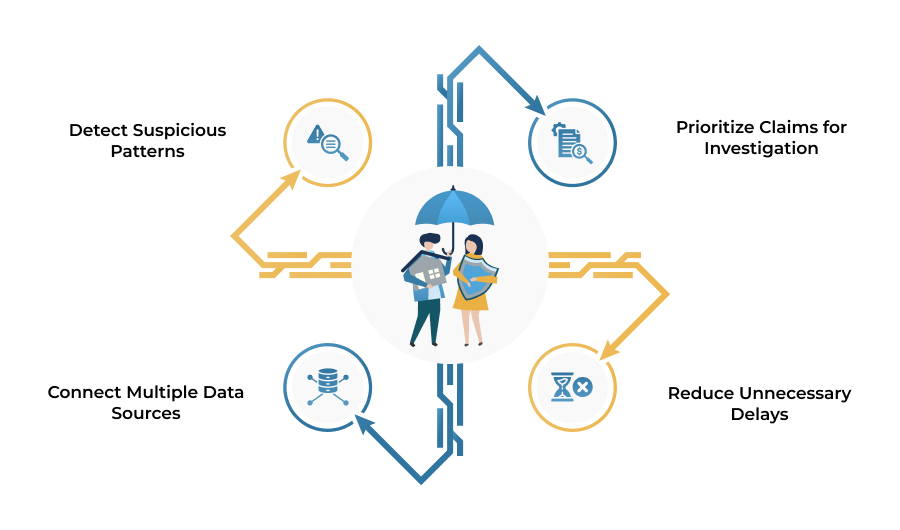
1. Detect Suspicious Patterns
AI can analyze large volumes of claims to identify unusual patterns, inconsistencies, and behaviors that may indicate potential fraud.
2. Connect Multiple Data Sources
Machine learning can analyze claims history, customer information, documents, images, transactions, and location data to identify risk signals.
3. Prioritize Claims for Investigation
AI can help categorize claims based on risk, allowing investigators to focus their attention on cases requiring deeper review.
4. Reduce Unnecessary Delays
By identifying low-risk claims for faster processing, AI can help legitimate customers receive quicker resolutions while suspicious cases receive appropriate human review.
McKinsey identifies advanced analytics and AI-powered fraud detection as important capabilities for modern claims management.
AI doesn’t replace fraud investigators—it helps them find the right claims to investigate, faster.
One of AI’s most visible benefits may be communication.
Customers rarely want to call an insurer simply to ask, “What is happening with my claim?”
AI can provide proactive updates through mobile apps, websites, SMS, email, chat, or voice interfaces.
For example:
Claim received → “Your claim has been successfully submitted.”
Assessment completed → “Your damage assessment is now under review.”
Additional information needed → “Please upload these documents to continue.”
Repair approved → “Your repair provider has received authorization.”
Payment processed → “Your claim payment has been initiated.”
This turns the claims journey from a black box into a visible process.
Deloitte notes that insurers can use AI to facilitate resolution, support human approvals, and deliver seamless communications across channels.
The goal should not be simply sending more notifications. It is delivering the right information at the right moment.
The future of insurance claims is not about choosing between AI and people. It is about combining both to create a faster and more customer-focused claims experience.
AI can handle repetitive tasks such as data entry, claim routing, document processing, and fraud screening. This allows claims professionals to spend more time on complex cases that require judgment, empathy, negotiation, and human understanding.
McKinsey highlights this hybrid approach, where AI supports claims workflows while employees remain involved in complex or unusual cases.
AI handles the volume. Humans handle the complexity. Together, they create a smoother claims journey.
AI can improve insurance claims, but successful implementation requires the right data, technology, people, and processes. Insurers must address several challenges before scaling AI across their claims operations.
Data Quality: AI needs accurate and consistent data. Poor, outdated, or incomplete claims information can reduce the accuracy of AI-driven insights.
System Integration: Legacy insurance systems can make it difficult to connect AI with claims, policy, payment, and customer-service platforms.
Governance & Explainability: Insurers need clear oversight of AI-supported decisions, including model monitoring, transparency, and appropriate human review.
Customer Trust: Customers may prefer automation for simple claims but still expect human support when situations become complex or sensitive.
Workforce Adoption: Claims teams need proper training to use AI effectively. The goal should be to reduce repetitive work while strengthening human decision-making.
AI works best when it complements existing claims operations rather than trying to replace the people and processes behind them.
The future of insurance claims is shifting from reactive processing to intelligent, proactive management. AI can automatically collect information, assess damage, detect risks, route claims, and keep customers updated.
Technologies such as computer vision, telematics, predictive analytics, and generative AI can work together to create faster and more connected claims journeys.
The goal is simple: fewer delays, smarter decisions, and a smoother experience for both customers and claims teams.
Insurance claims are often the moment when customers truly experience their insurer. If the process feels slow, confusing, or fragmented, it can quickly weaken trust.
AI can help change this by automating routine tasks, speeding up assessments, detecting fraud, improving communication, and supporting claims professionals. But successful transformation requires the right balance between technology and human expertise.
Insurers should focus on the areas where customers face the most friction and use AI to create measurable improvements.
When AI makes claims faster and people make them more human, every claim becomes an opportunity to build trust.

19 Oct 2026
15 Oct 2026
12 Oct 2026