From Manual Processes to Smart...
22 Oct 2026

Many disconnected healthcare systems lead to patients providing the same information repeatedly. Different EHR systems, labs, pharmacies, imaging centers, insurance companies, and specialty clinics use different systems and can’t share patient information seamlessly and therefore have to rely on patients to resubmit this information.
Digital health interoperability is one of the top issues related to inefficient health systems, according to the World Health Organization. Inefficient communication between different health services leads to higher reliance on patients.
Patients end up being the carriers of their own information because healthcare systems refuse to implement secure transfer of relevant medical data.
This causes a lot of extra work and a lot of first copy errors, including remaining redundant tests, lengthy diagnoses, and inconsistent treatment results.
Today’s healthcare system is rapidly integrating multiple care providers. Unfortunately, patient information most often does not travel with the patient. This creates more problems and unnecessary obstacles to optimal care. 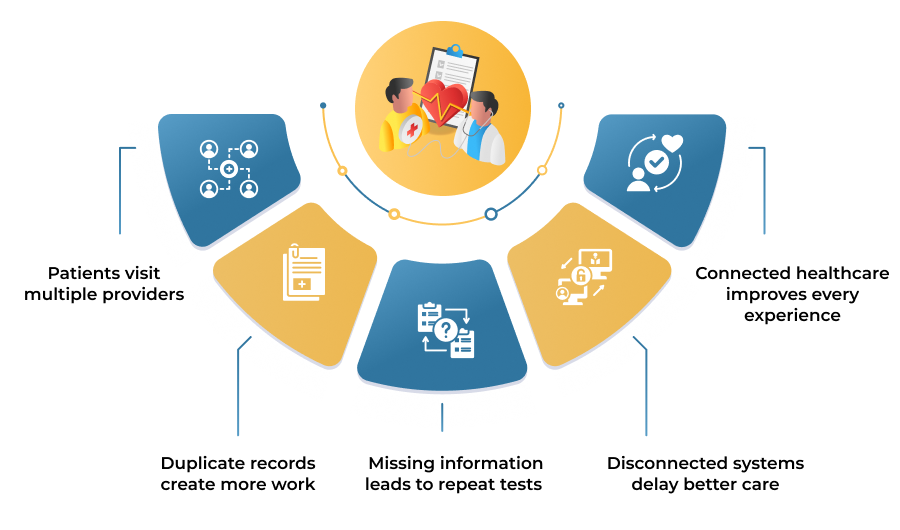
1. Patients Visit Multiple Providers
Moving between offices is where records get lost. Among patients who requested records, 40% struggled when switching medical groups and 37% when seeing a specialist or new doctor; 8% could not transfer their records at all (Harmony Healthcare IT, 2026).
2. Duplicate Records Create More Work
At least one-fourth of patient records within the same healthcare organization may be duplicate records. This creates repeated patient registration, increased workloads, and higher costs associated with administrative activities.
3. Missing Information Leads to Repeat Tests
In the absence of required patient information, care providers may be compelled to perform various diagnostic tests. About 15 percent of referred patients in an oncology unit have had to perform diagnostic tests on multiple occasions.
4. Disconnected Systems Delay Better Care
Imaging studies may need to be repeated in about 23-60% of other healthcare situations due to incomplete patient information.
5. Connected Healthcare Improves Every Experience
Linked provider systems geared toward patient record care integration eliminate redundant tasks and diagnostic testing, foster improved, coordinated systems of care, and timely, individualized systems of care. This enhances patient care and benefits the care provider system.
Healthcare generates enormous volumes of data, but much of it sits in systems that cannot talk to each other. Records are spread across EHRs, labs, pharmacies, radiology centers, insurance platforms and telehealth apps, so no single clinician sees the full picture.
Patients notice. 97% say it is important for providers to see their full medical history, yet only 37% are very confident clinicians can access records from the past three years. Just 37% are very satisfied with how their medical information is managed.
The infrastructure is improving. National exchange through TEFCA grew from about 10 million records in January 2025 to more than 1 billion by June 2026. Removing silos is not just about connecting systems; it is about making care faster, safer and more patient-centered.
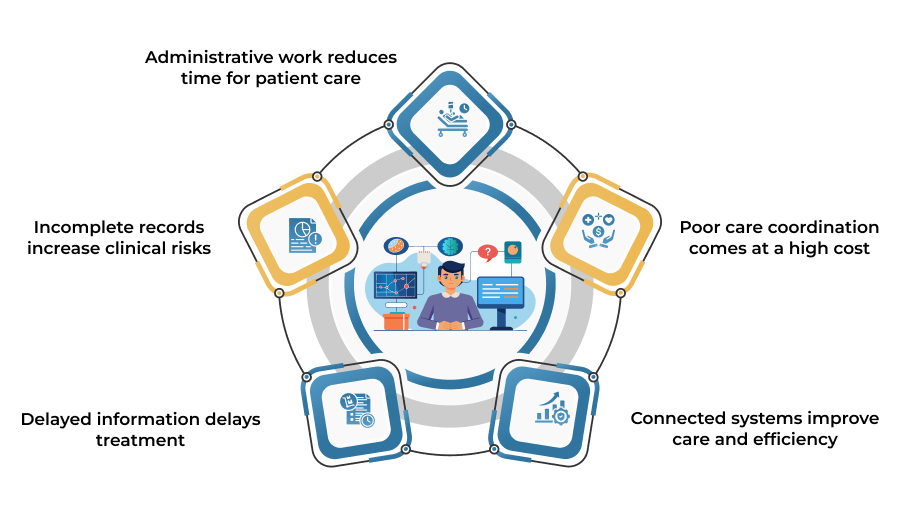
If healthcare systems are disconnected, it is not only patient inconvenience that is compounded but also patient safety, hospital efficiency and cost of care. If crucial patient information is scattered through various platforms delay duplicity, and missing entry in one or more of the stages will have an impact on the quality of care.
Trust is the starting point for every patient, provider relationship. Patients want the provider to have access to information, understand what they need, and coordinate care, but if they constantly having the same information and care repeated to them at every appointment that trust begins to wear away. Why can’t I get the information I just shared to my doctor, didn’t I already tell you that, why if one doctor knows this doesn’t all my doctors know that.
These questions and many others like them not only embody the frustration felt by the patient but also a larger concern about care and order. Having to say the same things over and over can make patients feel uncared for.
This perception has quantifiable consequences when it comes to the patient experience. As The Beryl institute states, “The strongest drivers of customer loyalty and satisfaction across all industries are clear communication, care coordination and easy access to information.” Our experience with customized digital services in banking, retail and travel has made consumers expect a seamless connection to their healthcare experience. Hospitals that remove the obstacles will have a competitive advantage by providing a smoother experience.
To provide smooth patient journeys, simply digitizing paper records is not enough. Healthcare providers need to create interconnected networks where authorized professionals have secure access to patients’ relevant data, anytime they require it.
The main features are:
In the healthcare industry, organizations that have adopted integrated, connected healthcare platforms consistently achieve substantial improvements in clinical, operational and patient experience results.
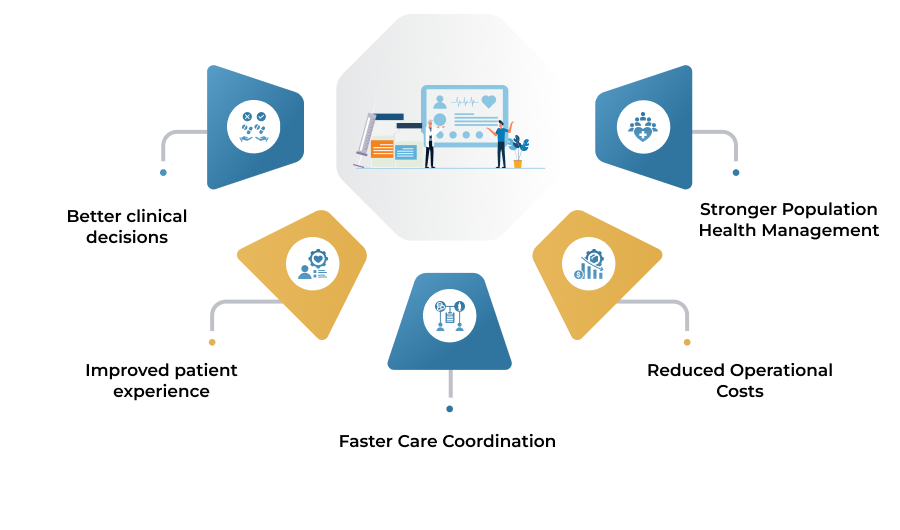
Connected healthcare has the potential to enhance patient experiences. However, unless the protection of sensitive medical data is improved, connected healthcare remains in its infancy. To operate healthcare systems and services that balance the demands of uninterrupted and unrestricted data flow with legal and ethical constraints, is the challenge for all healthcare organizations.
The number and sophistication of cyber-attacks in the healthcare space is increasing. The 2025 Healthcare Data Breach Report (HIPAA Journal) indicated that in 2025 there were 770 large-scale data breaches in healthcare, which affected 139,399,642 individuals. As a result, a growing number of healthcare providers are encrypting data, implementing multi-factor authentication (MFA), and adopting secure identity and cloud infrastructures.
The reliance on legacy systems by a significant number of healthcare providers has resulted in challenges exchanging data securely. Inefficient systems have inhibited the interoperability of healthcare systems. As a result, care coordination and integration has often been difficult. However, the recent rapid expansion and adoption of digital healthcare systems and services provides an opportunity to address these challenges and provide integrated, trusted, patient-centric care.
There’s no reason to believe that completely restructuring the current healthcare system is the only way to offer a better patient experience. Healthcare systems can focus on several different strategies to reduce friction. They can enhance interprofessional teamwork to improve connected care.
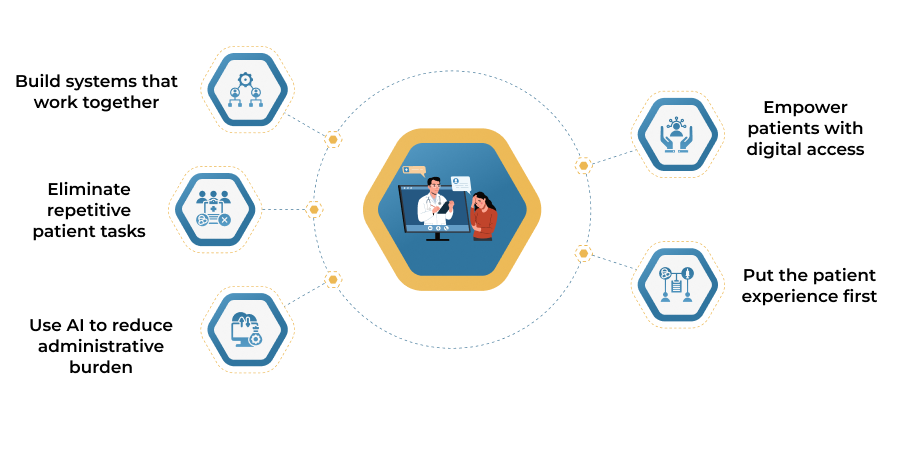
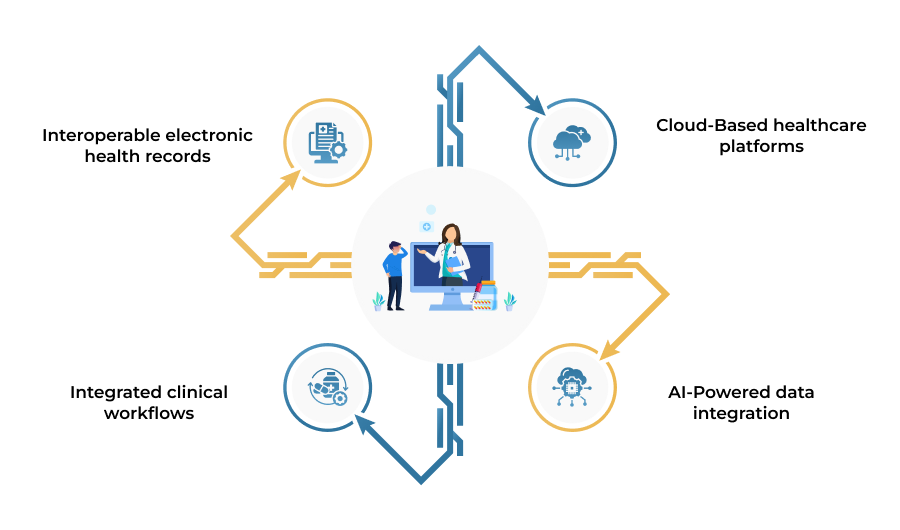
The future of healthcare is increasingly centered on connected, intelligent, and patient-focused ecosystems.
Emerging technologies are accelerating this transformation through:
Rather than asking patients to repeatedly explain their medical history, future healthcare systems will securely deliver the right information to the right provider at the right time.
Patients will experience smoother transitions between providers, while clinicians gain faster access to comprehensive health records that support better decision-making.
Healthcare organizations embracing interoperability today will be better prepared for the growing expectations of tomorrow’s digital-first patients.
Patients shouldn’t have to provide their entire medical history every time they interact with a new healthcare provider. It is time to address the disconnected systems that lead to incomplete or redundant medical data. The best and fastest way to provide a seamless, digital experience is to apply connected technologies to better integrate data.
Healthcare innovations need to move beyond increasing the adoption of technologies and focus on connecting various systems to the benefit of the patient. Healthcare can use technologies like artificial intelligence and secure data to design better systems.
Trust is important to patients. To build trust and care for the patient, healthcare organizations need to embrace technologies for data that is integrated and care that is synchronized. Providing care that is smarter and faster is more important than larger and stronger. With these connected technologies, healthcare organizations can assure patients that they care enough to allow patients to give their story only once. Organizations that embrace integrated technologies, care and data will thrive, and patients will love them.
19 Oct 2026
15 Oct 2026