From Manual Processes to Smart...
22 Oct 2026

As long as a claim stays in a queue, insurers lose more money and more customers. Customers have become accustomed to instant gratification and efficiency from digital-first brands. Customers compare their insurance experiences to brands with same-day delivery, instant credit approvals, and one-click refunds. Many insurers, however, still have manual claim reviews, workflows on paper, and processes that are not integrated. Simple insurance claims can take days, weeks, and even longer with these outdated processes in place.
The outdated processes result in a greater cost to the insurer and loss of customers and sales. Competition from InsurTech start ups has also displaced customers from insurers. Microsoft Power Apps combined with AI and machine learning has given many insurers a way to gain the sales and customers back that they have lost. Insurers can now improve their customer satisfaction with a shorter claims process. The combination of Power Apps, AI, and machine learning can take the entire claims process from weeks to minutes.
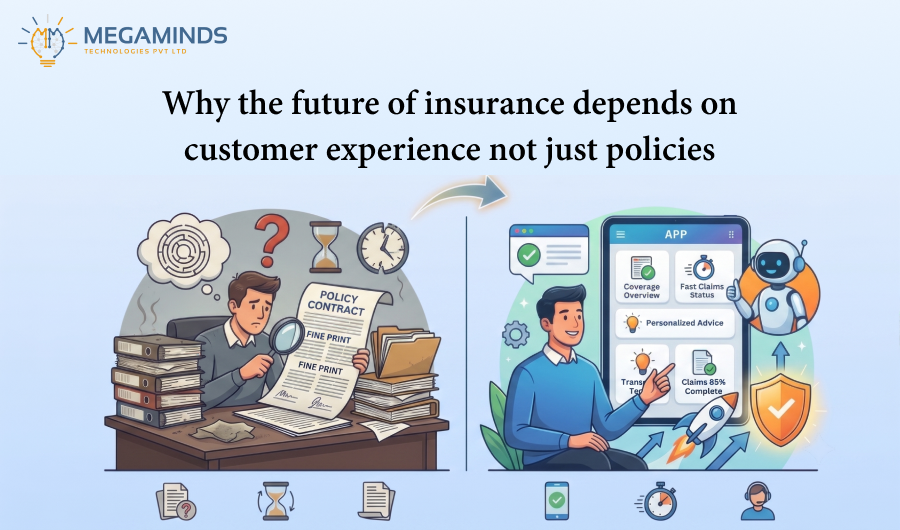
Customers have grown frustrated with slow, paper-based, and non-transparent claims processes. Many still feel that insurance claims operate as if they belong in the 1990s. Customer surveys show that more than 30% of policyholders are dissatisfied with today’s digital claims experience. Instead, they expect fast, personalized, proactive, and always-available services.
Poor claims experiences directly affect customer trust and business growth. Many policyholders switch insurers because of slow and frustrating claims processes rather than price. In several markets, life insurance ownership has fallen to its lowest level in more than a decade. At the same time, digital-first insurers continue to attract customers by offering faster, simpler, and frictionless claims experiences.
Customers are frustrated with the inefficient process that claims teams are required to work with. This process includes emails, spreadsheets, PDFs and phone calls that are all connected to legacy systems. The teams must enter the same data multiple times due to poor legacy systems, making achieving customer satisfaction more difficult. The cost of operations is affected, and cycle times are extended as a result of a poor process that requires team members to function manually. On the bright side, an adequate and upfront cost for modern systems of automation and digital workflows will cut operational costs by 28% and reduce processing times improved by one-third. Companies that don’t modernize their systems for customer satisfaction will also lack speed and suffer a loss in accuracy.
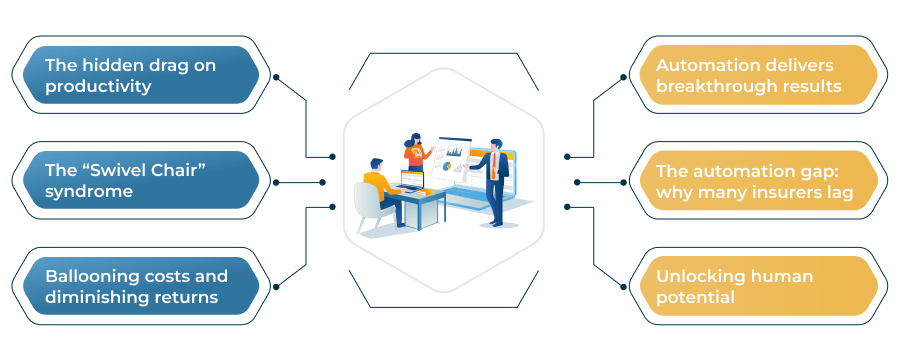
Challenges of Manual Claims Processing
Artificial Intelligence isn’t something to be invented. It’s a $100+ billion market today, and it has come to disrupt the insurance market. Insurers that improve the automation of claims processing through the power of AI will process claims quicker, lower operational costs, and foster a loyal customer base as a result of stronger market positioning.
As an example, think of the insurer that has the task of managing thousands of PDFs, photos, emails, and claim documents every single day. The power of AI can analyze the data within the PDFs and photos in mere minutes, can help guides with the detection of claim fraud, and can help process each claim to the right team. This can help staff and guides focus on more complex and nuanced claims instead of repetitive administrative processes.
Further, automating the more routine and easy to adjudicate claims also means that insurers can fully automate between 70 to 90% of claim submissions. This change improves the customer experience as claim payment and decisions that once took many days to process now occur in minutes.
One of the measurable business impacts of AI is that one insurer saved over £60 million with the automation of car claims. By rethinking and streamlining claims processes and the digital customer journey to mobile notifications and real-time claim status, AI is further helping insure a positive customer experience.
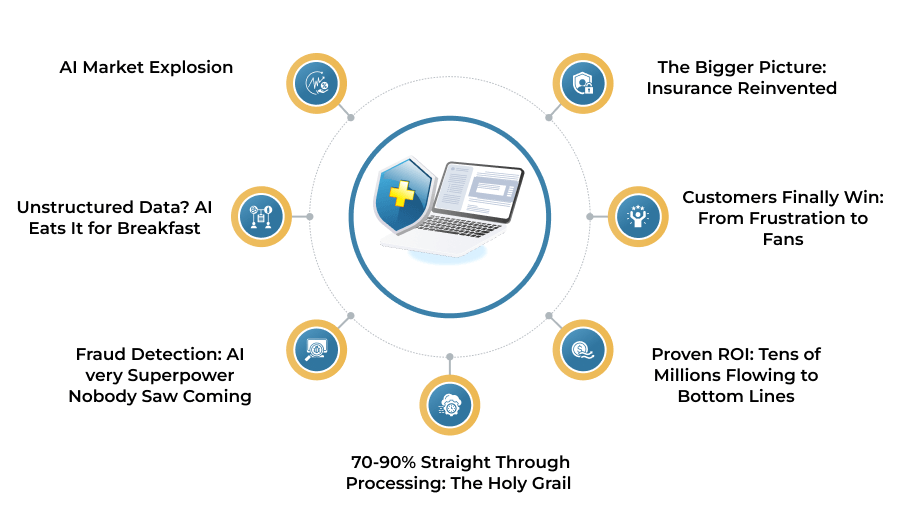
1. AI Market Explosion
2. AI for Unstructured Data Processing
3. AI-Powered Fraud Detection
4. Straight-Through Claims Processing
5. Proven Return on Investment
6. Better Customer Experience
7. Insurance Reinvented
Microsoft Power Apps allows insurance teams to develop bespoke apps in mere days. This encourages many companies to digitize policy issuance, claims, customer self-service, portals for agents and field-based staff, etc., without the burden of large development teams. Power Apps also encourages citizen developers and these business apps can help reduce manual work by as much as 50 %.
Power Apps help you get even more value when used with Microsoft Power Automate, Power BI, and existing insurance systems. Automated workflows, analytics, and integrated data across policies, claims, and operations help a lot. With the help of the platform, field adjusters can take pictures, record their GPS location and notes, and sync the information with the claims systems.
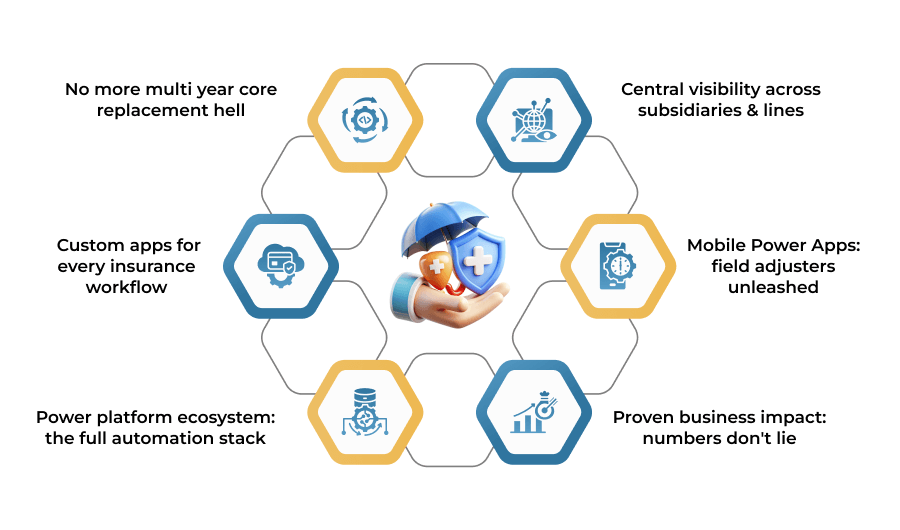
1. No More Multi-Year Core Replacement Hell
Traditional IT projects: 2–5 years, $10M+, always delayed and with increasing scope. Power Apps reality: Business users create working apps in a matter of weeks with a drag-and-drop interface. A modern overlay on old systems upgrades without tearing out billion-dollar cores. Just what a legacy-insulated industry needed.
2. Custom Apps for Every Insurance Workflow
Claim intake portals: Mobile-first forms with photo upload, auto validation, and instant submission. Agent dashboards: On-demand policy snapshots, renewal alerts, and customer 360° profiles with no more login juggling. Customer self-service: Policyholders verify coverage, lodge claims, and track progress at any time without agent intervention.
3. Power Platform Ecosystem: The Full Automation Stack
With Power Automate, you can easily set up coded-free approvals, notifications, and escalation processes.
For immediate data analysis, Power BI provides dashboards to evaluate the velocity of claims, SLA compliance, and trends regarding the cost per claim.
Moreover, easy integrations enable the connection of legacy systems, external 3rd party APIs, and AI-based fraud detection systems.
4. Central Visibility Across Subsidiaries & Lines
Comprehensive policy management: Record any kind of insurance from auto to life within a single platform. Efficient renewals: Auto triggers, document generation, and e-signature cycles that are 30% faster. Fewer manual operations: Local branches get standardized processes without the need for local IT support teams.
5. Mobile Power Apps: Field Adjusters Unleashed
Scene of loss capture: Pictures, videos, GPS, and damage descriptions are immediately synchronized with the claims core. Offline mode: Functions without a signal and uploads automatically when online, ensuring no data loss in remote areas. Real-time collaboration: Adjusters, desk teams, and customers can view live updates simultaneously.
6. Proven Business Impact: Numbers Don’t Lie
Over half of the time spent manually processing claims and policy operations has been eliminated. Siloed data and cross-departmental task distribution are eliminated by centralized visibility. With no impact on performance, the platform can effortlessly scale from small pilot projects to large-scale implementations across the enterprise of more than 10,000 users.
AI and Microsoft Power Apps allow insurers to modernize and optimize each stage of the claims process. Automated damage assessments, claim verifications and fraud checks, and AI-assisted decisions are all part of a single solution. Power Apps and Power Automate work together to cover all steps of the claims process from First Notice of Loss to payment. This consolidation means less time and money are spent to process a claim and, as a result, claims process quality and customer satisfaction both increase. Power Apps and Power Automate work together to cover all steps of the claims process from First Notice of Loss to payment. This consolidation means less time and money are spent to process a claim and, as a result, claims process quality and customer satisfaction both increase.
Automation + AI not only accelerate claims but also drastically reduce errors, increase the speed of the process, and help regain customer trust. Manual processes cause mistakes in data entry (with error rates of up to 20%; AI validation achieves an accuracy of over 98% while the cycle times are reduced by 75%. Adjusters work on complex cases; customers receive transparent and dependable service NPS increases by more than 25 points.
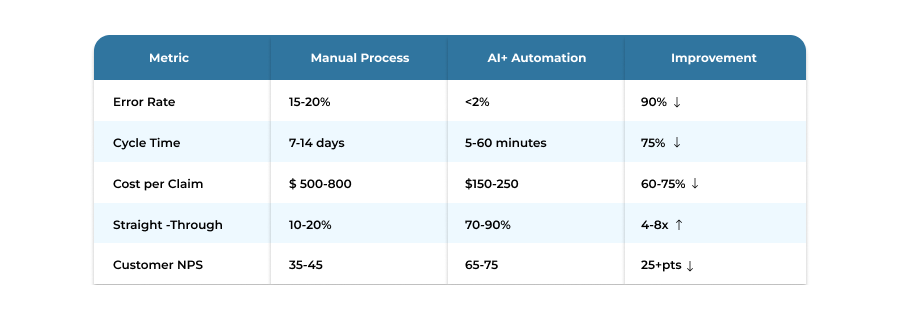
A top U.S. insurance company changed the way its claims department works by using AI models for over 500,000 claims a year, thus achieving more than 50% of its claims handling through automation. In fact, approvals that used to take weeks are now done in a matter of minutes for the majority of simple cases, thus drastically increasing the percentage of straight through processing as well as cutting costs and increasing customer satisfaction.
Another big carrier utilized AI powered digital capabilities to reduce underwriting turnaround time by more than 33%. This change not only made the company more efficient in terms of operations, but also improved the experience of policyholders, thus showing that intelligent automation can bring a measurable business impact in all areas.
Low code platforms and RPA projects are always able to bring about 25–33% reductions in cycle times and operating costs. Insurers have reported that their approval processes have become more streamlined and that the costs per claim have dropped significantly as a result of automated workflows that remove the manual bottlenecks in which their staff were engaged.
Power Apps implementations allow mobile claim submissions along with real time tracking. Field adjusters collect data on site while administrators get a consolidated view of all business units, thus changing from fragmented phone based processes to seamless digital journeys.
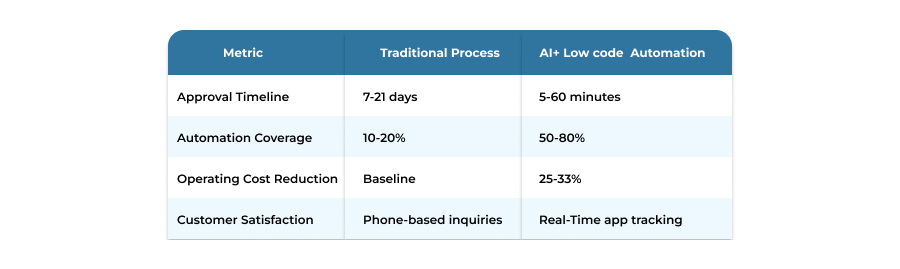
Insurance leaders: Don’t continue to make the decision between profits and customer satisfaction. The old decision is being completely eliminated by AI powered claims engines combined with Power Apps low code magic. What used to be slow, manual, and dreadful processes are now being transformed into real time intelligent workflows that are able to reduce cycle times by more than 75%, lower errors by 90%, and provide Amazon speed experiences that policyholders desire.
The AI insurance market worth more than $100B is growing exponentially while those who are not willing to change are losing their market share. Carriers that are implementing automation at scale are now creating almost impenetrable competitive moats at a very high speed faster claims, lower costs, and NPS going up like a rocket. The ones who are hesitating? They will be forever running after insurtech disruptors.
Collaborate with MegaMinds in order to integrate AI and Power Apps into your go to operations. Instead of dealing with the aggravating delays, make the trade for instant decisions that will be able to turn transactional policyholders into loyal lifetime advocates. The insurance of tomorrow is not arriving it is already here, and it is your opportunity to take it.
Get in touch with us today if you want to change your claims within 90 days or be left behind.
19 Oct 2026
15 Oct 2026