Why the Future of Insurance...
15 Oct 2026

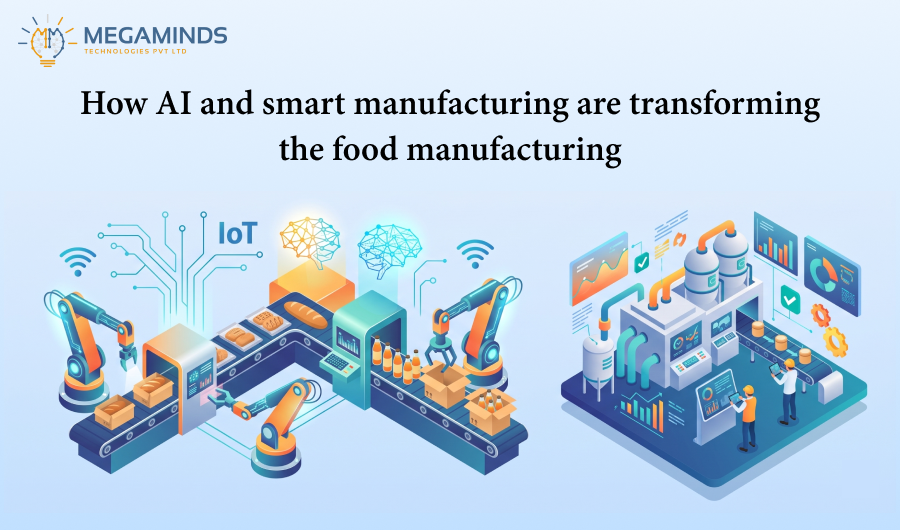
Food production is benefiting from automation and artificial intelligence in similar ways to other manufacturing sectors. AI-enabled machines are nearly eliminating equipment failures and optimizing equipment utilization. Continuous, real-time analysis of process data by AI is making food processors more efficient. Process data can now be combined with ingredient and batch data to further enhance food safety and enable traceability.
The food industry is embracing these advances. AI and automation were named the most disruptive trends in food manufacturing in the 2025 survey by Food Engineering magazine. Food processors are now building competitive advantages and enhancing profitability by reducing operational costs, decreasing equipment downtime, and improving the speed and data quality of decisions while still ensuring human oversight of processes and food safety.
The Biggest Challenges Facing Food Manufacturers in 2026
Various obstacles face food manufacturers in 2026, including increased operational costs, unreliable equipment, food safety risks, and data systems not speaking to one another. All these things negatively affect productivity, increase waste, and negatively affect the bottom line.
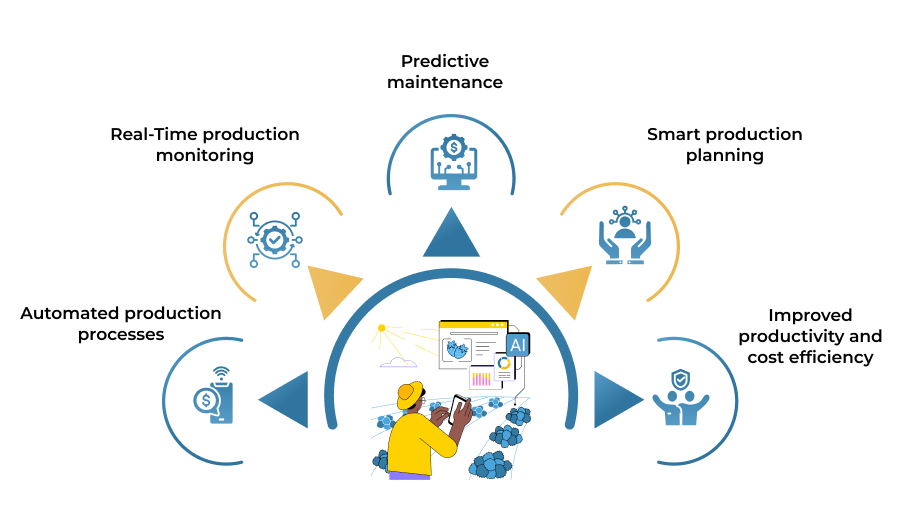
AI and automation optimize food manufacturing by streamlining production processes and minimizing the time spent on manual tasks. Real-time monitoring detects efficiency losses and performance issues in the production process. AI and automation allow companies to boost production, minimize quality and consistency issues, and reduce unplanned production stoppages.
By utilizing AI and Automation, Food Manufacturing Companies can reduce their operational costs and improve productivity and reliability of their production processes.
Smart manufacturing integrates machines and sensors with software to help food manufacturers improve their decision-making with real time data on production. It helps capture data on many aspects of the production process including energy consumption and product quality. Real time data helps resolve issues and improve efficiency in a number of ways. It helps identify issues in the production process, and helps maintain optimal conditions for perishable foods.
Smart manufacturing is expected to further improve production by incorporating more data analytics. The early adopters of these technologies are already measuring positive results. Deloitte’s 2025 Smart Manufacturing survey of 600 U.S. manufacturing executives highlights that 67% of respondents, on average, reported net gains of 10% to 20% in production output, employee productivity and capacity since implementing smart manufacturing initiatives.
The survey also confirmed that food and beverage manufacturers were able to increase production 10% to 20% by leveraging data and analytics. Smart manufacturing can improve order fulfillment, on time delivery, and reduce waste in the supply chain. It has the potential to provide real time data analytics to improve food security and safety.
Predictive maintenance uses AI, sensors, and data analytics to identify potential equipment failures before they interrupt production. In food manufacturing, it helps monitor critical machines such as conveyors, refrigeration systems, mixers, and packaging equipment to reduce unexpected breakdowns and maintain consistent production.
By analyzing machine temperature, vibration, pressure, and performance data, AI systems can detect unusual patterns and alert maintenance teams when equipment requires inspection. This allows manufacturers to schedule repairs before minor issues become costly production disruptions.
Key Benefits of Predictive Maintenance:
By implementing AI-powered predictive maintenance, food manufacturers can improve equipment reliability, reduce production delays, and control maintenance expenses. Results depend on sensor quality, historical data, equipment conditions, and the effectiveness of maintenance processes.
AI helps food manufacturers reduce production waste, control operating expenses, and improve product quality through real-time monitoring and intelligent data analysis. By identifying inefficiencies early, businesses can minimize material losses, improve production consistency, and make more informed decisions.
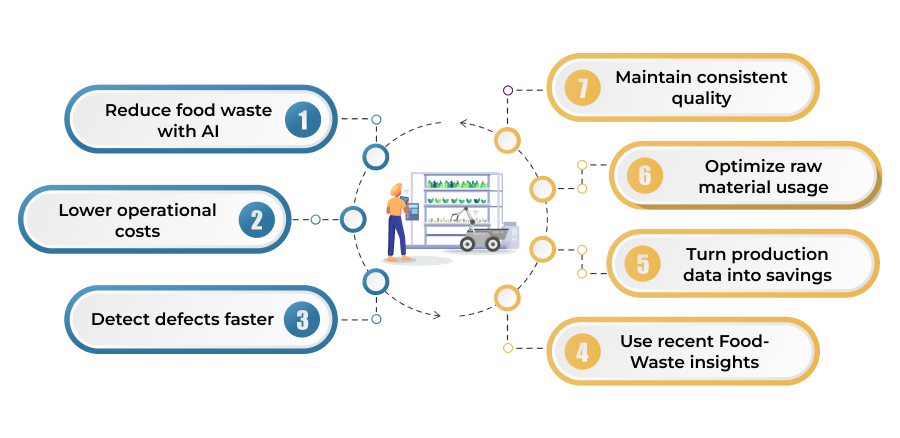
Business impact: By combining AI-powered inspection, predictive analytics, and real-time monitoring, food manufacturers can improve production efficiency, reduce avoidable waste, strengthen quality control, and build more cost-effective operations. Actual savings depend on the facility, production processes, and implementation quality.
Using them and custom software development, and data analytics, cloud technology helps enable the linking of the food production chain, as well as automating workflows and decision-making throughout the value chain. They enable more visibility and control for operations and management, while minimizing manual errors.
Custom Software Development: the integration of production, inventory, maintenance, and QC systems to deliver integrated and process-oriented production management.
Cloud Platforms: work as a unified, centralized location for production data, reports, and operational information from multiple sites.
Production analysis: Monitor production, machine, and resource usage to pinpoint bottlenecks and increase throughput.
Smart Inventory: Map inventory to production to reduce excess, obsolete, and waste inventory. AI Detect bottlenecks in production, quality issues and trends.
Improved Traceability: Enabled products and/or batches to be traced and/or investigated.
Collectively, these advanced and connected technologies together enable food manufacturers to simplify the supply chain and benefit from greater control and visibility, lower costs, higher quality products and sustainable business growth eventually.
Artificial intelligence and smart manufacturing enable food manufacturing companies to operate more efficiently, reduce downtime, waste, and ensure the production of high-quality consistent products. With automation, predictive maintenance, cloud platforms, and real-time data, AI can bring your manufacturing processes into the future.
Why build your software solution with AI and custom software development? Integrating systems, controlling costs, and adapting to market demands can give food manufacturers a competitive edge. With digital transformation, today’s food manufacturer can form a more streamlined, responsive, and profitable operation.
15 Oct 2026
12 Oct 2026

08 Oct 2026