The healthcare frustration nobody talks...
05 Oct 2026


Traditional fraud detection methods that rely on rules are quickly becoming obsolete.
AI enables fintech companies to detect and stop financial fraud in real time by instantly analyzing payments and assessing the risk of fraudulent activity.
Fintech companies can leverage a combination of AI and machine learning to effectively detect and prevent fraud.
For fraud prevention and detection, fintech companies can utilize the AI and combine it with other analytical models and tools. AI helps fintech companies to shift from being fraud reactive to being fraud predictive and proactive.
AI-based solutions are making fintech fraud prevention smarter by using real-time data analysis, behavioral data science, and predictive detection.
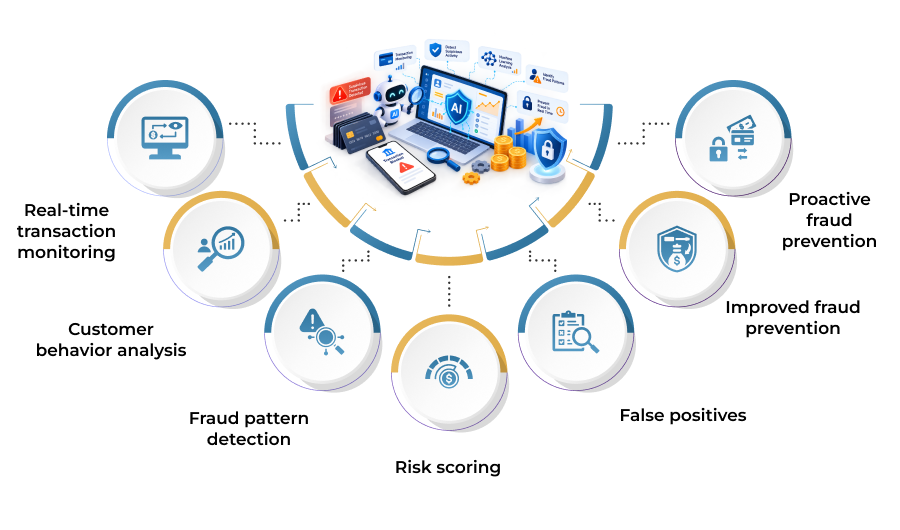
AI allows fintech companies to instantly analyze transactions and stop fraud in real time.
For example, say a customer made small domestic payments and then made a high-risk $5,000 international payment using a new, unfamiliar device.
The 2020 research paper published by the Bank for International Settlements stated that payment analytics helped Banks identify 12% more high-risk accounts and uncover 26% more behavioral patterns of financial crimes.
In summary, AI helps quickly detect fraud, lower false positives, decrease payment friction for customers, and help protect customers’ accounts.
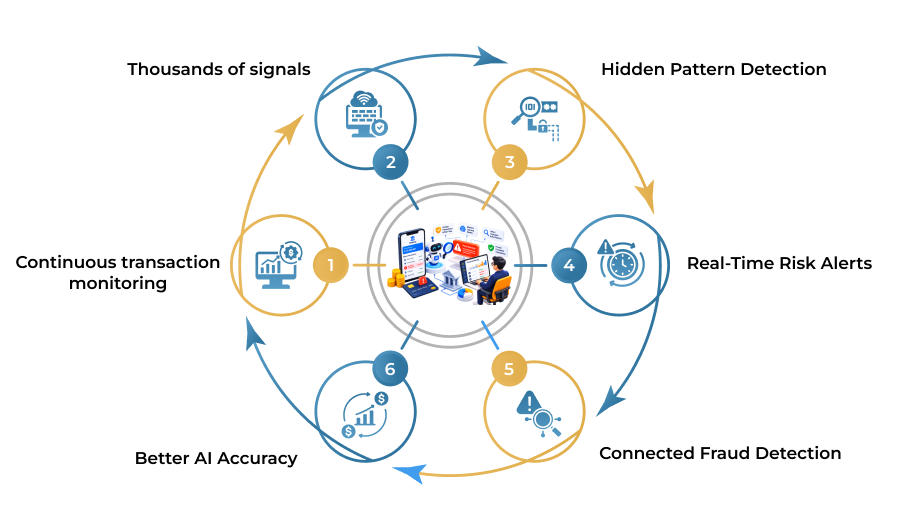
Machine learning algorithms use previous cases of fraud to teach themselves how fraud looks like. This way, they can identify patterns and call out potential frauds in new transactions. For example, they can analyze thousands of signals in transactions to catch fraudulent behavior.
Such models are successful in detecting payment fraud, account takeover, synthetic identity, suspicious transactions, money laundering, and scam rings. According to BIS project Hertha, payment analytics enhanced the detection of illicit accounts by 12% and identified previously unseen behaviors associated with financial crime by 26%.
Fusing AI predictions with anti-money laundering (AML) and Know Your Customer (KYC) business rules and compliance automation can further enhance fraud prevention. Adding human oversight to the process can help prevent false negatives due to innocent mistakes. The Federal Reserve is also noticing a growing number of financial institutions implementing AI and ML in fraud prevention, but are warning of the importance of appropriate risk management and governance.
Real-time analytics helps fintech companies monitor transactions continuously and identify suspicious activity before it develops into significant financial loss.
Fraud prevention begins before a transaction occurs.
AI can strengthen customer onboarding and account protection by analyzing identity documents, biometric signals, behavioral patterns, and authentication activity.
During onboarding, AI can help fintech companies identify suspicious identity characteristics or inconsistencies. After onboarding, behavioral models can establish a baseline for how customers normally interact with the platform.
If a user’s behavior suddenly changes, the system can trigger additional verification.
This becomes particularly important as fraudsters increasingly use generative AI, deepfakes, and synthetic identities. Federal Reserve officials have warned that AI-generated voices and images can be used to impersonate customers and undermine traditional authentication approaches.
Therefore, fintech businesses need AI not only to detect traditional fraud but also to defend against AI-enabled fraud.
Fraud detection has another major challenge: legitimate customers can sometimes look suspicious.
A system that blocks too many legitimate transactions can create customer frustration, abandoned payments, unnecessary support requests, and lost revenue.
AI can help reduce false positives by considering multiple contextual signals instead of relying on one isolated rule.
For example, an unusual transaction may initially appear risky. However, if the customer’s device, location, authentication behavior, recipient history, and transaction context are consistent with previous activity, the overall risk may be lower than expected.
This enables fintech companies to move toward risk-based decisions rather than blanket restrictions.
Better precision can improve both fraud prevention and customer experience.
Modern financial fraud often involves multiple connected accounts, devices, identities, merchants, and payment destinations, making individual transaction monitoring insufficient.
For example, several accounts sending money to the same recipient while using related devices or similar behavioral patterns may indicate coordinated fraud.
According to BIS research on financial crime detection, network-based analytics can help identify complex financial-crime patterns that transaction-level monitoring may overlook.
In short, connected analytics helps fintech companies detect fraud networks—not just individual suspicious transactions.
AI can significantly improve fraud detection, but fintech companies must address several challenges to ensure accurate, secure, and responsible implementation.
AI helps fintech companies detect suspicious transactions faster, reduce fraud losses, and respond to threats in real time.
It can reduce manual investigation costs by automatically analyzing transactions and prioritizing high-risk cases for fraud teams.
AI also helps reduce false positives, creating a smoother customer experience by avoiding unnecessary payment blocks and verification requests.
As transaction volumes grow, AI provides scalable fraud prevention while continuously learning from emerging fraud patterns and supporting AML, KYC, and compliance operations.
According to the Federal Reserve, machine learning has already been used for payment fraud and money-laundering detection, with newer AI capabilities expanding its potential.
The future of fintech fraud prevention will likely involve increasingly connected AI systems rather than isolated fraud models.
AI agents could help fraud teams investigate alerts, correlate information from multiple systems, identify emerging patterns, summarize cases, and recommend appropriate actions.
The FSB’s 2026 consultation report describes an example of an internationally active bank using agentic AI to identify emerging fraud and scam patterns in real time. The system monitored more than 80 million signals each day across transactions, card payments, online payments, and digital banking interactions.
However, autonomous fraud prevention should not mean removing human oversight.
The strongest approach will combine AI speed with human judgment. AI can identify patterns and prioritize cases, while fraud analysts and compliance teams provide context, oversight, and accountability.
Financial fraud is evolving rapidly, making traditional rules and manual monitoring less effective. AI helps fintech companies detect suspicious activity in real time, predict emerging threats, reduce false positives, and protect customers.
By combining AI, real-time analytics, behavioral intelligence, strong data governance, and human oversight, fintech businesses can build smarter and more adaptive fraud prevention systems.
Ultimately, the future of fintech fraud prevention is not just about detecting fraud faster—it is about preventing losses before they happen and building lasting customer trust.