Why the Future of Insurance...
15 Oct 2026


Large organizations often face pressure to innovate and launch new solutions quickly. However, traditional software development can be time-consuming and expensive. Microsoft Power Apps addresses this challenge with its low-code development platform. It enables citizen developers to build business applications without advanced programming skills. As a result, organizations can solve business problems faster, reduce development costs, and accelerate digital transformation without placing additional demands on IT teams. The result is a smaller IT backlog, quicker innovation, and less money spent on development. This blog will address how Power Apps supports citizen development and what that means for large enterprises.
Citizen developers are business users who create or modify applications using low-code and no-code platforms such as Microsoft Power Apps. They do not require traditional programming skills to build business solutions. Instead, they use visual development tools, drag-and-drop features, and pre-built components to develop applications that meet specific business needs.
Unlike professional developers, citizen developers focus on solving everyday business challenges rather than writing complex code. They understand their team’s workflows, pain points, and operational requirements. As a result, they can quickly build practical applications that improve productivity and streamline business processes.
Citizen developers work across many business functions. For example, HR managers can automate leave requests, sales teams can simplify pipeline updates, finance analysts can digitize approval workflows, and operations coordinators can optimize supply chain processes. This approach enables organizations to accelerate digital transformation while reducing development time and costs.
The rise in non-professional or citizen developers represents a major shift in the technology dynamics of enterprises. In order to achieve a digital transformation, companies are spending a lot of money, and as a result, the demand for custom business applications has gone up so high that it is beyond what centralized IT development teams can deliver. Power Platform of Microsoft (including Power Apps) is one of the major contributors to this shift as it offers user-friendly tools:
This new way of working between the citizen developers and the IT team has a huge effect on the speed of the process of innovation, the reduction of the IT backlog, and the change of the corporate culture to one that is more agile and experimental.
Business leaders get along with non-professional developer empowerment a positive-impact which is inquests:
Typical citizen developers working in big companies might be: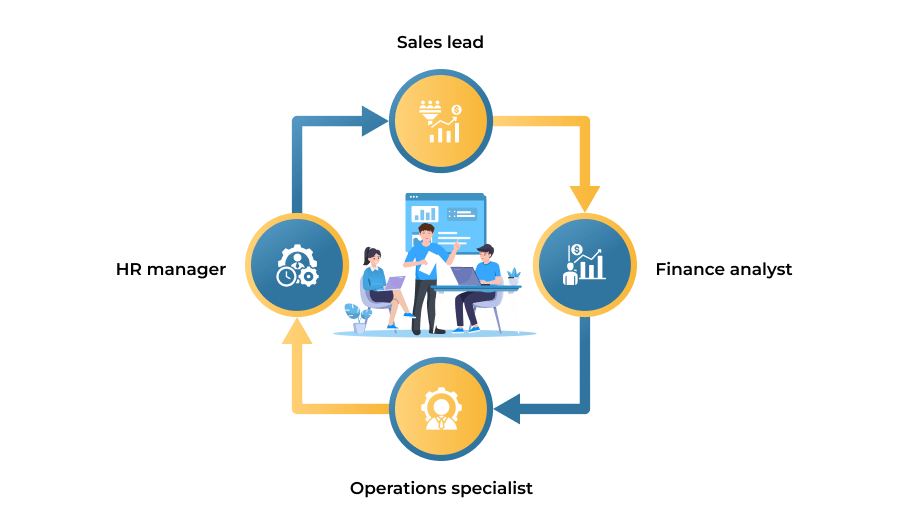
These are just a few examples of the citizen developer role that is crucial in bridging the gap between business needs and IT provision in today’s organizations.
Microsoft Power Apps is changing the way organizations build apps to solve business problems by giving non-tech employees the ability to build their own apps. Without writing any complicated code, the users can create apps that are suited to their needs. This user enablement not only brings the organization the benefits of faster delivery and lower IT backlogs but also the capability to race the digital transformation across the enterprise.
One of the biggest advantages of Microsoft Power Apps is its low-code/no-code development approach. It enables employees without programming experience to build business applications with ease. Users can create apps visually by using drag-and-drop tools, forms, buttons, and data fields instead of writing complex code. As a result, teams in HR, finance, sales, and operations can develop solutions that address their specific business needs.
This approach transforms how organizations build internal applications. Employees can automate workflows and solve business challenges without waiting for IT support. For example, an HR manager can quickly create a custom employee onboarding app instead of waiting months for a traditional development project. Consequently, organizations improve productivity, accelerate innovation, and foster a culture of continuous improvement..
Power Apps can be a great tool for citizen developers, as one of the key features that enable them is the seamless integration with other Microsoft products that are already in place. These are:
Such an interoperable system enables citizen developers to create applications that are connected to real-time data from different departments of the organization and hence not using the traditional way of separate data silos, moreover, they can also make these solutions part of the integrated workflow of employees.
For instance, sales teams can develop Power Apps which extract customer-centric data from their CRM tool and fill the result of a sales activity right into Teams, thus making the processes highly effective and the data trustworthy.
One of the recent developments, like Microsoft Copilot and AI Builder in Power Apps, can empower citizen developers to create new applications by turning off the regular tasks that occupy their time and by simplifying the creation of apps:
Moreover, this AI support in application development is an important factor in the citizen developers’ transition from the manual application architect mode to the guided and accelerated innovation mode, which non-developers rapidly multiply their capability to do and create.
Microsoft Power Apps is a tool that brings change-intent value to big companies and that is such a value that it is by no means limited to one or two aspects but rather it can bring to the table four key benefits i.e. one of the benefits being agility which is the ability to react quickly to changes another being cost savings through elimination of expensive maintenance and so on besides innovative applications at an unimaginable scale which is not common with any other product. Moreover, the platform makes it possible for the non-technical personnel spread across the whole company to develop solutions by
Traditional software creation has the potential to drag on for several months or maybe even years which inevitably leads to a stagnation of business initiatives and a delay in the return of value. Power Apps makes it possible for citizen developers to quickly produce and repeat their applications using a no-code visual interface. The speed is that it enables companies to:
For a large number of enterprises, this transformation has resulted in development cycles that are up to 50% shorter than those achieved through traditional development methods, thus they are able to deliver solutions weeks and even months earlier.
Citizen development brings down the total cost of ownership as it eliminates the need for professional developers and costly external consultants. Research indicates that organizations gain a 206% return on investment (ROI) over three years when they use Power Apps. They make their initial investments back usually within six months.
Cost savings include:
A lot of enterprises point out that they save millions of dollars each year as a result of lowering operational friction through the implementation of better workflows and reduction in application development time
Companies that have put a lot of resources into Microsoft 365, Dynamics 365, and Azure get a great value out of Power Apps that is very well compatible with these platforms. Such an interaction allows companies to:
Besides saving money on technology, this compatibility breathes new life into the relationship and the return on the investment (ROI) of the company’s technology assets.
With the integration of Power Apps, Power Automate, and Power BI, companies are simplifying their workflow automation, making processes visible — allowing insights to flow seamlessly from analytics to business. Citizen developers are building applications to:
Power Apps comes from Microsoft’s reliable cloud platform and it has some solid internal security features which are a must for big companies:
Large businesses can thus keep re-imagining their futures with confidence that data privacy and regulations will not be compromised.
Lerøy Seafood Group simplified its production planning through automation, which enabled the company to save a lot of money and also improve customer service.
Microsoft Power Apps allows non-technical users to create custom applications that address various business challenges in different departments and industries. The use cases mentioned here are just some of the real-world examples, where Power Apps had a decisive influence, allowed companies to be more agile, and saved them a lot of money.
Often, HR departments are overwhelmed with repetitive paper-based, manual operations related to the procedures of onboarding, leave management, and tracking of performance. Apps built by citizen developers:
These are all the applications that fundamentally embrace the reduction of the administrative burden on human resources, facilitate the accuracy, and promote the employee experience with the faster HR processes. An example – a multi-national manufacturing company powered by Power Apps cut the onboarding time by 40%.
Sales teams create Power Apps client engagement, lead tracking, and pipeline management tools through mobile device apps that:
The time and efficiency will lead to better sales effectiveness and thus allow real-time decision-making, which is very important in fast-moving markets. One instance is a global insurance company that Power Apps has been credited with reducing sales cycle times by 25%.
Power Apps are adopted by finance departments to simplify the processes of reimbursements, budget management, and the flow of compliance.
After the launch of citizen-developed financial automation apps, banks, and retail firms have experienced an accelerated approval process that was simplified and strengthened financial controls.
The governance and security aspects are essential, when big corporations decide on citizen development using Microsoft Power Apps, in order to make sure that innovation is not sacrificed against the rest of the data accuracy, compliance, or reliability. It “empowers” businesses to have up to thousands of users who can create applications on their own, however, this also entails having a system that can keep the balance between enterprise controls and management of creativity.
Governance defines how organizations develop, use, and manage business applications. It establishes clear policies for application development, deployment, and maintenance. Without proper governance, organizations may face challenges such as app sprawl, shadow IT, security risks, compliance issues, and inconsistent application quality.
A strong governance framework ensures that every application aligns with business objectives and IT policies. It also defines clear roles, responsibilities, and ongoing monitoring processes. As a result, organizations can maintain security, improve compliance, and support sustainable application development. For businesses adopting Microsoft Power Apps, a dedicated low-code governance framework is essential for scaling citizen development safely and effectively.
One of the most important things to make a good decision is the Power Platform Center of Excellence, a group that includes cross-functional IT, business leaders, security officers, and citizen developer champions. The CoE:
By setting up CoE efficiently, companies such as Zurich Insurance and Shell have managed to scale citizen development through smart allocation of resources.
It is very important to make sure that data breaches are prevented from happening when the data is being shared between different applications.
With these features, the companies can have a good level of data governance, which is not heavy on the part of citizen innovation.
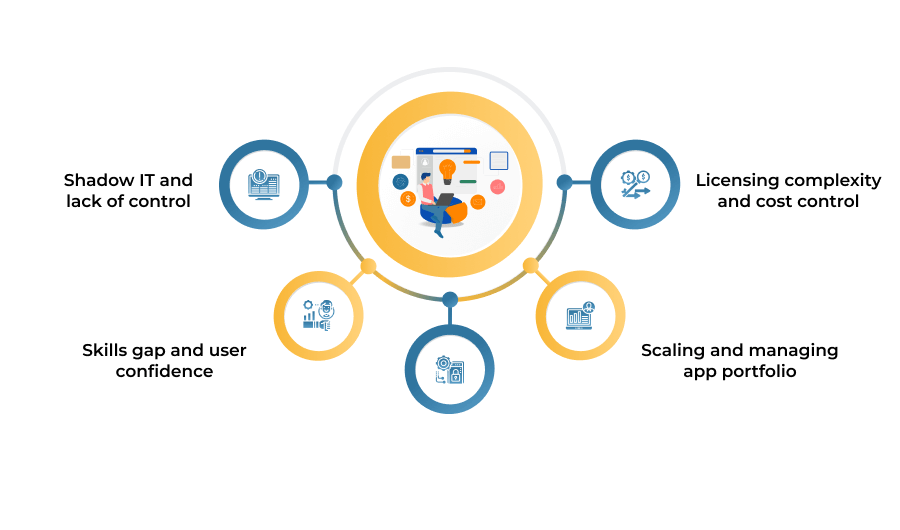
Challenge: There is a risk that the non-centralized development will lead to shadow IT which is an undesirable consequence that typically accompanies the increase in the number of unmonitored applications. These unmonitored apps can generate silos of data, cause duplication of data, and even create security loopholes.
Solution:
Challenge: Although Power Apps is a low-code platform, a lot of business users are still doubtful about making an app because of their unfamiliarity with the app logic, data structures, or integrations, which eventually results in them quitting the platform or making poorly designed apps.
Solution:
Challenge: When decentralized application (dApp) developers implement security policies that are not consistent, it is likely that the organization can be exposed to data leaks or even break compliance regulations.
Solution:
Challenge: One of the consequences of companies expanding their pool of citizen developers is that they are, basically, faced with the question of how to manage the increasing number of apps in an effective way. Moreover, one of the biggest issues is the need to find a way to avoid redundancies and keep the quality of apps, which is an extremely challenging task.
Solution:
Challenge: Without sufficient advice and monitoring the associated expenses, it is sometimes a confusing task to grasp the ideal Power Apps licensing models.
Solution:
The use of Microsoft Power Apps for citizen development is definitely not just a trend that will fade away; it is a significant change that profoundly impacts the future of enterprise IT, innovation, and employee empowerment. The journey of Power Apps and citizen development has opened the door to unimaginable opportunities and has raised the capabilities of organizations exponentially as they aim to be more responsive and data-driven.
AI (Artificial Intelligence) will be more and more essential in broadening the citizen developers’ skills: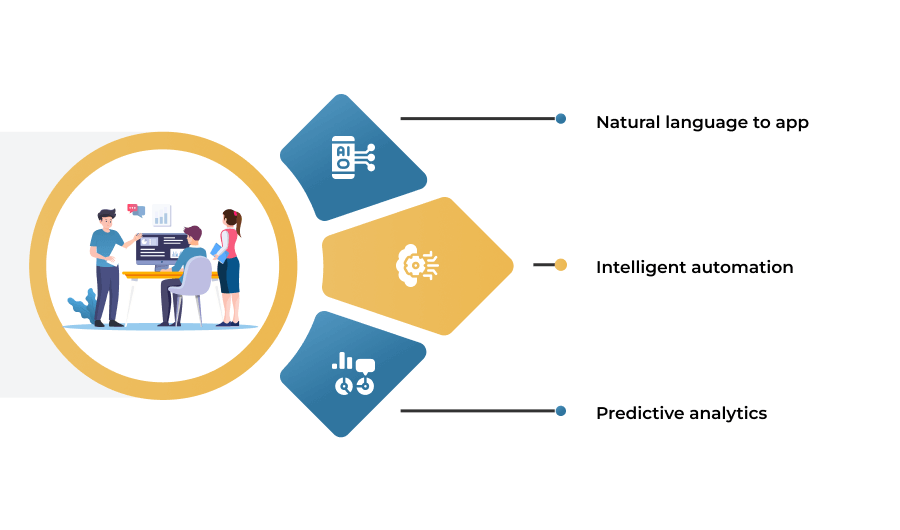
This will decrease the entry point still more, and hence non-technical employees will be able to engage in complex app development and automation, thus up to the whole enterprise innovation.
In the current scenario, companies are running their processes with a hybrid combination of on-premises systems and various cloud platforms and Power Apps development’s future will revolve around these priorities:
Such adaptability would even extend the use of power apps to more complex, large-scale organizations.
The community behind citizen development will become a much bigger community because of:
Such a vibrant ecosystem will ignite the innovation, decrease replication, and speed up the development cycles.
Citizen development is expected to be an important factor in the digital transformation of enterprises that will lead the following:
Trained citizen developers, working with the latest Power Apps capabilities, will not only help large enterprises stay competitive and vibrant but also make them future-ready.
Genetic testing examines an individual’s DNA to identify genetic mutations associated with specific diseases. Moreover, healthcare providers can perform these tests using blood, saliva, or tissue samples. For example, genetic screening detects inherited conditions such as cystic fibrosis, sickle cell anemia, and BRCA gene mutations. As a result, doctors can provide personalized care, early intervention, and more effective treatment strategies. Why not take advantage of your staff’s capabilities and accelerate the transformation journey with Microsoft Power Apps?
15 Oct 2026
12 Oct 2026

08 Oct 2026