By 2025, sustainable manufacturing will be a significant focus area for Original Equipment Manufacturers (OEMs). For OEMs, sustainable practices will be a necessity to comply with changing regulations, meet customer and stakeholder demands, and be competitive in the operating environment. Sustainable practices will reduce environmental impacts and boost operational efficiency.
For sustainable practices, automotive, electronics, and industrial machinery manufacturing OEMs do not have an option. This article analyzes the ways OEMs will incorporate new materials, emerging technologies, and sustainable business practices to achieve net zero in a way that promotes business growth and environmental sustainability.
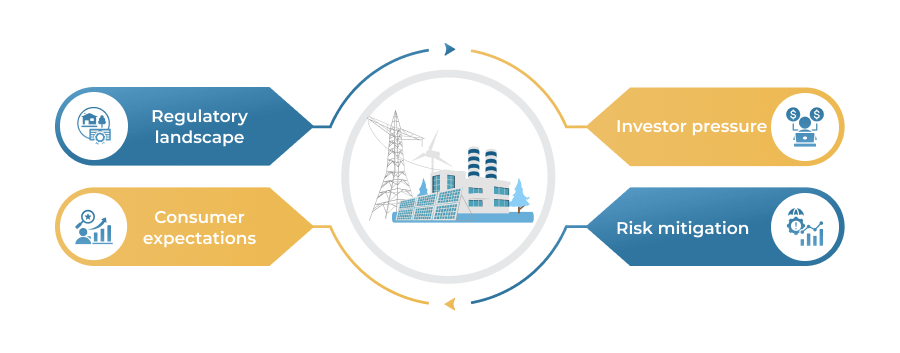
Traditionally OEMs for their manufacturing lines would focus on the products’ quality, the amount they produced, the cost to produce, etc. Sustainability was not a focus. However, OEMs have shifted manufacturing focus to include the environment. This change has been due to new and emerging regulations, the will and wants of the customers, the will and wants of investors, and risk management.
Regulatory Landscape: Stricter carbon emission and waste management regulations are driving OEMs to adopt sustainable manufacturing. Frameworks such as the EU’s Fit for 55 package encourage manufacturers to reduce carbon emissions across production processes.
Consumer Expectations: Today’s consumers value sustainability and transparency when choosing products. OEMs that demonstrate strong environmental responsibility earn greater customer trust and brand loyalty.
Investor Pressure: ESG-focused investors increasingly support companies with sustainable manufacturing practices. Businesses that prioritize innovation, transparency, and renewable operations are more likely to attract long-term investment.
Risk Mitigation: Sustainable manufacturing helps OEMs reduce risks related to rising resource costs and supply chain disruptions. It also strengthens supply chain resilience through reshoring and localized sourcing strategies.
Key Strategies for Eco-Friendly Integration
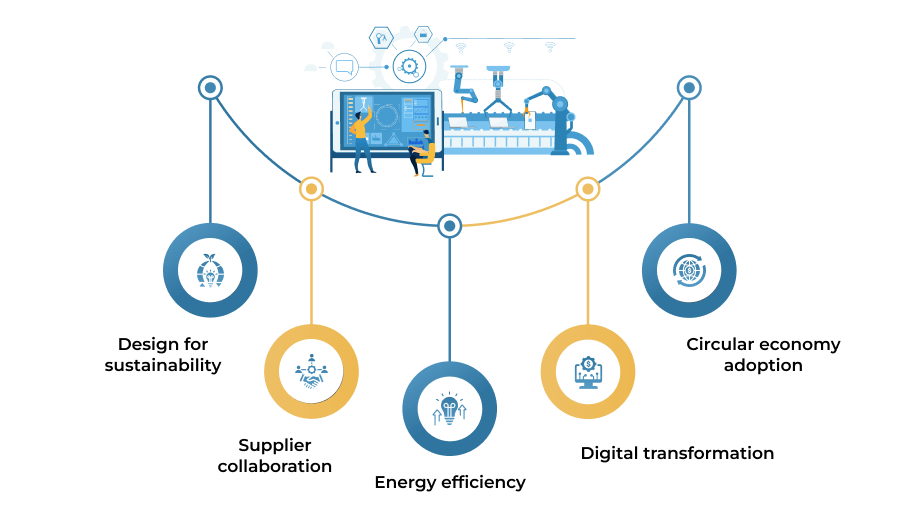
Today’s original equipment manufacturers (OEMs) adopt environmental sustainability in multiple ways such as:
Design for Sustainability: OEMs design products for a longer lifecycle with minimal resource consumption. They also make products easier to repair, reuse, recycle, and remanufacture.
Supplier Collaboration: OEMs partner with suppliers that follow sustainable sourcing practices and strong environmental standards. They also source materials locally to reduce transportation emissions.
Energy Efficiency: Manufacturers power factories with renewable energy sources such as solar, wind, and green hydrogen. This approach lowers carbon emissions and improves energy efficiency.
Digital Transformation: OEMs use IoT, AI, and digital twins to optimize resource utilization, reduce waste, and improve production efficiency. These technologies also support smarter and more sustainable manufacturing.
Circular Economy Adoption: Manufacturers implement closed-loop systems that recover, recycle, and repurpose materials. As a result, they reduce waste and maximize resource utilization.
By adopting these strategies, OEMs can turn sustainability into a competitive advantage. They can drive innovation, strengthen business resilience, and support global climate goals while achieving long-term growth.
What is Sustainable Manufacturing in the OEM Context?
Sustainable manufacturing in Original Equipment Manufacturer (OEM) operations focuses on designing, producing, and using products with minimal environmental impact. At the same time, manufacturers maintain strong economic performance and business growth. This approach goes beyond reducing emissions and waste. It also improves resource efficiency and supports long-term sustainability.
Sustainable manufacturing is more than a “green” business model. It goes beyond meeting regulatory requirements. Instead, OEMs integrate sustainability into their business strategies, manufacturing processes, and daily operations. This approach helps companies achieve long-term growth while protecting the environment.
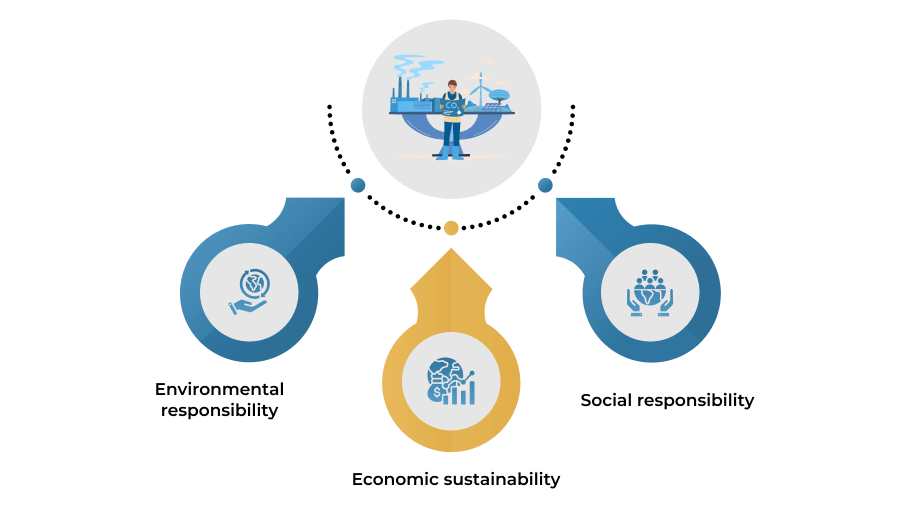
Core Principles
Environmental Responsibility: One of the main ways a company can make a positive impact on the environment is through a sizable reduction in the release of carbon dioxide, waste, and water consumption. Besides that, the company should also reduce the release of harmful pollutants to air, water, and soil that accompany the whole product lifecycle.
Economic Sustainability: A business can always keep its profits even though it decides to carry out the above actions. This can be done through utilizing resources more efficiently and thus saving money, improving the supply chain with the resultant benefit of it being more resilient to external factors and finally, opening up access to an increasing consumer segment of green products.
Social Responsibility: A company concerned about its human resources, produces in an environmentally friendly way and has a positive impact on society in the product life cycle are the three main support bases of the company’s social responsibility.
OEM-Specific Applications
Circular Manufacturing: The production of items that are easy to disassemble and recycle, which allows materials to be used multiple times—in other words, materials with multiple life cycles. This is a very significant aspect for the car and electronic industries.
Scope 1, 2, and 3 Emissions Management: Original equipment manufacturers (OEMs) declare the amount of greenhouse gases released as a result of their direct production activities (Scope 1), the energy consumed by them (Scope 2), and the supply chain to which they belong (Scope 3). The third is most often the largest contributor to their total CO2 emissions.
Lean + Green: The company can have the advantages of lean manufacturing that allow it to grow with the help of environmental indicators which enable the company to completely get rid of waste from energy and materials, and significantly change the process.
Digital Integration: AI-driven demand forecasting, condition-based maintenance, and energy consumption at every single minute enable the company to save resources and reduce its negative impact on the environment.
Moreover, OEMs employ sustainable manufacturing as a compass to develop products and processes that meet the demands of the present without compromising the ability of future generations to meet theirs.
Innovative Materials and Processes for Sustainability
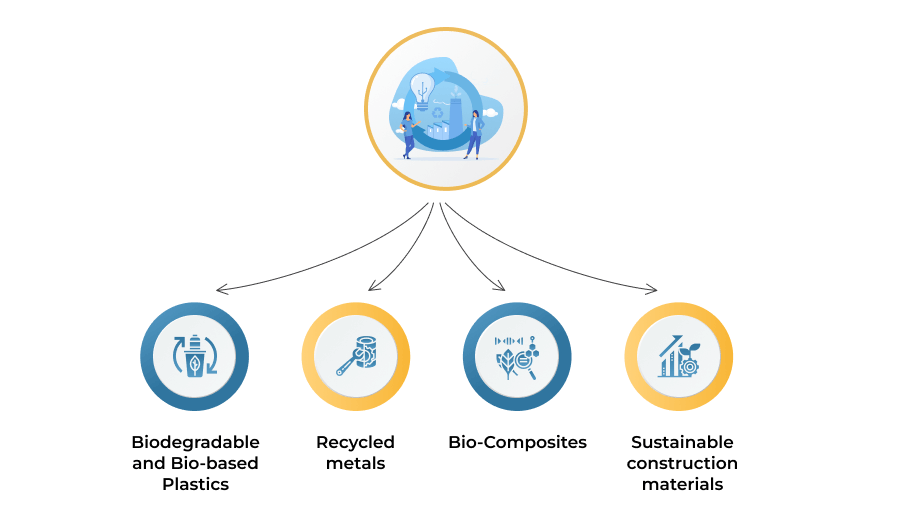
Biodegradable and Bio-based Plastics: These are plastics that are completely made from renewable agricultural sources and are meant to significantly reduce the use of fossil products and make the disposal of plastics at the end of their life cycle much simpler.
Recycled Metals: The development of technologies has made it possible for metals such as aluminum and steel to be recycled with up to 95% less energy that the recycling process of the virgin metals, thus cutting emissions substantially.
Bio-Composites: The materials made by combining natural fibers with polymers, which are lighter, less polluting, and less biodegradable (if at all) than the traditional automotive and aerospace industries materials can replace those industries.
Sustainable Construction Materials: The likes of straw panels, hemp composites, and mycelium products not only can become the solution to the eco-friendly construction demand problem of industrial buildings and infrastructures, but they also have the potential to become the future of the construction industry.
Green Manufacturing Processes
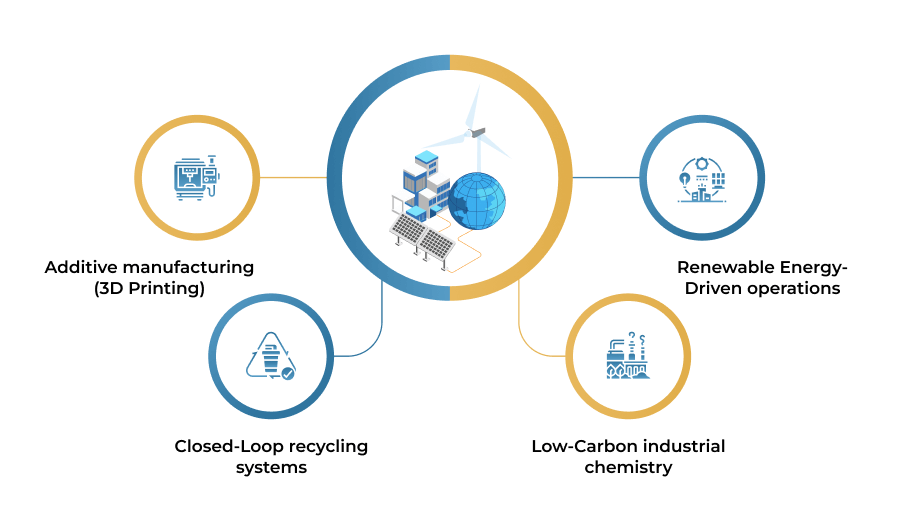
Additive Manufacturing (3D Printing): The waste of raw materials can be reduced by up to 80% if OEMs use additive manufacturing instead of the traditional subtractive manufacturing. Moreover, this also enables the creation of more efficient designs with lesser material usage.
Closed-Loop Recycling Systems: Recycling on-demand of scrap materials that is carried out within factories lowers both the consumption of raw materials and the amount of waste deposited in landfills.
Low-Carbon Industrial Chemistry: The innovations for steel, cement, and chemical industries that rely on alternative materials and procedures to decrease carbon emissions are the exemplary cases of low carbon industrial chemistry.
Renewable Energy-Driven Operations: The emissions from the operations can be decreased to a great extent by utilizing renewable electricity or green hydrogen in manufacturing.
These novel materials and processes which reduce the negative impacts on the environment not only through decreasing dependence on extractive resources and cutting price volatility but also by improving supply chain resilience.
Core Technologies Supporting Green Manufacturing
Technology is the basis of sustainable manufacturing, where it opens up the possibilities for original equipment manufacturers (OEMs) to visualize, not only measure but also optimize the environmental impact of the products.
Digital Twins
By successfully and inaccurately trying out and combining ways of working in the copies of their plant, manufacturers virtually reduce the consumption of energy, wastes, and other inefficiencies before they make physical changes.
Internet of Things (IoT) and Sensors
Factories that are IoT-enabled not only keep a close watch on the energy consumption but are also able to follow the whole process of the carbon emission, waste matter, and water consumption in real-time. This data opens up room for quick fixes as well as for the sustainability plan with long-term goals.
Artificial Intelligence (AI) and Predictive Analytics
AI sculptures go on energy saving and waste reductions of raw materials arising from the well sight forecasting of equipment maintenance requirements, on the bases of perfect logistics offline routes and by dynamically changing the production schedules.
Cloud and Edge Computing
These sorts of technology make the process of sustainability reporting across the globe and supporting local decisions, which in turn, promote green indicators becoming part of the daily operation without putting stress on the flows of information.
Renewable Energy Integration
In order to prevent power shortages in manufacturing plants and simultaneously lower scope 2 emissions, most OEMs are now turning to solar power, wind power, and green hydrogen electrolysis as their sources of energy.
The combination of all these technologies creates a very powerful, data-driven, transparent, and real-time approach to operational excellence and, as a result, extends the sustainability performances all the time.
Benefits of Sustainable Practices for OEMs
Except for environmental care, there are big benefits to integrating sustainability into manufacturing.
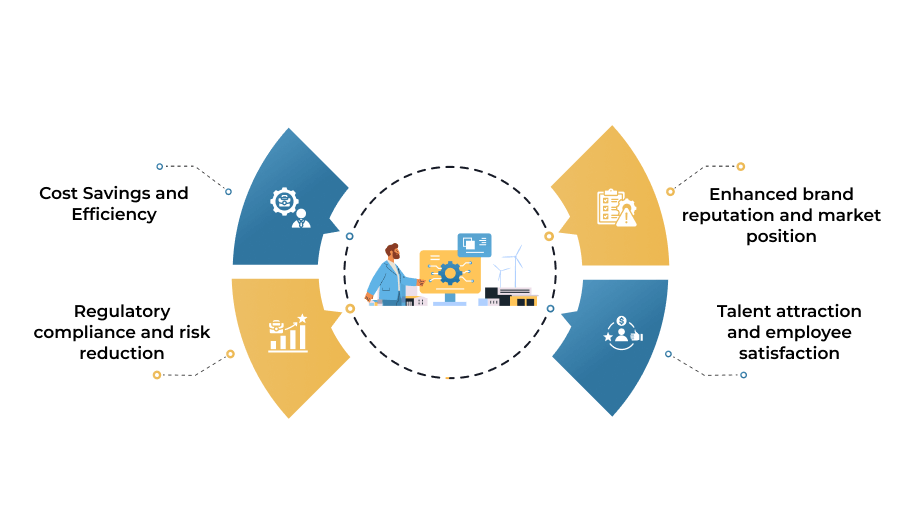
Cost Savings and Efficiency
Energy consumption being reduced, utility bills will follow.
Simply cutting off waste and refeeding the products lower the costs that are related to raw materials.
It is also possible to foresee the disappearance of costly downtime with the help of predictive maintenance.
Enhanced Brand Reputation and Market Position
Consumers are the source of the benefits market share can be obtained by meeting their eco-friendly product requirements.
Being an ESG leader elevates the company’s relations with customers and attracts new investors.
Regulatory Compliance and Risk Reduction
The most trustworthy way to manage emissions and waste is through waste management to become free of any possible trade restrictions or fines.
Supply chains that are strong are not vulnerable to the political situation and the depletion of resources.
Talent Attraction and Employee Satisfaction
Sustainability brings in talented people and keeps them through good workplaces.
Purpose-driven companies activate workers more which leads to the triple output of them.
Case Study: Automotive OEMs Championing Sustainability
Automakers like Ford, BMW, and Toyota have cut their emissions and operating expenses considerably by implementing circular economy principles. Using recycled materials by BMW and Ford’s carbon-neutral Cologne plant are just two of many examples to show how sustainability is transforming innovation-led growth and gaining competitive advantage.
Future Outlook: OEMs and the Path to Carbon Neutrality
With the goal of achieving net-zero emissions in operations first, and then across supply chains, OEMs are laying out ambitious plans to decarbonize manufacturing.
Emerging Trends Ending 2025
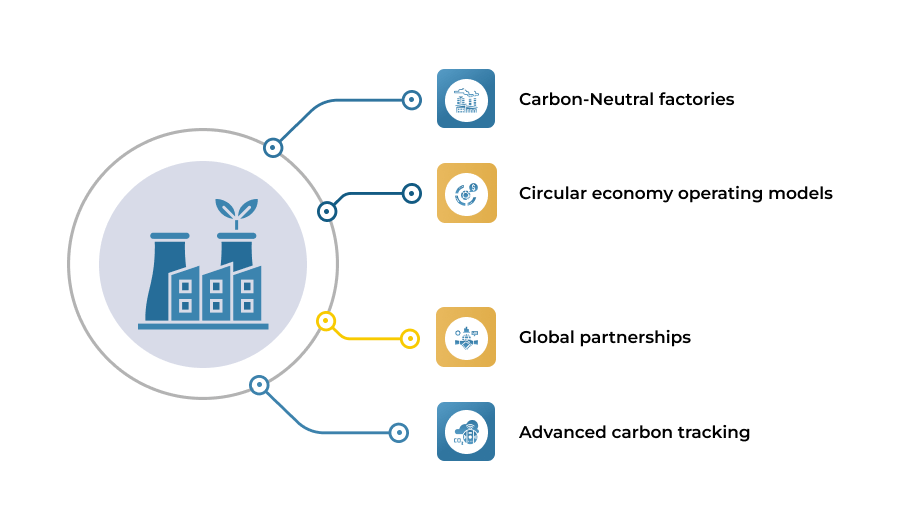
Carbon-Neutral Factories: These factories are going to be more and more powered by renewable energy sources. Also, they will be equipped with energy recovery systems.
Circular Economy Operating Models: These models are built with the idea of material recapture and resale or reuse throughout the entire lifecycle.
Global Partnerships: Companies, through working together with startups, governments, and academia not only innovate but also spread the adoption of green standards.
Advanced Carbon Tracking: Artificial intelligence and blockchain-based reporting systems make it possible that the emissions monitoring is transparent, occurs in real time, and serves compliance and marketing purposes.
Strategic Moves for OEMs
Area of spending will be renewable energy infrastructural facilities and green hydrogen usage for large industrial processes
Forming up battery end-of-the-life recycling procedure is one of the crucial issues in the automotive and electronics original equipment manufacturers (OEMs) sectors as they are responding to the regulatory frameworks.
Work is increasing on digital twins, AI, and IoT leading to environmental sustainability that is maintained in the long term.
The development of circular business models is the result of the increasing interaction that exists between manufacturers, consumers, and recyclers in order to obtain materials.
Vision Toward 2030
OEMs have the opportunity to lead the industrial sector in achieving net-zero targets. They can establish global supply chain standards and implement sustainable best practices. As a result, they improve business performance, support economic growth, and advance environmental sustainability.
Conclusion
By 2025, sustainable production has evolved from a compliance requirement into a competitive advantage for OEMs. Companies now use green designs, innovative materials, and advanced technologies to reduce their carbon footprint. These strategies also lower operating costs, strengthen brand value, and improve operational efficiency.
As environmental regulations become stricter, customer expectations continue to evolve. OEMs that embrace sustainable innovation today will gain a long-term competitive advantage. Transitioning from traditional manufacturing to sustainable production creates new opportunities for growth, resilience, and industry leadership.
Businesses that want to stay competitive should invest in tailored sustainable manufacturing strategies. Contact us today to accelerate your journey toward green innovation and carbon neutrality.
Sustainable manufacturing for OEMs stands for manufacturing products and processes that will have a minimal or zero negative impact on the environment, that will save resources and that will be economically feasible for the company to survive on the market.
Why is sustainability important in manufacturing?
Sustainability is not only a requirement from the environmental laws but also a market need and a method of cost-efficiency which, in the end, enables manufacturers to stay competitive in the market and, by doing so, to gain customer loyalty and to lower the possibility of operational risks.
How do OEMs reduce energy consumption?
OEMs are able to do this when renewables are used to power their facilities, operations are conducted to optimize the capacity, and smart technologies are employed to keep a check on the energy usage.
What challenges do businesses face in going green?
High costs for a company to switch to greener products and services are just one of the challenge areas. Other issues are the nonavailability of the green technologies, supply chain restrictions, and even the challenge of getting employees engaged and regulatory compliance.
How is employee engagement related to sustainability goals?
Employee awareness and training schemes are necessary for the effective execution which results in wider production team engagement which in turn strengthens the implementation of the ideas.
How do OEMs ensure transparency in sustainability efforts?
OEMs have adopted blockchain, an auditing system run by independent third-parties, and supply chain mapping services for making sure as well as showing to stakeholders that they have implemented the required changes in their sustainability policies.
Quickly scale your development capabilities by hiring pre-vetted tech experts who align perfectly with your project goals, timeline, and company culture.
What to expect after you reach out?
1. Share Your Requirements
Tell us your project goals, tech stack, and resource needs for a perfect talent match.
2. Talent Shortlisting
We screen and shortlist top-tier professionals based on your exact technical and cultural fit.
3. Interview & Selection
You interview the candidates and select the ones that align with your expectations and company values.
4. Onboard & Integrate
Seamless onboarding process to ensure smooth collaboration with your in-house team from day one.
5. Monitor & Scale
We assist with performance tracking and help you scale the team as your project evolves.