Nature-inspired and AI systems have combined to create swarm intelligence which is being integrated into elements of decision-making at an unprecedented level. Companies have started using swarm intelligence to enhance collaboration, refine processes, and improve decision-making. This blog explores the current and potential effects swarm intelligence will have on various industries.
Swarm Intelligence is a branch of AI designed by looking at systems of nature like ant colonies, bird flocks, and honeybee swarms. The agents solve problems by organizing themselves around simple local rules. No outside or centralized control is needed. Consequently, Swarm Intelligence is flexible enough to adapt to multiple systems. Some of these include logistics and route management, robotics, optimization, or even business AI.
Applications in Artificial Intelligence
A strong example of artificial intelligence is swarm intelligence. This type of AI is based on group behavior in natural systems. Features of swarm intelligence are the ability to perform complex tasks, make decisions without central control, and adapt to the task. These features enable businesses to tackle tough problems. Many organizations are using swarm intelligence for process optimization and greater efficiency. It is for improvement and advancement of more intelligent and resilient AI systems. It is used in all fields.
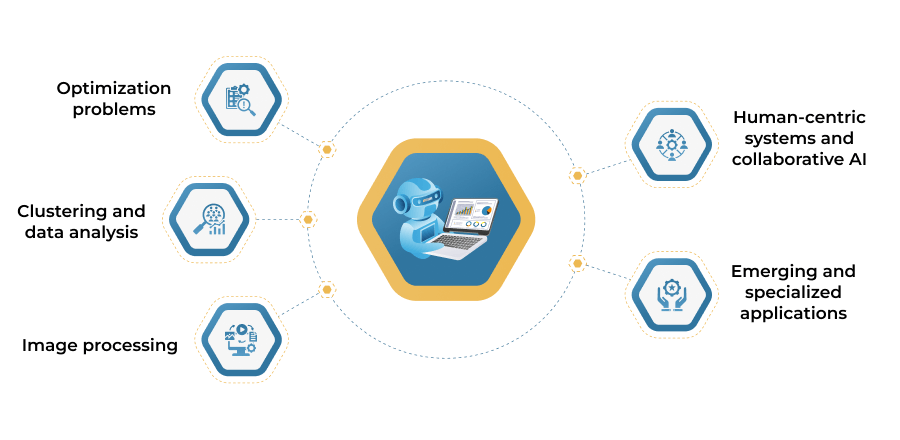
Optimization Problems
Particle Swarm Optimization (PSO): Based on the flocking behavior of birds, PSO is used to optimize continuous problems in neural network training, portfolio management, and engineering design by progressively enhancing solution candidates through iterations.
Ant Colony Optimization (ACO): Using the model of ant foraging, ACO determines shortest paths and optimal resource allocation that are indispensable solutions in supply chain optimization, route planning, and telecommunication network design.
Logistics and Supply Chains: AI algorithms following the swarm principles are used for the real, time tracking of goods, the identification of bottlenecks, and the dynamic rerouting of shipments which by far are cutting transport and storage costs.
Clustering and Data Analysis
Bee Algorithm: The performance of the method can be seen in the application fields such as customer segmentation, anomaly detection, and big data clustering where the search of a honey bee for food is simulated and data spaces are explored in a decentralized, adaptive manner.
Pattern Recognition: One of the main benefits of swarm intelligence is that it helps to find complicated correlations in huge datasets for use in fraud detection, marketing analytics, and personalized recommendations.
Image Processing
Feature Extraction & Image Segmentation: The use of swarm intelligence in the above-mentioned activities is highly beneficial, as it allows for faster and accurate processing of medical images, satellite data, and security footage through dynamic segmentation and pattern identification even in noisy and complex environments.
Pattern Recognition in Vision AI: The algorithms perform the feature optimization, which is most valuable for object detection and image classification under varying conditions.
Human-centric Systems and Collaborative AI
Sales & Marketing Optimization: Swarm AI revolutionizes the marketing process through forecasting, lead scoring, and real-time market responsiveness by synthesizing the insights of distributed data sources and expert inputs.
Customer Service: AI, based swarm systems enhance chatbot interactions by collectively learning from user behaviors so that they can provide answers faster and more accurately.
Decision Support Systems: The team intelligence gathered through swarm, enabled collaboration tools can be used more effectively for the agile and inclusive decision-making process in dynamic business environments.
Emerging and Specialized Applications
Healthcare: Swarm intelligence is one step behind the human doctor and surgeon in terms of precision and adaptation from diagnostics to surgical robots.
Smart Cities: Traffic management, energy conservation, and the distribution of resources through decentralized AI inspired by swarms.
Edge Computing & IoT Optimization: Small-scale swarm algorithms are designed for the edge devices that are capable of making quick, local AI decisions for situations that require immediate action.
Swarm intelligence is becoming a powerful AI approach for solving complex business challenges. Inspired by nature, it enables decentralized decision-making, real-time adaptation, and scalable problem-solving. Organizations use swarm intelligence to optimize operations, improve resource allocation, and build more resilient AI systems. As AI evolves, this approach will continue to drive innovation across industries.
How Swarm Intelligence Transforms AI Development
Swarm intelligence is reshaping AI through decentralized and adaptive decision-making. It helps organizations respond quickly to change, improve operational efficiency, and drive continuous innovation. Businesses that adopt this approach can unlock new capabilities and gain a sustainable competitive advantage.
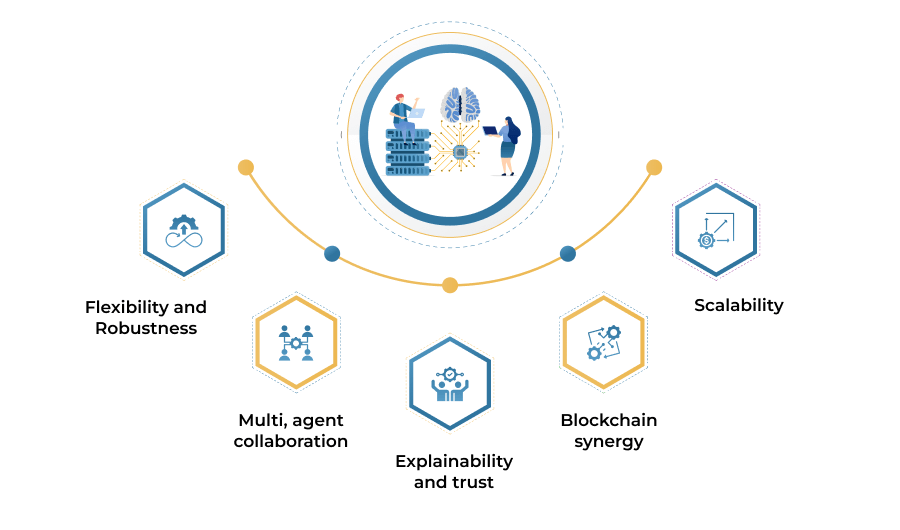
Flexibility and Robustness: Additionally, decentralized swarm intelligence adapts quickly to changing conditions without relying on centralized control. As a result, organizations improve resilience and keep operations running smoothly during disruptions, failures, or unexpected events.
Multi agent Collaboration: Furthermore, swarm intelligence enables AI agents to communicate, learn, and collaborate in real time. Consequently, organizations solve complex problems faster, accelerate innovation, and achieve better outcomes than isolated AI systems.
Explainability and Trust: Moreover, modern swarm AI models improve transparency by making AI decisions easier to understand and validate. Therefore, organizations build greater trust and support adoption in regulated industries such as healthcare, finance, and defense.
Blockchain Synergy: In addition, integrating swarm intelligence with blockchain enables secure, decentralized coordination among AI agents. As a result, organizations improve transparency, governance, resource sharing, and collaboration while supporting innovative business models.
Scalability: Finally, swarm intelligence distributes workloads across multiple AI agents to process large volumes of data efficiently. Therefore, organizations in logistics, finance, telecommunications, and smart manufacturing can maintain high performance even in demanding, real-time environments.
Swarm Intelligence: Leading Change and Innovation Across Various Industries
Healthcare and Finance: Swarm AI improves diagnostic accuracy, medical image analysis, and patient data clustering to support personalized treatment plans. In finance, it strengthens fraud detection, enhances risk assessment, and optimizes investment portfolios through continuous learning and real-time analytics.
Manufacturing and Transportation: Swarm intelligence helps manufacturers optimize production, automate assembly lines, and improve inventory management. In transportation, it enhances traffic management and autonomous vehicle coordination, reducing congestion and improving road safety.
Logistics and Supply Chain: Swarm intelligence optimizes routing, scheduling, and inventory management using real-time data. Businesses can reduce delivery times by up to 30%, lower transportation costs, and respond more effectively to supply chain disruptions. These capabilities create more agile, efficient, and resilient supply chain operations.
Future Trends and Possibilities
Swarm intelligence is shaping the future of artificial intelligence. Its rapid growth and seamless integration with emerging technologies are expanding the capabilities of modern AI systems. Together, these advancements are driving the next generation of intelligent decision-making, automation, and business innovation.
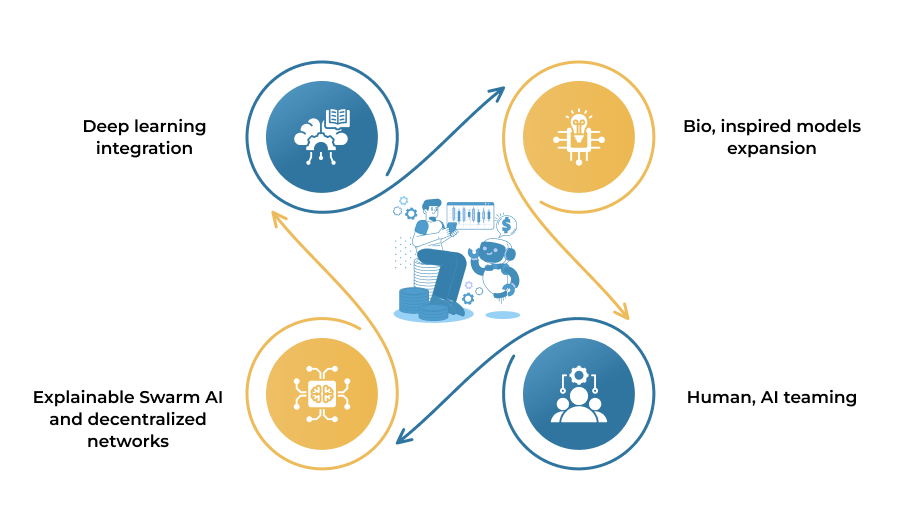
Deep Learning Integration: Combining swarm intelligence with deep learning enables AI agents to learn, adapt, and improve their performance in dynamic environments. This integration enhances applications in robotics, agriculture, autonomous vehicles, and real-time analytics.
Bio, inspired Models Expansion: Researchers are expanding swarm intelligence beyond ants and bees by studying bacteria, immune systems, and neural networks. These biological models inspire new solutions for routing, sensor optimization, fault tolerance, and distributed AI systems.
Explainable Swarm AI and Decentralized Networks: Explainable AI improves transparency by helping users understand swarm-based decisions. Combined with decentralized technologies such as blockchain, it enables secure, trustworthy, and coordinated AI systems for critical industries.
Human, AI Teaming: Swarm intelligence is evolving to combine human expertise with AI decision-making. This collaboration improves problem-solving, supports complex business decisions, and delivers better outcomes in high-stakes environments.
Together, these advancements are shaping the future of swarm intelligence. Organizations can build scalable, adaptive, and resilient AI systems that handle uncertainty, accelerate innovation, and support long-term digital transformation.
Why Businesses Should Care
Organizations should not only adopt swarm intelligence but also integrate it into their long-term AI and innovation strategies. The reason is that it allows them to have a considerable competitive advantage by being more adaptable, efficient in operations, and innovative in complicated and rapidly changing markets. By Application (Robotics, Drones, Human Swarming): Global Opportunity Analysis And Industry Forecast, 2023-2032.” The swarm intelligence market was valued at $28.5 million in 2022, and is estimated to reach $725.4 million by 2032, growing at a CAGR of 38.6% from 2023 to 2032. Such a powerful expansion is due to various leading technological and market trends.
Swarm intelligence, powered AI systems offer essential business advantages:
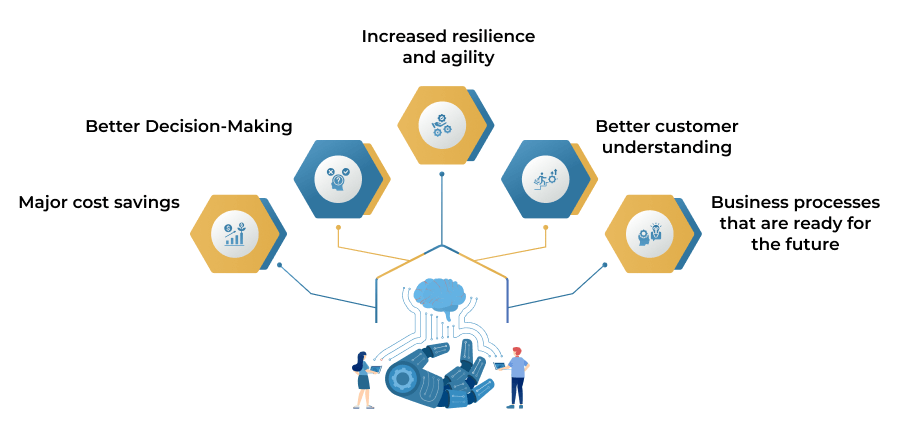
Major Cost Savings: Optimizing resource use and automating complex procedures with swarm intelligence reduces waste and lowers costs while improving efficiency by 40%.
Better Decision-Making: Swarm intelligence systems improve business responsiveness and speed up decision-making through the generation of real-time insights from the swarm-based analysis of data.
Increased Resilience and Agility: Swarm systems adapt quickly to market changes, disruptions, and unexpected events. This flexibility helps organizations maintain operational continuity and stay competitive.
Better Customer Understanding: Swarm intelligence analyzes customer behavior and identifies emerging patterns. These insights help businesses personalize experiences, strengthen customer relationships, and improve marketing performance.
Business Processes That Are Ready for the Future: swarm intelligence combined with scalable and innovative AI systems allows businesses to undergo an accelerated and innovative phase of digital transformation by making their processes more intelligent, adaptive, and ready for the future.
Swarm intelligence helps organizations strengthen decision-making, improve operational agility, and maintain a competitive edge in the digital economy.
Conclusion
Swarm intelligence enables the design of AI systems that integrate four attributes: decentralization, adaptability, and collaboration. Organizations can design AI systems that facilitate swarm intelligence to enhance their decision-making frameworks. Manufacturing, logistics, and even healthcare can benefit from the powerful agility and scalability of swarm intelligence. Organizations must also be willing to invest in new technologies that enable continual swarm intelligence features. Investing in swarm intelligence will yield rewards such as sustaining innovation to advance the organization.
What Is Swarm Intelligence?
Swarm intelligence stands for the ant, like behavior of a communality of small, distributed, leaderless, problemsolving units using only simple, local, and direct interactions. The notion comes from the observation of the nature, for example, of cellular societies of ants or bee hives.
How Does Swarm Intelligence Help AI Development?
With swarm intelligence, AI becomes a system of many small, socially interacting agents (or multi, agent system). As the work of decision is shared among the agents who cooperate, they become more scalable, robust, and highly adaptive. So the AI improves its real, time responsiveness and is able to handle difficult scenarios which are evolving all the time.
What Sectors Use Swarm Intelligence?
The use of swarm intelligence has penetrated the sectors of logistics, health care, finance, manufacturing, transportation, and marketing. Here the technology is part of the companies commitment to enhancing optimization, decision support, automation, customer insights, and operational efficiency.
How Is Swarm Intelligence Useful in Logistics?
The introduction of swarm intelligence in the supply chain management repertoire makes routing, scheduling, and inventory management optimization possible through real, time adjustment. Delivery times are, therefore, shortened by up to 30%, and there is a massive drop in operational costs.
Can Swarm Intelligence Make Supply Chains More Resilient?
Swarm networks increase supply chain agility through the use of decentralized and adaptive actions in response to disruptions and hence support the supply chain in going on with continuous operations even if there are unexpected challenges causing the supply chain to be disrupted.
What Is the Role of Swarm Intelligence in the Medical Field?
Swarm AI technologies are implemented in healthcare to enhance the diagnostic capabilities, medical image analyses automation, and facilitate patient data clustering, in this way, enabling the creation of personalized treatment and raising with healthcare the level of service.
How secure is swarm intelligence against cyber threats?
Swarm systems offer robust anomaly detection and collective defense mechanisms, continuously learning to identify and respond to emerging cybersecurity threats.
Quickly scale your development capabilities by hiring pre-vetted tech experts who align perfectly with your project goals, timeline, and company culture.
What to expect after you reach out?
1. Share Your Requirements
Tell us your project goals, tech stack, and resource needs for a perfect talent match.
2. Talent Shortlisting
We screen and shortlist top-tier professionals based on your exact technical and cultural fit.
3. Interview & Selection
You interview the candidates and select the ones that align with your expectations and company values.
4. Onboard & Integrate
Seamless onboarding process to ensure smooth collaboration with your in-house team from day one.
5. Monitor & Scale
We assist with performance tracking and help you scale the team as your project evolves.