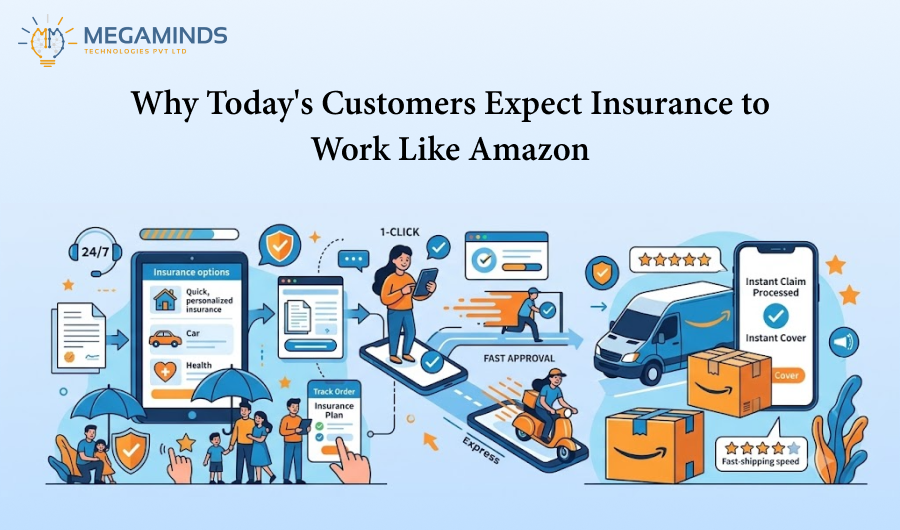
Why Today’s Customers Expect Insurance...
12 Oct 2026


Insurers have to deal with a lot of different difficult situations at the same time. While IT teams are struggling with too many priorities and too few resources due to the combination of changing customer expectations, compliance requirements, and digital transformation goals, all departments from claims to underwriting are asking for faster, more reliable applications. However, traditional development cycles are slowing everything down.
So, what is the outcome? Employees are losing opportunities, getting frustrated, and customers do not receive responses on time. The gap between IT’s capabilities and business needs is getting bigger as insurers are racing against time to provide accurate and quick services, thus, the difference between what IT can deliver and what the business really needs is widening. Luckily, there is a future ready solution that offers agility without giving up control: Microsoft Power Apps.
Technology backlogs have, without much noise, become one of the biggest bottlenecks in the insurance industry over the last couple of years.
Every business unit is asking for a new tool to make the work process more efficient claims want automation, underwriting wants smarter analytics, compliance wants better reporting but the IT department’s list of things to do is already very long.
As per Gartner, more than 80% of large companies have an increasing backlog of their application portfolio, and Financial Services lead that list. Projects accumulate faster than the completion rate, thus innovation is postponed by months, or even years. As a matter of fact, digital first insurtech startups are operating at a totally different pace, i.e., building new apps in a matter of weeks, instead of quarters, and attracting customers who are in immediate need.
The widening gap between demand and delivery is not solely an IT problem, rather it is a strategic risk. Each delay results in lost revenue opportunities, lowered customer satisfaction, and employees getting frustrated because they have to work with outdated tools.
Let’s analyze the factors that are really causing this digital standstill: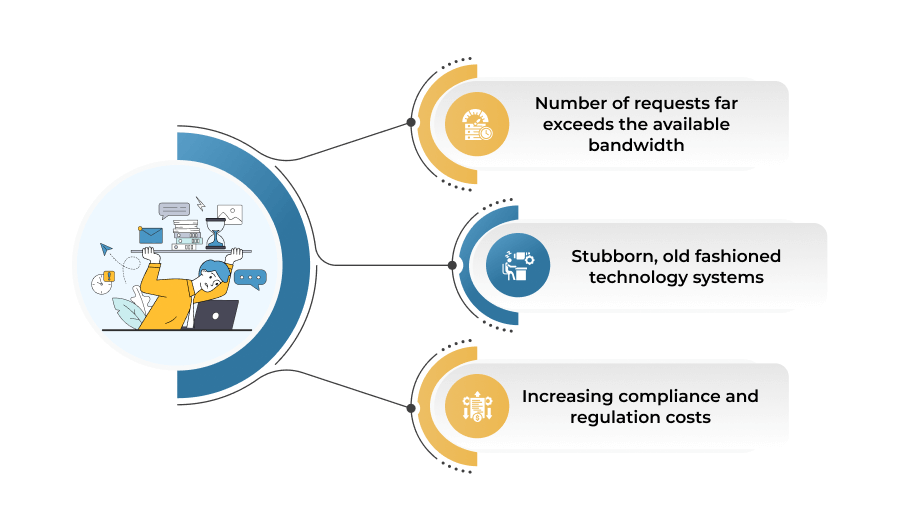
The needs of contemporary consumers, who require quick quotes, real-time claims updates, and personalized insurance recommendations, just cannot be met by traditional development. Structured software planning used to take 12 months, but it now takes 12 days or less. But the earlier model was not designed to have that degree of agility.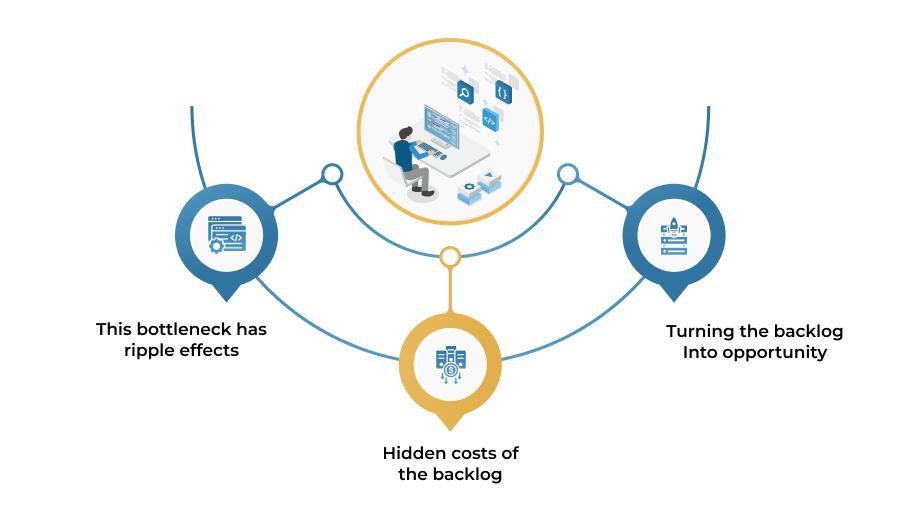
Beyond lost time, many insurers ignore a financial aspect. Every project that is delayed stands for:
Businesses with persistent IT backlogs face more than delays; McKinsey highlights that legacy systems, accumulated technical debt, and slow IT delivery significantly constrain operational efficiency and limit overall business value creation.
Here’s the truth: the backlog challenge isn’t a dead end it’s a wake-up call for transformation. It points to a fundamental shift in how digital work gets done. Instead of treating IT as a gatekeeper, insurers must empower the business side to become active co-creators of solutions.
That’s not a futuristic vision it’s happening right now with low-code platforms like Microsoft Power Apps. They’re redefining what “capacity” means by multiplying productivity across the entire organization.
For dependability and control, traditional app development has long been the gold standard. But in the insurance sector, where speed, automation, and client experience are crucial, that paradigm is growing out of date. Even a simple internal tool might take months to plan, code, test, and implement. Regulations and consumer expectations might have changed by the time it launches.
IT departments in the insurance industry are under increasing pressure to accomplish more with less, but the waterfall methodology compels them to use time-consuming, sequential procedures. It’s similar to attempting to operate a sports car while the handbrake is locked.
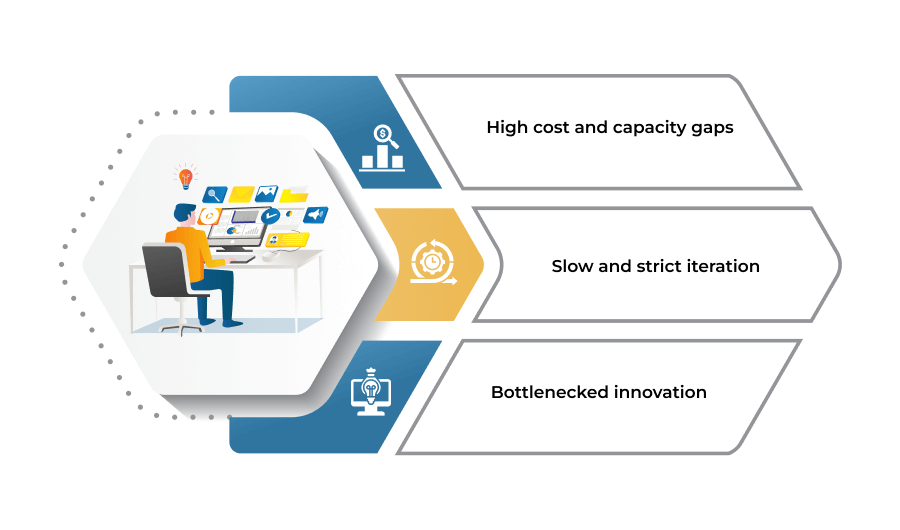
Companies that use low-code platforms report up to 90% faster development and 40% lower costs than those that use traditional programming.. This speed immediately affects competitiveness for insurers in addition to increasing efficiency.
Faster app development results in proactive underwriting, real-time agent help, and quicker claims turnaround the kind of responsive experience that consumers today expect from every engagement. The message is very clear: an agile alternative is more important than ever because traditional development cannot keep up with the modern insurance ecosystem.
Low code platforms like Microsoft Power Apps are rewriting the way rules are set for corporate software development. With Power Apps, which features drag and drop interfaces and prebuilt templates, teams can build scalable applications that require no complex coding thereby making the delivery of applications much faster and less time consuming.
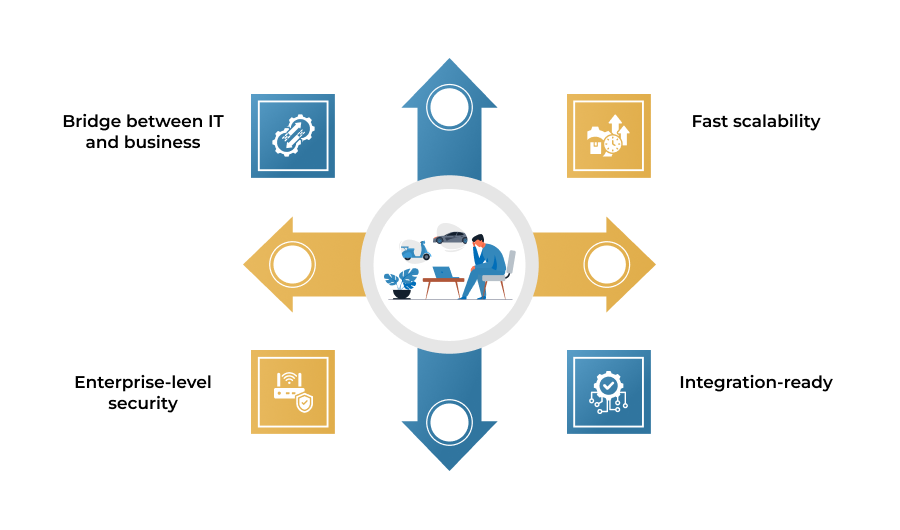
The outcome? With automation taking care of the tiresome manual work that previously slowed down processes, decisions that used to take weeks to make are now made in real time.
Every insurance company has unseen innovators: the sales managers who envision a more efficient lead flow, the underwriters who envision quicker risk models, and the claims specialists who identify process flaws. However, these same individuals lack the resources necessary to realize their ideas in the majority of conventional arrangements. The outcome? While the backlog continues to build, brilliant ideas perish in inboxes.
Power Apps drastically changes this narrative. Using straightforward drag-and-drop tools, it enables non-developers those closest to the issues to create robust, safe apps. There are no technical obstacles or protracted coding cycles just business logic and creativity in action.
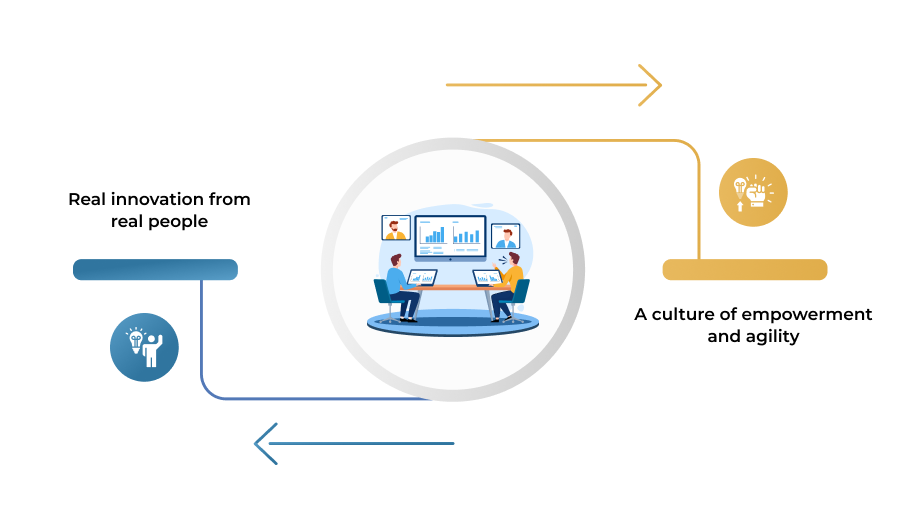
These are business-critical products that were created in a couple of days rather than months; they are not side projects. The IT department can assist the task rather than postpone it when front-line staff members solve their own problems.
Consequently, this shift in the organization’s operations has a significant effect on how the business views the potential of digital innovation.
The influence goes far beyond technology. Innovation is everyone’s responsibility when every employee is enabled to create. Departments change at a faster pace, teams collaborate more, and digital transformation is no longer a project initiated from the top but rather a shared goal.
Companies using this strategy usually experience positive changes in employee morale and productivity. Employees perceive that their voices are heard, they are valued, and they are empowered to make a change. The development of apps only is not as important as giving people the opportunity to fully develop their potential.
Many insurance organizations still depend on manual, repetitive workflows. Highly skilled employees spend valuable hours on policy documentation, claims adjudication, and client onboarding. Re-entering data, performing duplicate checks, and completing compliance verification slow productivity. This prevents teams from focusing on innovation, customer service, and strategic decision-making.
In such a case, AI Builder, Power Automate, and Microsoft Power Apps are the main tools. They are a single intelligent digital workforce that is capable of learning, adapting, and completing daily duties faster and more accurately than before as they work together. The organization changes from a series of simply automated procedures into an efficient, uninterrupted flow.
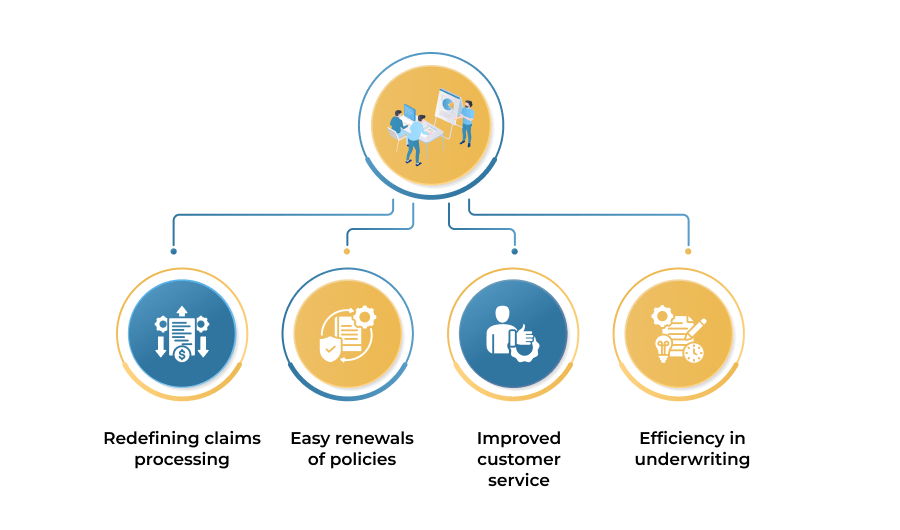
Automation in insurance is about more than just cutting down on work; it’s about enabling adaptability. When every process is automated, workers may focus on challenging claims, customer relations, and strategic innovation instead of data input and emails.
Executives recognize the results that automation produces. Insurers using AI-driven automation and low-code:
And what’s best? ROI is apparent weeks after deployment rather than years away. Power Apps generates quantifiable company value by automating all repetitive processes.
Automation has become the silent force driving competitive advantage. Customers now judge insurers by their speed, accuracy, and service quality. With Power Apps, organizations redesign how work gets done instead of simply streamlining existing processes.
Claims, underwriting, sales, and compliance are all handled by different systems in insurance companies, which frequently operate in silos. Decision-making is slowed down and collaboration is hampered by this fragmentation. By centralizing access via the Microsoft Dataverse and associated connections, Power Apps modifies that.
Power Apps guarantees that no data is lost during transitions and that all departments use the same digital language by integrating everything, even Excel sheets and Azure SQL databases.
Global insurers and brokers are already leveraging Power Apps to disrupt their processes.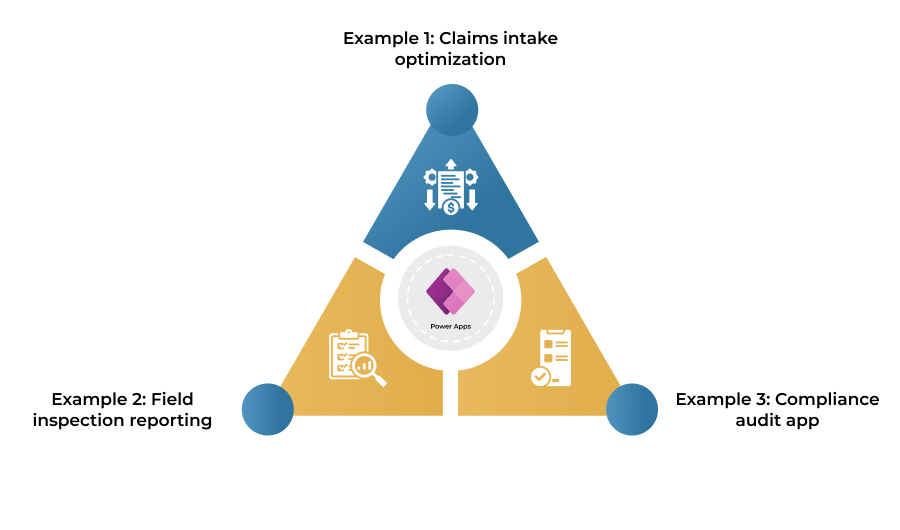
A vintage claims intake portal was replaced with Power Apps by a European insurance provider. A cross-functional team used Power Apps to reproduce what took IT six months to prototype in just two weeks. The outcome was an automated, mobile-first procedure that cut the time it took to enter a claim by 60%.
An American property insurance company deployed a Power Apps–based inspection tool with GPS and image recognition for its field assessors. Field teams created reports on-site, synchronized them instantly with headquarters, and stored them in SharePoint. As a result, the company reduced paperwork time by 50%.
By integrating Power Apps and Power Automate, a worldwide insurance company created a compliance management tool to shorten the internal audit process. The division enhanced real time visibility by moving away from scattered email based submissions to a unified digital platform.
All these cases are just the different ways of the same concept: cooperation between IT and business teams empowered by low code tools results in improved business outcomes due to increased speed, simplicity, and scalability.
The leaders in insurance modernization stand out because they innovate faster and make better decisions. Traditional development approaches can no longer keep pace with growing digital demands. Microsoft Power Apps enables organizations to build business applications quickly, reduce development time from months to hours, and connect data seamlessly across systems.
The future of insurance depends on digital, automated, flexible, and data-driven operations. Organizations that adopt Power Apps today will set the standard for faster innovation, greater efficiency, and smarter decision-making in the years ahead.
Get in touch with us right now to find out how Power Apps can transform your insurance business.
12 Oct 2026

08 Oct 2026
05 Oct 2026