From Manual Processes to Smart...
22 Oct 2026


Manufacturers are encountering several new challenges, namely supply chain interruptions, shortages in workers, changes and increases in customer demands, and a growing focus on sustainability. Historically, manufacturing enterprise systems are unable to meet the flexibly required to counter these quick shifts in the market. Microsoft Power Apps provides the ability to build customized applications, refine processes, and equip workers with the data needed for the essential tasks. For these reasons, companies are advancing their digital capabilities at a rapid pace and maximizing productivity, all while remaining within budget and managing the intricacies of the manufacturing process.
With the advancement in manufacturing, companies are learning the value of flexible digital systems that are attention span adaptable. Microsoft Power Apps assists less technical employees and software developers to construct unique applications with very little programming. As a result, manufacturing companies are able to quickly alter the way the business runs.
Legacy applications and unreliably interconnected systems and manual processes hinder many manufacturers. Microsoft Power Apps provide manufacturers with a way to build low-code applications that integrate with Microsoft technologies like Azure, Dynamics 365, and Microsoft Teams. Using Microsoft Power Apps, manufacturers have better optimization of processes, better collaboration, and are more responsive to changes in the business and production environment.
Main advantages include: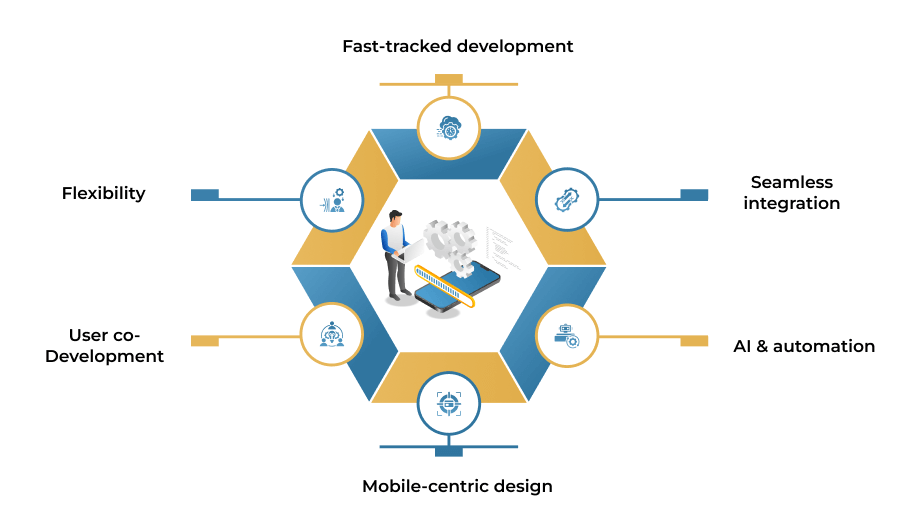

Workforce Management: Driving Productivity and Compliance
Companies rely on skilled flexible workers who can operate across shifts and locations effectively. Power Apps can provide customized workforce management solutions that digitize scheduling, attendance, skills tracking, and performance management – creating visibility and agility. Features include:
Example: An OEM for the automotive sector reduced overtime by streamlining shift swap workflows using Power Apps, which allowed for increased productivity during periods of high demand.
Equipment breakdowns bring a chain of events starting with production delays and ending up with a reduction in company profits. Power Apps is a great tool that allows manufacturers to create easily integrated maintenance management apps which can facilitate complete asset tracking and preventive maintenance processes:
For instance, an electronics manufacturer built a CMMS using Power Apps, which was able to bring down the machine stoppages unintentionally by 18%, equating roughly a $2 million annual savings.
Especially for manufacturers in pharma, aerospace, automotive, and food processing, quality assurance and regulatory compliance matter a lot. Many organizations use slow, disconnected, or paper-based systems that hurt the auditing process, accuracy, and traceability. Microsoft Power Apps can help modernize quality and compliance for manufacturers. It aids the building of custom applications that integrate quality management systems and provide data and process visibility in real time.
Manufacturers endure multiple challenges during quality auditing including::
This increases operational risk which can lead to fines, recalls, and long-term damage to the brand.
To remain competitive, manufacturers need agile digital solutions that can adapt to changing business requirements and regulatory standards. Microsoft Power Apps enables organizations to build custom, scalable applications that integrate with existing manufacturing systems. Consequently, manufacturers can streamline operations, improve productivity, and accelerate digital transformation in a cost-effective way.
Flexibility:The use of Power Apps developed specifically for the manufacturer identifies solutions that well-suit his/her firm’s manufacturing processes. Be it adjusting for the products’ variation, complicated maintenance routines, or additional requirements, apps constructed with Power Apps offer the customers one-of-a-kind flexibility. This flexibility gives the team a new opportunity to implement quick changes in the process, still, they should not be dependent on the assistance of a developer and the IT staff while they maintain operational efficiency and compliance.
Speed:The creation of the Power Apps allows a lot of the time that is usually spent in the development process to be cut down, so businesses can go from having an idea to the implementation in a matter of weeks, not months. The low-code platform enables IT and business users to prototype, test, and improve their applications at a rapid pace. The rapid application delivery is what allows such fast solving of the problems, and it also gives manufacturers a chance to react to the market changes much faster.
Cost Efficiency:Power Apps are apps that are developed in such a way that they use the least IT resources and at the same time, they are less dependent on expensive custom software projects. Automation of manual, paper-based processes is one way that labor and error costs are lowered. The continuous Microsoft updates along with cloud-hosting have the effect of further lowering maintenance costs, and thus, the return on investment is improved at a much smaller part of the cost of traditional development.
Workforce Empowerment:One of the benefits of Power Apps is that it makes the staff that is on the frontline which in turn leads to their increased motivation and higher levels of productivity as they get customized digital tools that are created especially for them and that can be found on their mobiles. The use of role-specific apps accelerates an employee’s engagement with his/her team and supervisor as the execution of tasks becomes faster, and the accuracy of data is increased. Employee empowerment is the main factor that leads to operational excellence and the increase of innovation speed.
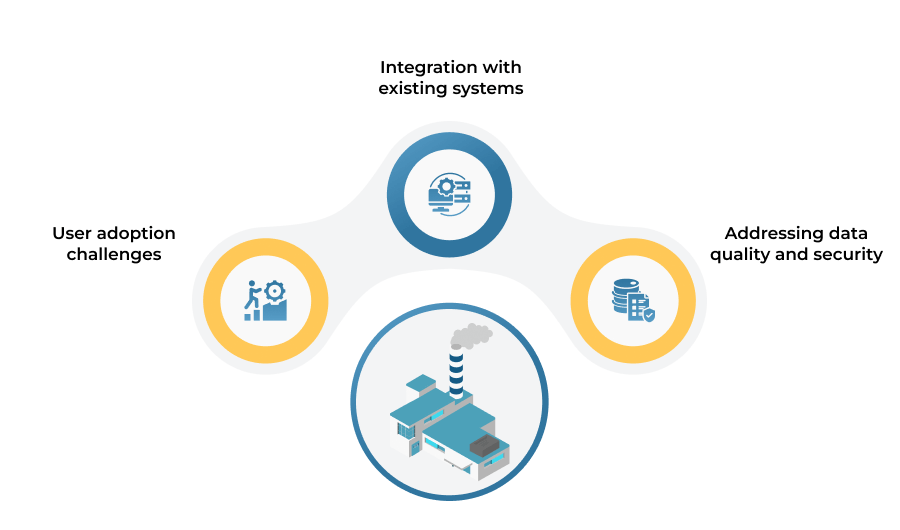
Power Apps can accelerate digital transformation in manufacturing, but successful implementation requires organizations to address user adoption, system integration, and data governance challenges.
User Adoption Challenges
An impressive, digital solution is practically useless if it is not supported by effective user adoption, especially in production facilities where employees may oppose the changes or are not used to the technology. Fears about complexity or the chance that the technology might take their jobs are just some of the reasons why workers who are accustomed to manual processes or old systems find it hard to accept digital applications. Designing Power Apps with role-based, user-friendly, simple-to-understand interfaces that lower the learning curve and ensure that apps really help employees in their daily activities without increasing their workload is the most important step toward overcoming resistance. Early involvement of frontline employees during app development also builds trust and results in solutions that better meet operational needs. In addition, continuous training and clear communication help create a culture where technology is viewed as a tool for empowerment rather than a threat.
Integration with Existing Systems
Legacy ERP, MES, and SCADA systems often operate independently, creating disconnected processes and fragmented data. Microsoft Power Apps integrates with these systems through Microsoft Dataverse, Power Automate, and hundreds of pre-built connectors. As a result, manufacturers can synchronize data in real time, streamline workflows, and improve collaboration across business and production teams while protecting existing technology investments.
Addressing Data Quality and Security
Maintaining accurate and secure manufacturing data is essential, particularly when collecting information from sensors, machines, and production lines. Manufacturers should implement strong data governance, validation rules, role-based access controls, encryption, and regular security audits. Partnering with experienced Power Apps professionals also helps organizations build secure, scalable, and compliant applications that support reliable manufacturing operations.
Best Practices for Successful Adoption
Successful Power Apps implementation depends on combining technology with effective change management, seamless system integration, and strong data governance. By following these best practices, manufacturers can maximize user adoption, improve operational efficiency, and achieve long-term digital transformation.
Microsoft Power Apps has numerous benefits for manufacturing that extensively test their impact in productivity and generate observable business results. These are a few business examples that highlight how Power Apps is revolutionizing workflows across diverse manufacturing industries.
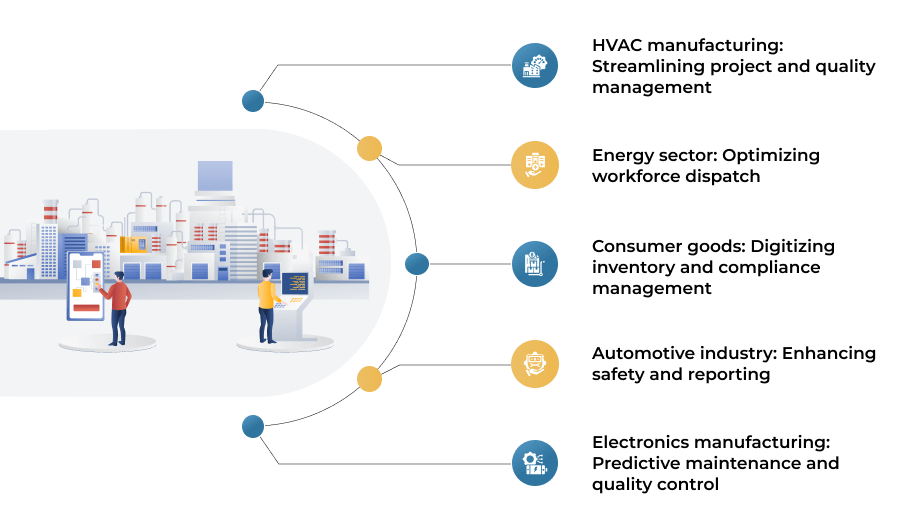
Microsoft Power Apps is helping manufacturers across industries digitize operations, improve productivity, and streamline complex business processes. The following real-world examples demonstrate how organizations are using Power Apps to solve operational challenges and accelerate digital transformation.
1. HVAC Manufacturing: Streamlining Project and Quality Management
Customer Air Products & Services, Inc. (CAPS), a Houston-based HVAC manufacturer, modernized its operations using Microsoft Power Apps to manage complex projects and improve quality control. The company replaced manual, paper-based processes with a digital platform that integrated quality assurance, project management, and root cause analysis. As a result, teams gained real-time visibility into project data, received instant alerts for quality issues, and improved collaboration. This digital transformation reduced workflow delays, improved on-time project delivery, and increased customer satisfaction.
2. Electronics Manufacturing: Predictive Maintenance and Quality Control
Going for predictive maintenance, the electronic manufacturer combined Power Apps with IoT sensor data. Technicians get automated alerts about equipment abnormalities directly on their mobile devices, and prompt actions are taken before costly failures occur. On the other hand, the company deployed mobile apps to digitalize quality control checks, which brought fewer defects, faster audits, and delighted customers. Without the predictive maintenance program, which alone accomplished the reduction of downtime by 18%, the strategic impact of Power Apps would not have been so visibly proven, and millions of dollars yearly would not have been saved.
3. Energy Sector: Optimizing Workforce Dispatch
Canadian energy company TransAlta used Microsoft Power Apps to optimize technician scheduling and field service operations. Its “Economic Callouts” application identifies the most cost-effective technician assignments for maintenance tasks during non-working hours. As a result, the company reduced unnecessary overtime, optimized technician routes, and recovered its development investment within two weeks of deployment. This case demonstrates how customized Power Apps solutions can deliver measurable business value, even in large and complex operational environments.
4. Consumer Goods: Digitizing Inventory and Compliance Management
The Japanese consumer goods company Kao Corporation was facing the problem of manual inventory systems that were not only old but also heavily dependent on paper forms for raw material management, chemical storage, and regulatory compliance. A non-developer in the organization built an internal inventory management system using Power Apps, which centralized the data and automated the compliance workflows. The net saving in time was more than 480 monthly work hours, and process efficiency was greatly enhanced. This showcases how Power Apps empower employees at all organizational levels to initiate significant digital transformation.
5. Automotive Industry: Enhancing Safety and Reporting
Top automakers such as Toyota and Rolls-Royce extensively employ Power Apps for manufacturing floor operations, particularly for safety management and employee issue reporting. The companies improved safety compliance, accelerated issue resolution, and enhanced data accuracy by digitizing safety audits, incident reporting, and maintenance tracking through mobile applications. In addition, leadership teams gained real-time visibility into operational and safety metrics, enabling faster identification and mitigation of workplace risks.
Artificial intelligence (AI) and Microsoft Power Apps are transforming the future of manufacturing by enabling smarter, data-driven operations. Power Apps has evolved from a low-code development platform into an AI-powered solution that helps manufacturers build intelligent applications with greater speed and flexibility. As a result, organizations can automate complex workflows, predict operational needs, and gain real-time, actionable insights to improve productivity and decision-making.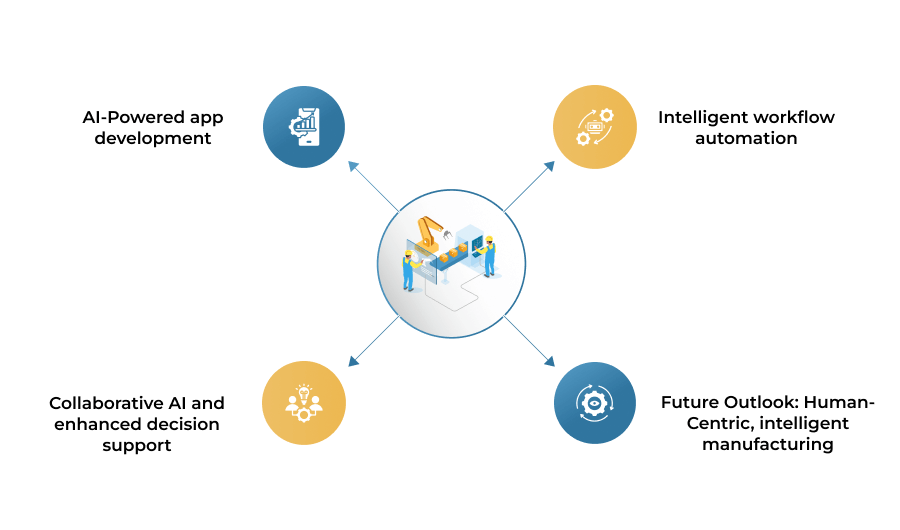
Power Apps is an AI-first platform that enables business users to create application prototypes using simple text prompts, eliminating the need for traditional coding. Built-in AI capabilities, including Microsoft Copilot, accelerate application development and simplify the entire process. As a result, developers spend less time on repetitive tasks while improving application quality. Furthermore, AI continuously enhances applications by recommending workflow automations, UI improvements, and formula corrections throughout the development lifecycle.
Manufacturers can automate key operational workflows by combining Power Apps, Power Automate, and AI Builder. Predictive maintenance applications use AI and IoT sensor data to detect potential equipment failures before they occur. As a result, maintenance requests are generated automatically, reducing downtime and maintenance costs.
Furthermore, AI-powered quality inspection applications identify defects in real time by analyzing production images. In addition, AI-driven workforce scheduling optimizes shift planning based on production demand, employee availability, and historical data. Consequently, manufacturers improve productivity, quality, and overall operational efficiency.
Moreover, AI in Power Apps improves collaboration between management and frontline employees while simplifying everyday operations. AI-powered assistants provide intelligent recommendations, identify potential risks, and automate routine decisions. For example, embedded AI chatbots guide users through workflows and instantly answer operational questions. As a result, organizations reduce training time, improve employee productivity, and resolve issues more efficiently.
Industry 5.0 builds on Industry 4.0 by combining AI, automation, and human expertise to create smarter, more sustainable manufacturing. Rather than replacing people, AI empowers employees with intelligent tools that improve decision-making, productivity, and innovation. Power Apps supports this transformation by enabling digital workflows, real-time collaboration, and AI-driven applications. As a result, manufacturers can strengthen operational efficiency, improve governance and security, and build more resilient and future-ready operations..
In 2025, manufacturers must become more agile, innovative, and digitally connected to remain competitive. Custom Power Apps provide flexible, scalable, and cost-effective solutions for modern manufacturing operations. They help digitize workforce management, equipment maintenance, and quality control processes. Furthermore, AI integrated with factory systems streamlines operations, improves productivity, and delivers predictive insights for smarter decision-making. However, achieving these benefits requires the right technology partner and a well-planned implementation strategy.
19 Oct 2026
15 Oct 2026