How AI and Smart Manufacturing...
19 Oct 2026

Insurance can be confusing for customers because most people don’t know how their policy will respond in different scenarios. While purchasing insurance may be a straightforward process, the details of the actual policy can be very complicated, as they include almost impenetrable technical language, terms and conditions, exclusions, and limitations. Most customers find this very difficult to interpret and process.
When customers are faced with a claim, they begin to realize the complexities of their policy, such as deductibles and exclusions, which they previously assumed they understood. Perceived understanding of insurance policies, coupled with the dissatisfaction of having to face the impenetrable policy language when attempting to make a claim creates a frustrating experience.
Insurance is complicated by design and extremely difficult to process for the average customer. Insurance is by definition a covenant to protect against a myriad of risks, and the more the insurer tries to protect against multiple risks, the more complicated the policies become.
The scale of the problem is measurable. The 2026 TIAA Institute–GFLEC Personal Finance Index found that U.S. adults answered only 47% of basic personal finance questions correctly the lowest result in the study’s ten-year history. Of the eight areas the index measures, comprehending risk is the weakest: just 36% of risk questions were answered correctly, and that number barely improves with age. Risk comprehension is the exact skill insurance asks customers to exercise.
Today’s consumers expect fast, simple, and transparent experiences across all industries. Insurance is no exception. PwC’s 2025 Customer Experience Survey, based on 5,511 consumers and 406 executives, found that 52% of consumers stopped buying from a brand because of a bad product or service experience, and 29% walked away specifically because of poor customer experience. PwC’s earlier and widely cited Experience Is Everything research put the headline number at 73% of consumers naming experience as an important factor in their purchasing decisions still true directionally, but the 2025 data is what to lead with.
Understanding the insurance product remains one of the most difficult experiences in personal finance.
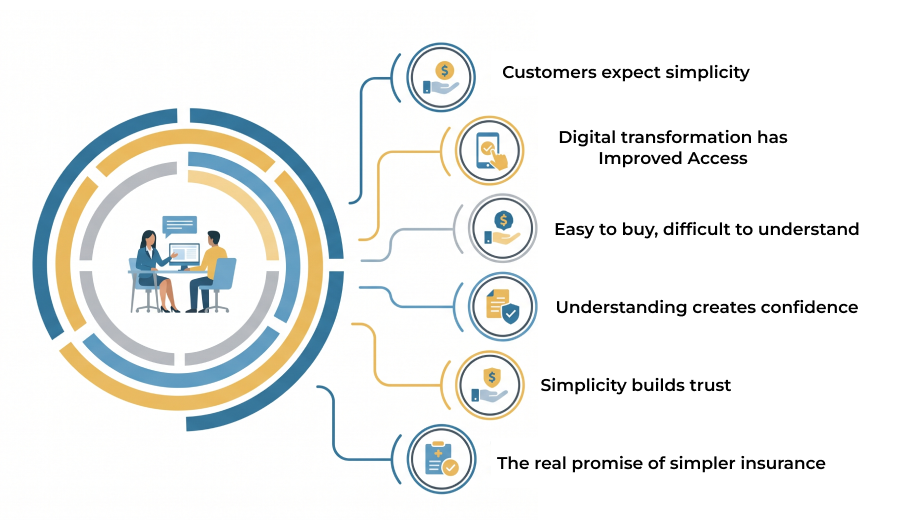
Many insurers think that after customers buy a policy, they are content. But buying a policy is very different than understanding a policy.
Financial confidence comes from knowing the answers to these questions:
Most people do not have this knowledge. This is why customers are still nervous, even after they pay their premium.
Consider a small business owner who buys commercial insurance. They may think they are covered for all operational risks. But they may have a big surprise when they find out they have a coverage gap for cyber, supply chain, or some other type of liability. This loses the customer’s confidence and creates a negative perception of the insurer.
Insurance companies should focus on education and transparency. This way customers will know they are truly protected and not just paying a premium.
One of the most difficult obstacles customers must overcome is determining the real value of the benefits offered with their policy.
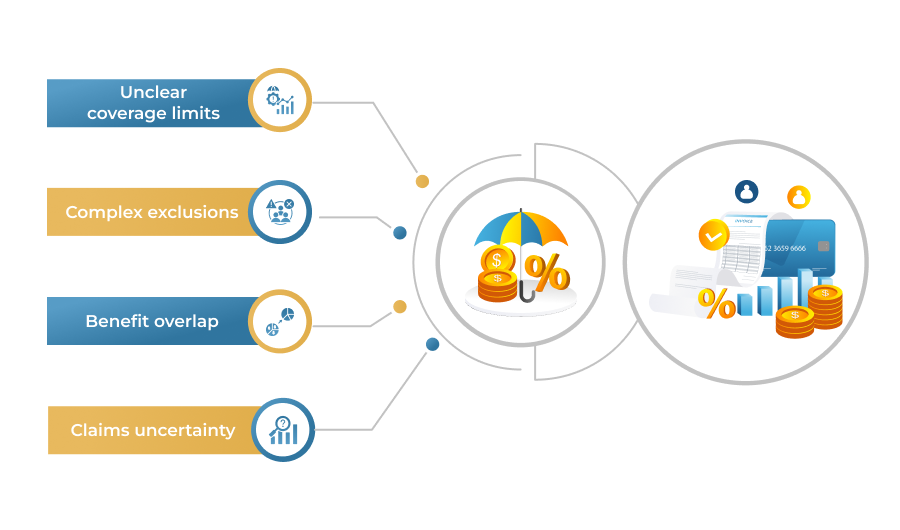
With so many pages devoted to detailing benefits and policy provisions, riders, endorsements, and exclusions, policy documents can be very long. While this information is put there for legal purposes, it can be very user-unfriendly.
Common frustrations include:
Insurance companies like to commodify insurance policy aspects like limits, add-ons, premiums, and types of protections. While customers consider these aspects, they tend to overlook these extremely broad and vague concepts, especially when it comes to insurance.
For insurance customers, the settlement’s simplicity is key: Will my family be financially complete? Will my business be able to bounce back? Will there be a helping hand in my moment of need? These questions give you more closure than jargons ever could.
Communicating the aspects of a policy leaves customers hanging on the true worth of the insurance they purchased, because these companies tend to focus on policy results rather than the financial aspect.
The companies that do the best at this clearly communicate how their insurance solves the important, real problems in their customers lives and the insurance companies provides the protection from their customers allowing them to be financially sound and offering them peace of mind.
It’s as important to insurance companies to give customers a real perspective on the importance of the insurance offering peace of mind as it is to bring a real profit. Stronger relationships and more loyal customers with greater trust and confidence are the result.
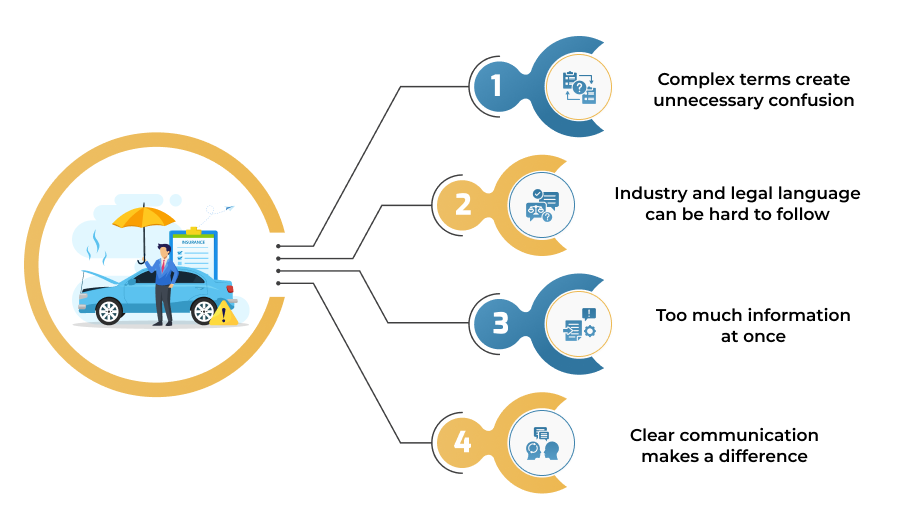
Insurance should not resemble a secret code. In the modern market, consumers want to know the answers to their questions and want their decisions validated. To satisfy their customers, insurance companies must adopt a more human-centric approach to reduce the confusion.
Insurance does not need to be complicated. It can be deemed simple and easy to understand when explained in plain language, along with the use of visual aids and real-world examples. Technical jargon should be avoided as much as possible. It is important that insurance companies explain how the coverage will help protect the insured when it is needed most whether it be on the family, finance, or business.
This approach should be extended to involve the means of communication that are proactive and targeted so that the unique, specific needs of each customer are met.
Cumulatively, these elements will satisfy the customer. The insurance companies will gain a customer for life and have elevated trust and satisfaction gains.
People want insurance that’s easy to understand. But let’s be honest—making insurance simple isn’t as easy as it sounds. Insurers have a lot to juggle: they need to keep things clear, stay accurate, and handle all sorts of industry headaches.
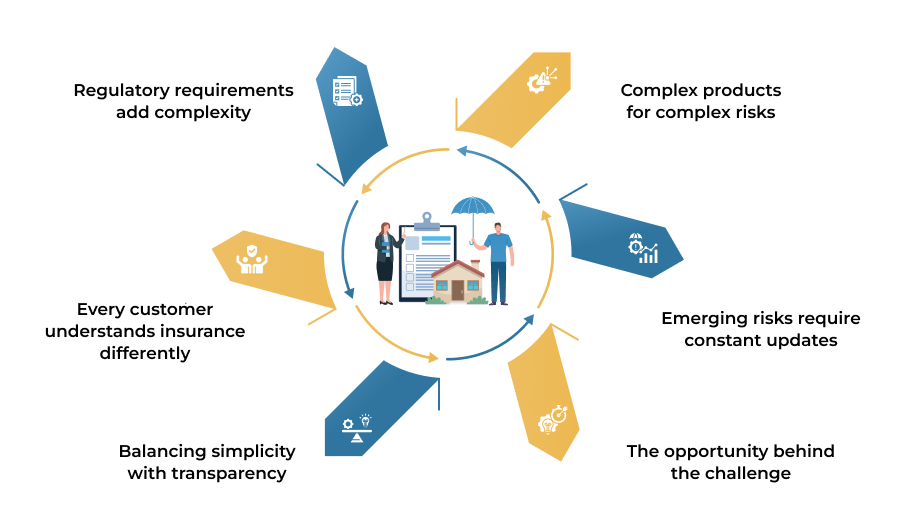
Customer-friendly insurance experiences not only benefit the insurers but also the policyholders. Here are some of the ways that such experiences can make a positive impact:
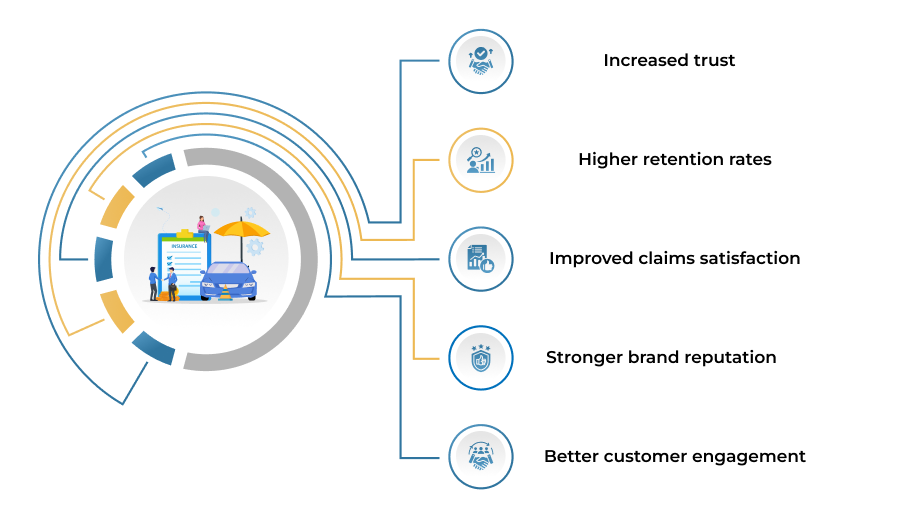
The Future of Clear and Personalized Insurance Services
Technology driven personalization will change the face of insurance. In the not too distant future, insurance companies will be able to generate personalized suggestions based on individual data using new technologies.
Some examples of new insurance technologies may include the following:
As customers become accustomed to more and more personalization, insurance companies that become more transparent will experience faster growth over their less transparent competitors.
The leading insurance companies will move beyond transactions and provide insurance coverage in a way that allows their customers to manage and reduce risk.
Insurance policies should instill confidence, but complicated terms and lack of available support cause more uncertainty for consumers regarding their policies.
For insurers, this creates an opportunity to build greater confidence through greater clarity, transparency, and customized support. Customers do not ask for more features; they want to understand how the offered features protect them in a given, real world situation.
Insurance companies that simplify their insurance products and services and meet their customers needs will be able to shift their customers’ confidence from being uncertain to being certain. Insurance companies will be able to add their customers’ trust to their clients’ lists and enhance customer loyalty.

19 Oct 2026
15 Oct 2026
12 Oct 2026