In the fast-paced world of modern manufacturing, OEMs are desperate for novel methods of higher efficiency, lower costs, and better competitive levels. So far, the fusion of digital transformation technologies-from Digital Twins to Business Intelligence Systems such as Power BI-has the potential to be greatly rewarding. This blog underscores ways OEMs can leverage the analytical capabilities of Power BI to unleash the full potential of their Digital Twin implementations and thus transform operational insights and strategic-level decision-making. We discuss key concepts, benefits, and implementations that allow businesses to excel under Industry 4.0.
The digital twin market is experiencing explosive growth, expanding from $21.01 billion in 2024 to an expected $29.06 billion in 2025, representing a staggering 38.4% compound annual growth rate. This exponential expansion reflects the critical role digital twins play in modern manufacturing operations, where more than 52% of manufacturers are actively investing in digital transformation technologies.
Competitive Pressures Demanding Innovation
The current manufacturing environment is unlike anything ever seen before and cannot be addressed through conventional means. Supply and distribution challenges apart, OEMs are confronted with:
Being resource-constrained due to talent shortages and supply chain challenges now becoming a norm
Heightened customer demands for quicker delivery, superior quality, and customization options
An ever-fluctuating market demanding fast adjustment as per altered demand patterns
Operational intricacies-allied around global supply chains and distributed manufacturing networks
What is a Digital Twin, and Why Does It Matter for OEMs?
Consider an OEM manufacturing complex machinery. The digital twin of the machine receives data concerning the parameters of operation of the machine, environmental conditions, and wear and tear. This virtual representation enables engineers to:
Monitor Performance: Benchmark tracking of KPIs in real-time to identify incidences when the product deviates from optimal functioning.
Predict Failures: Use the data from past failures and the conditions of the present working state of the equipment to predict when it is most likely to fail so that preventive maintenance is encouraged.
Optimize Operations: Through simulation of various situations, ascertain those operating parameters that consume less energy but ensure maximum output.
Improve Design: Use feedback from the field to improve a subsequent product design so as to produce more sturdy and efficient machinery.
Enhance Customer Service: Offer remote services that include diagnostics and predictive maintenance, thus ensuring near-full uptime of the products for the customer.
5 Game-Changing Benefits of Power BI in Digital Twin Implementation
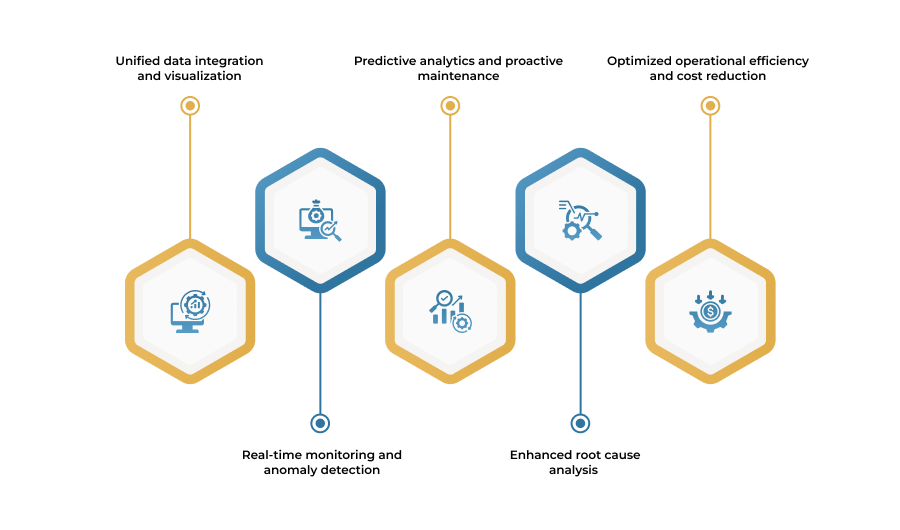
1. Unified Data Integration and Visualization
Power BI integrates the data from IoT, SCADA, ERP systems, and historical systems into a single dashboard, removing data silos. OEMs obtain real-time and historical insight for anomaly detection, enhanced asset performance tracking, and wiser decisions through intuitive visualizations.
2. Real-time Monitoring and Anomaly Detection
Using Power BI, OEMs can build real-time dashboards for their digital twins and scenarios for anomaly detections such as temperature spike occurrences. Reactive maintenance then becomes rather predictive; hence interventions are made at early stages, resulting in lesser downtime and cost.
3. Predictive Analytics and Proactive Maintenance
Power BI with its integration with Microsoft’s ML tools allows OEMs to build predictive models: modeling situations of failure for maintenance optimization and maximization of life span of an asset. This sort of approach ensures moving equipment to its full potential efficiently, minimizing the cost of operation, and making interventions in due course shall be clearly based on insights from data.
4. Enhanced Root Cause Analysis
By drilling down into detailed data, Power BI allows OEMs to perform rapid root cause analysis by detecting the patterns and correlations. This method helps OEMs to discover cause effects for the failure, solving these problems fast, and improving operations, maintenance strategies, and equipment design in the long run.
5. Optimized Operational Efficiency and Cost Reduction
When synergized with digital twins, Power BI drives performance, maintenance, and bottleneck-oriented actionable insights to increase efficiency and reduce costs. This also helps OEMs optimally use resources, eliminate waste, virtually analyze changes for improving productivity, and reduce risks, thereby giving an edge to their competitiveness.
The Perfect Power BI Dashboard for Digital Twin Insights
Key Elements of a Digital Twin Power BI Dashboard:
Real-time Performance Metrics: Present live data on the critical parameters for operations such as temperature, pressure, vibration, energy consumption, throughput, etc. Gauges, KPIs, and line charts can be used for visualization.
Asset Health Status: Displays a comprehensive overview, color-coded based on asset health (green for healthy, yellow for warning, and red for critical) for single assets or entire production lines, through conditional formatting and custom visuals.
Predictive Maintenance Alerts: Should feature notifications for pending failure indications or anomalies, detected by predictive models, describing what is predicted to happen, how severe the issue is, and what actions are recommended.
Historical Performance Trends: Enable the user to observe the past data to detect long-term trends and cyclical occurrences and analyze the impact of intervening actions taken in the past. The fundamental visual tools here are time-series charts and trend lines.
OEE (Overall Equipment Effectiveness) Breakdown: Detailed disaggregation of all OEE factors, namely availability, performance, and quality. These assist in identifying production areas targeted for improvement in efficiency.
Maintenance Schedule and History: The calendar will have upcoming maintenance activities, completed maintenance, and the respective costs attached to them. Having such an overview supports planning resources and examining the execution of maintenance.
Geospatial Data (if applicable): For distributed assets, incorporate maps to visualize the location and status of equipment across different sites.
Drill-down Capabilities: Ability to click on an asset or data point so that more detailed information about it may be seen; additionally, one can be taken to a root cause analysis report or directly to the digital twin model.
Who Benefits from Power BI-Enabled Digital Twins in Manufacturing?
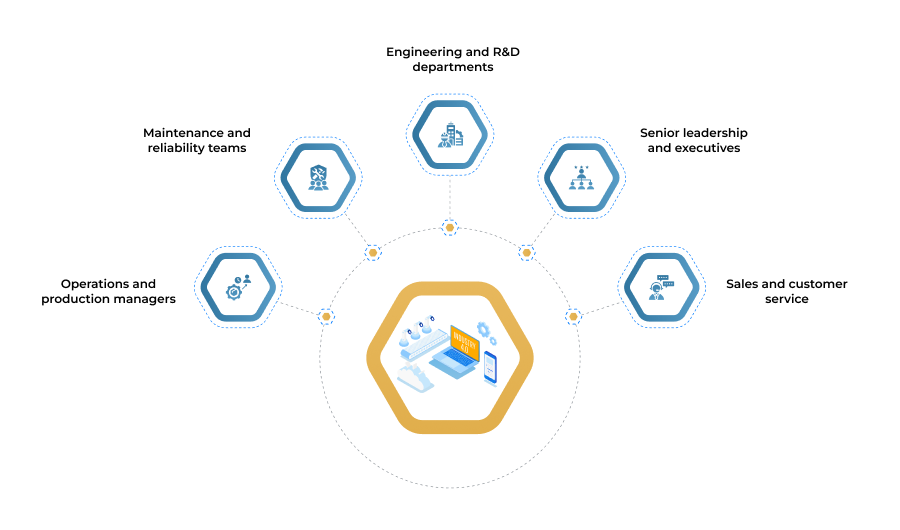
1. Operations and Production Managers
Optimize Production Schedules: Adjust the schedules based on the capability of the asset in place and based on its performance to minimize delays.
Improve Resource Allocation: Arrange the unnecessary resources so that personnel and materials are better utilized in maintenance or production work.
Enhance Quality Control: Identify quality issues and address them proactively, therefore reducing rework and scrap.
Boost Overall Equipment Effectiveness (OEE): Occasionally perform an assessment to improve availability, performance, and quality.
2. Maintenance and Reliability Teams
Implement Predictive Maintenance: Predict any equipment failures and schedule the required maintenance before breakdowns actually occur, thus ensuring the reduction of unplanned downtime.
Streamline Troubleshooting: Utilize detailed performance data to diagnose problems faster and pinpoint root causes.
Optimize Spare Parts Inventory: Predict spare parts demand using predictive models, thereby reducing inventory costs and guaranteeing availability.
Improve Safety: They help to create a safe working environment by avoiding unexpected failures.
3. Engineering and R&D Departments
Validate Designs: Test and validate new designs in a virtual environment prior to creating any physical prototypes, thereby saving valuable time and cost.
Identify Design Flaws: Use actual field performance data and information to locate design faults and build improved versions.
Accelerate Innovation: Promote continuous improvement of the product as well as prepare for the next-generation product based on operational data obtained from the field.
4. Senior Leadership and Executives
Make Data-Driven Decisions: Strategic investments and operational changes have to be made on real-time and accurate data.
Assess ROI of Digital Transformation: Determine financial benefits from digital twin initiatives, such as getting allowances for downtimes and improvements in production level.
Improve Business Agility: React fast to changes in the market or operational challenges, having a deeper understanding of manufacturing abilities in mind.
Enhance Competitiveness: Use advanced analytics to hold an extraordinary competitive edge in the market.
5. Sales and Customer Service
Offer Proactive Support: The need must be anticipated and some maintenance or support offered before arising.
Improve Customer Satisfaction: The product has to remain more operative, and from the customer side, services have to be faster, thereby creating loyalty.
Develop New Service Offerings: Using the data from digital twins, one can formulate value added services.
Conclusion
For OEM manufacturers aiming to future-proof their operations, integrating Power BI with digital twins is a strategic imperative. This synergy turns raw data into actionable intelligence, supporting predictive maintenance, better decision-making, and continuous improvement. Businesses that embrace this combination can expect improved agility, lower costs, and faster time-to-market.
Ready to leverage Power BI in your digital transformation journey? Contact us today for a personalized consultation.
A digital twin is a dynamic virtual model of physical assets or processes that integrates real-time sensor, operational and historical data to simulate, analyze and optimize manufacturing performance.
What makes Power BI ideal for digital twin visualization?
Power BI delivers interactive dashboards that combine digital twin datasets with predictive analytics, real-time alerts and customizable visuals, empowering stakeholders to monitor operations and drive data-driven decisions efficiently.
What are the core technologies that support digital twin implementation?
Digital twins rest on IoT sensors, cloud computing, edge devices, data integration platforms, advanced analytics and machine learning algorithms, collectively enabling scalable modeling, simulation and optimization of manufacturing systems.
How do digital twins reduce manufacturing costs?
Digital twins enable predictive maintenance, cutting unplanned downtime up to 60 percent, optimizing production schedules to minimize waste, and validating designs virtually to avoid costly physical prototypes.
What compliance requirements apply to digital twin systems?
Digital twins must adhere to data privacy regulations like GDPR, industry-specific standards (e.g., ISO 27001), IP protections and sectoral guidelines ensuring secure, transparent handling of operational and personal data.
Quickly scale your development capabilities by hiring pre-vetted tech experts who align perfectly with your project goals, timeline, and company culture.
What to expect after you reach out?
1. Share Your Requirements
Tell us your project goals, tech stack, and resource needs for a perfect talent match.
2. Talent Shortlisting
We screen and shortlist top-tier professionals based on your exact technical and cultural fit.
3. Interview & Selection
You interview the candidates and select the ones that align with your expectations and company values.
4. Onboard & Integrate
Seamless onboarding process to ensure smooth collaboration with your in-house team from day one.
5. Monitor & Scale
We assist with performance tracking and help you scale the team as your project evolves.