Why Do Meetings and Approval Processes Slow Down Digital Transformation?
Approval-driven processes and meetings impede digital transformation slow down transformation by stalling decision-making, fostering a reliance on hierarchy, and stopping teams from utilizing real-time data. Instead of fostering speed, they create bottlenecks that diminish productivity, increase lost opportunities, and stifle innovation. Organizations that eliminate these processes in favor of real-time dashboards with data-driven decision-making and systems can operate faster, be more efficient, and remain competitive.
When Innovation Requires Approval at Every Step
If every innovation and every new idea need a process, a documentation, and a sign-off, innovation slows down at the pace of your busiest vice president.
How approval culture shows up
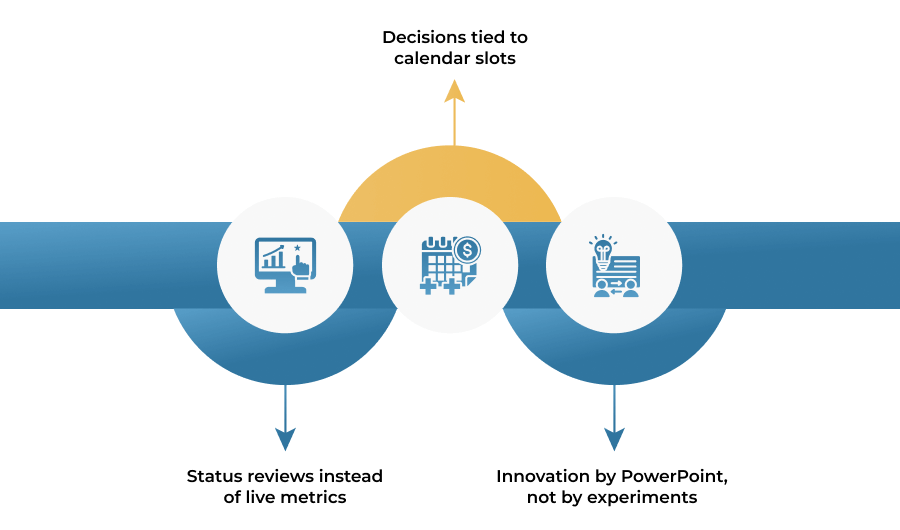
Status reviews instead of live metrics
Submit teams presentations to “report” on events that happened long ago because there’s no reliable dashboard which is always on and can be checked by the leaders themselves.
Time spent aligning on “what the numbers are,” rather than debating options, trade-offs, and next steps.
Decisions tied to calendar slots
Because some but not all important choices are made days or weeks after their proper moment-in-time steering committee, some underlying data can be available.
Thus, work is piling up, and teams “work around” issues instead of solving them since they can’t access decisions.
Innovation by PowerPoint, not by experiments
Investors sit as major stakeholders and innovators rather than silent partners and benefactors concerned with bringing their name to opportunities to projects.
That leaves managers in the dark without a real-time feedback loop on how users are actually behaving or what the actual operational impact is.
Why this kills digital speed
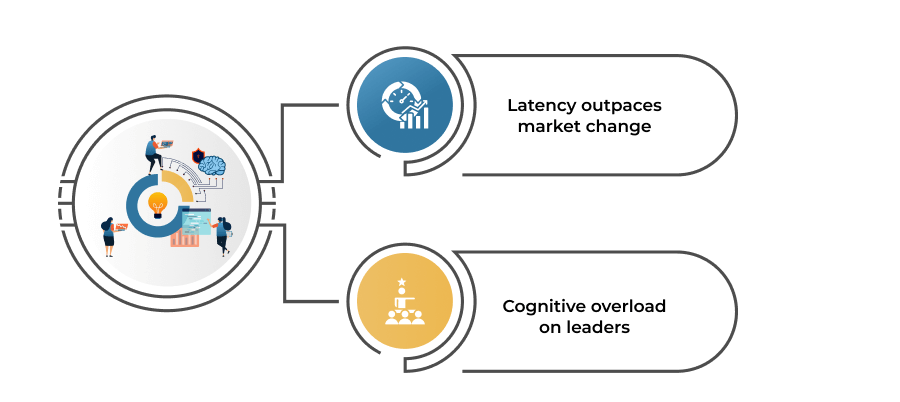
Latency outpaces market change
Marginal delays of several weeks in pricing decisions, product launch decisions, or campaign launch decisions in fast-moving markets could equate to missing quarters, rather than just missing meetings.
Those having live dashboards are able to react to signals from the live analytics-hours compared to days.
Cognitive overload on leaders
Lengthy approval processes force executives to review every decision because teams cannot access information directly. This lack of data democratization slows decision-making across the organization.
Executive burnout reduces leadership effectiveness, while middle managers lose decision-making authority. As a result, teams complete work more slowly.
Core point: A meeting-oriented culture is not careful; it is structurally ready to lose to organizations that forward such decisions through transparent real-time dashboards.
How Permission-Driven Processes Kill Speed and Momentum
Mostly such processes are designed to control risks, but with the greater speed of advancement, quite a few of those processes would destroy momentum for digital initiatives.
The mechanics of permission drag
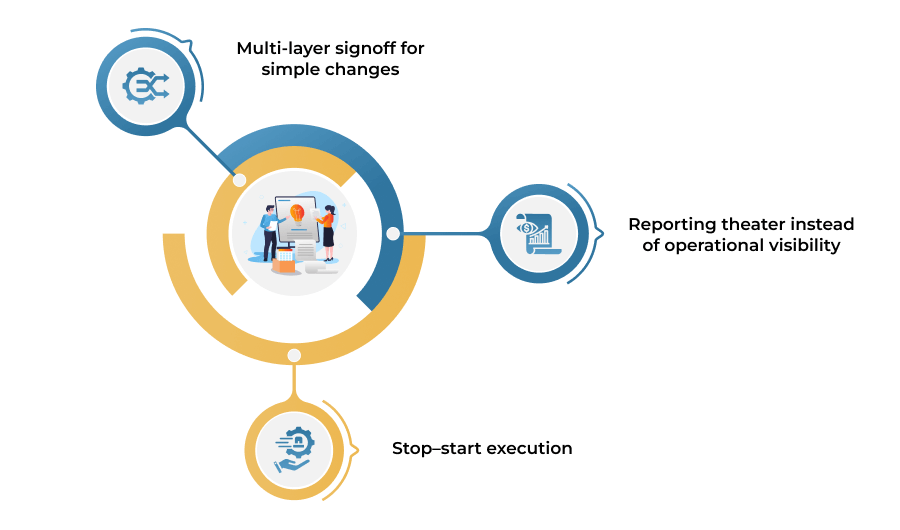
Multi-layer signoff for simple changes
It wouldn’t matter anyway, as the chain of approvals keeps Marketing from being able to change a landing page or promo, even if impact could have reasonably been monitored by dashboards and feature flags.
Product teams wait for the go/no-go call rather than making use of the metrics in advance, like conversion, latency, or error-rate thresholds.
Reporting theater instead of operational visibility
It is difficult to find a reusable information model in this place so that all the analysts can prepare one-off reports and slide decks for each decision forum for days together.
This “factory for reports” pattern duplicates data logic, maintains conflicting numbers, and limits trust.
Stop–start execution
Teams make progress after each meeting, but higher-level approval requirements quickly create new bottlenecks.
Many teams feel they accelerate briefly before another approval process brings work to a halt, reducing accountability and slowing execution.
Dashboards as a replacement for permission
The more sophisticated dashboards, with defined key performance indicators, thresholds, and ownership attributes, allow an organization to pre-approve ranges of action.
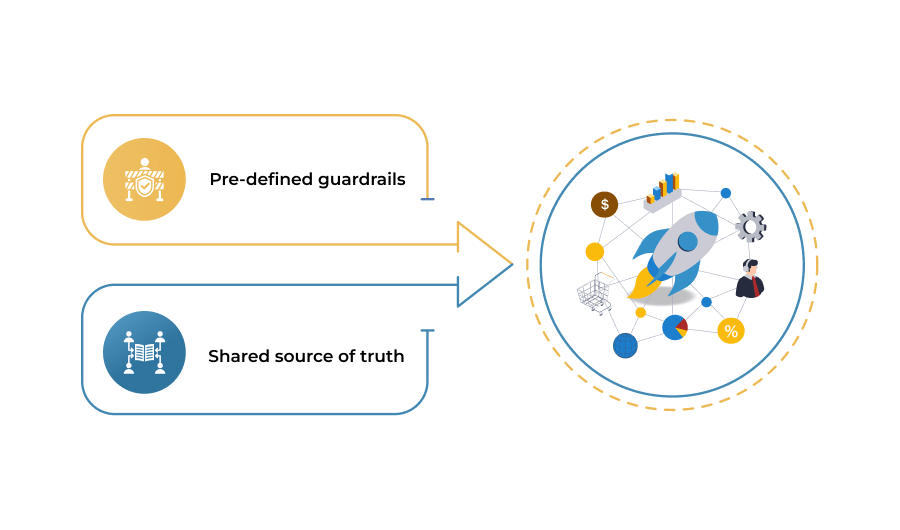
Pre-defined guardrails
Successive iterations subsequently proceed without requisites any permission as long as the parameters for customer satisfaction, error rates, and financial guardrails are maintained within satisfactory ranges.
Alerts and anomaly detections notify only when metrics cross a threshold, allowing leaders to act as escalation points instead of being gatekeepers.
Shared source of truth
Clear definitions of KPIs and lineage-aware dashboards strongly reduce arguments around “whose number is right,” and that allows for faster decision making.
According to a study released by KPI Institute, 68 percent of organizations reported improvement in performance when they put their KPIs into dashboards. This supports the idea that dashboards encourage coordination of teams toward execution.
When thresholds and dashboards make permission explicit, teams cease waiting for direction to see what to do next; they can see it.
The Hidden Cost of Delayed Decisions and Missed Opportunities
Direct Productivity And Salary Waste
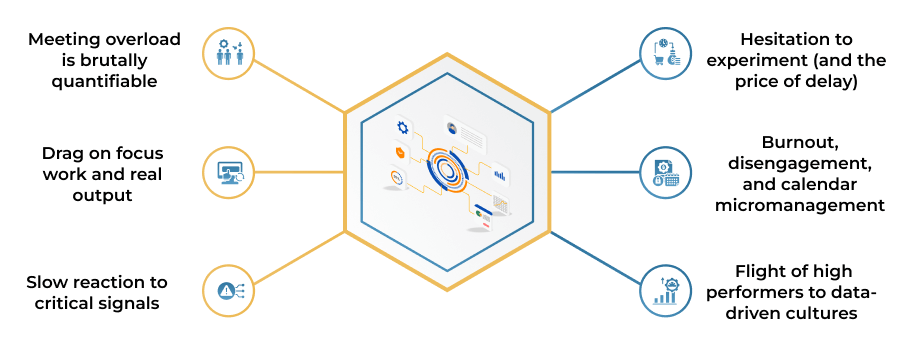
Meeting overload is brutally quantifiable
Employees are estimated to spend an average of around 7.5 hours per week in meetings, and a lot of this time is considered to be low-value meeting time, or totally unproductive meeting time in their view.
Therefore, unproductive meetings probably burn away hundreds of dollars from organizations for every employee across the globe in salary costs, resulting in billions of global lost productivity hours every year.
Drag on focus work and real output
More often than not, cultures that are high in meetings are highly correlational with increased overtime since employees would have to do their ‘real work’ during the before or after business hours when their calendars were finally clear.
When even simple status update requests need face-to-face conversations, the deep work time turns into gaps of 15-30 minutes, which research shows do not allow enough for complex, creative, and analytical tasks; hence it slows innovation directly across functions.
Strategic Opportunity Cost
Slow reaction to critical signals
Without a real-time dashboard, organizations often discover conversion drops, churn spikes, or SLA breaches only during weekly or monthly review meetings. By then, the data has already revealed the issue, leaving little time to respond effectively.
In fast-moving digital markets, even a one-day delay can cost organizations revenue, customer trust, and valuable business opportunities.
Hesitation to experiment (and the price of delay)
Not having strong analytics and dashboards is a huge hindrance to conducting any controlled experiments by companies because of the fear of impact monitoring and rollbacks being unsafe and not easily performed. I helps reduce this uncertainty by providing predictive insights and supporting more confident decision-making.
A culture arises where the most “safe” call is to postpone making an action; however, studies on digital transformation suggest that delaying decisions tends to incur a bigger price than what failed experiments actually cost, since these decisions forego all learning cycles and will continue accumulating loss of opportunity over time.
Talent And Culture Impact
Burnout, disengagement, and calendar micromanagement
Touching the experiences of employees, workdays filled with meeting after meeting make them find themselves drained in their minds, and knowledge workers refer most to meetings in their greatest causes of burnout and frustration.
When people notice that every decision requires another meeting instead of being resolved through transparent, trusted data, they stop proposing improvements and default to passive execution, eroding innovation from within.
Flight of high performers to data-driven cultures
High-level talent always find environments where they can view a scoreboard, make autonomous decisions, and be measured for outcomes: not for how many meetings a person attends.
In cultures overrun by permission, dominated by endless meetings, these people would rather take their skills to organizations with modern, real-time dashboards and self-service analytics, where empowerment is dictated by data and not calendar invites.
Why Traditional IT-Centric Models Can’t Keep Up
The Bottleneck Of Centralized Analytics And Reporting
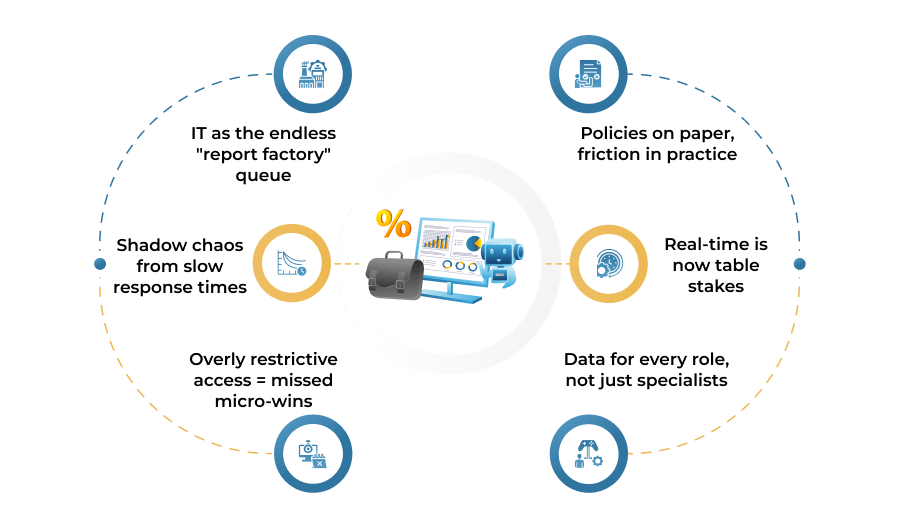
IT as the endless “report factory” queue
Data scientists spend 80% of time on data prep (60% cleaning + 19% collecting + 1% other) piling BI/IT requests behind overworked central teams.Every new metric, dashboard slice, or ad-hoc request queues up, turning simple insights from days into weeks of waiting.
As business demand surges (self-service analytics market hitting $5.7 billion in 2025 and growing at 5.7% CAGR), backlogs sprawl-70% of analysts report spending time on manual prep instead of strategy.
Shadow chaos from slow response times
Digital issues change every hour; therefore, marketing teams need their cohort slivers, sales teams need their pipeline views, and the operations need to keep an eye on their quality metrics, but centralized builds fail, delivering answers for yesterday’s problems.
Hence, 42% of the corporate apps become shadow IT, with companies running 975 unknown cloud services (compared with only 108 tracked), creating inconsistent “truths” and data silos.
Governance As Blocker, Not Enabler
Overly restrictive access = missed micro-wins
Unapproved tools are typically used by 67% of Fortune 1000 employees use unapproved SaaS tools to bypass locked-down data requiring tickets for basic views. 80% of companies show shadow AI activity, costing $670K extra per breach from unauthorized tools.
This kind of “security” keeps thousands from frontline optimizations; teams can’t act on insights they can’t access, turning governance into a velocity killer.
Policies on paper, friction in practice
Governance lies in docs, not tools. In case one’s preferred shadow IT proliferates, users knock out the rules so far as to abandon data for guessing.
In the absence of a centralized control, there is an increase by 68% in shadow GenAI usage, with staff members posting permissible data into free and unsafe tools.
Market Expectations Have Shifted
Real-time is now table stakes
Modern BI enables continuous KPI tracking with dynamic adjustments organizations achieve 127% ROI over 3 years from real-time analytics, slashing decision lag and spotting trends dramatically faster
No more quarterly reactions: real-time dashboards boost efficiency, with adopters gaining 25-40% higher margins via automated insights.
Data for every role, not just specialists
“Data-mature organizations see daily data usage across roles self-service BI market hits $13.1B in 2025 (15.4% CAGR to $54.9B by 2035), led by large enterprises empowering non-tech users.”
Specialists-only IT loses federated platforms deliver 3X SPEED. Business builds 3x faster on centralized data + governance, killing ticket queues. Shadow IT drops 50%, decisions accelerate 3x, governance becomes your edge.
Evolve from gatekeeper to platform kingmaker standardize KPIs centrally, let domains execute. Teams act on live truth, not approvals. Competitors still drown in meetings while you lap the field.
Shifting from Control to Enablement in Modern Organizations
Contemporary leaders have replaced strict control with decision hubs that indicate “How do we provide teams with live dashboards + guardrails?” instead of “How do we micromanage?”
Accountability surpasses approvals: executives determine the desired outcomes in advance, the frontline follows the results live. Latency plunges by 50–70%, projects are completed 28% faster, the sense of ownership skyrockets as visibility kills calendar gating.
Hub, and, spoke analytics eliminate BI bottlenecks: the IT department constructs certified data models + governance; sales/ops/product quickly create custom dashboards. The result is a 60% reduction in backlogs, insights are generated 3 times faster shadow IT dies, execution is powered by a consistent truth.
Decision, grade dashboards are rolled out everywhere with role, specific views: 5, 7 metrics answer the questions “Healthy? Off, track? Who? When?” Real, time pulses (hourly ops, daily finance) lead to 25% faster decisions, 18% sales increase, 35% trust improvement. Meetings are reduced by 40–60%; the teams rely on data to take action, not on getting permission.
Empowering Teams to Innovate Without Breaking Governance
Governed empowerment makes self-service a superpower through the repeated single-sourcing of KPIs (‘active user’, ‘qualified lead’) by an analytics team in a domain that can subsequently be reused in dashboards without redefining them. With tiered access, row-level security restricts but frees operational metrics while the embedded policies (certification badges, usage logs) automatically enforce trust. This blueprint allows teams to innovate safely, with insight cycle times 68% faster and zero breaches of governance.
Empowered teams run experiments like clockwork: product launches A/B tests watched live on dashboards, reverting instantly if metrics dip below pre-set guardrails-40% on risk through accepted templates. Weekly status calls vanish as living dashboards broadcast progress/risks asynchronously- stakeholders check any time, reducing recurring syncs by 50% and reserving meetings for real escalations only.
Continuous wins are driven by frontline ownership, as operations spot likely SLA slips or NPS dips in real-time on workflow-tied dashboards and fix the anomaly before things snowball. Local optimizations add up to 25% in productivity, with governed self-service becoming the backbone for frequent and reversible innovation, which is always able to outpace ungoverned chaos.
Building Faster Feedback Loops with Modern Digital Tools
Your team becomes unbeatable with faster feedback loops. It provides real-time data, intelligent tracking, and tool integration with the dashboards for planning and implementation. Not only does this bring waiting down from days to minutes, but it gives teams the ability to repair issues five times faster than competitors.
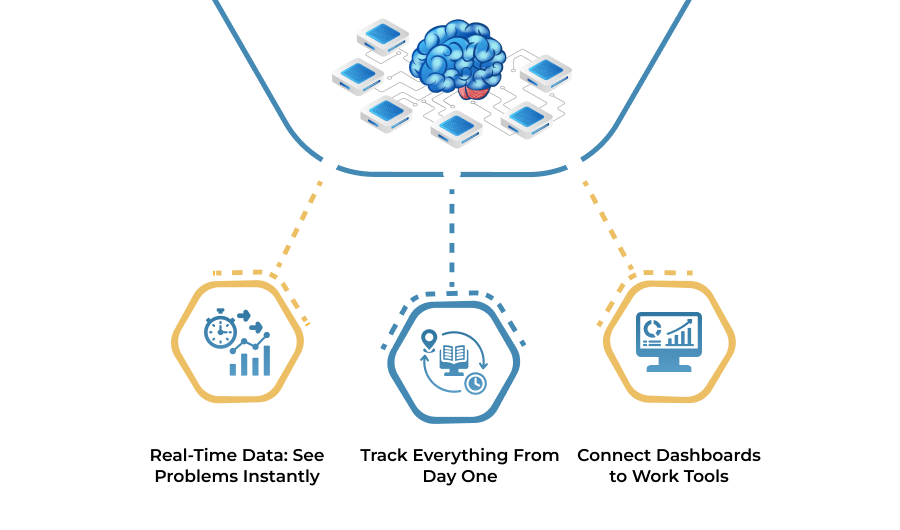
Real-Time Data: See Problems Instantly
Dashboards are updated by streaming tools in less than five minutes.
Operations, customer care, and growth teams reduce fix time by 60% and resolve problems on the same day.
Track Everything From Day One
Create campaigns and products so you can immediately see people, systems, and outcomes.
Every launch turns into a safe test—improvements that happen 80% faster.
Connect Dashboards to Work Tools
Automatically connect to Teams, Jira, or Slack.
Does churn increase? 45% faster fixes are generated by tickets.
Kill Meetings With Live Dashboards
Daily Standups → Quick Dashboard Checks
Add notes directly on the dashboard and do away with hourly calls.
Leaders save 70% of the time by checking five teams in ten minutes.
Monthly Slides → Live Project Views
Display outcomes, dangers, and health on a single screen.
Bosses use real trends to make decisions three times better while meeting less frequently.
Execs Get Simple Top Numbers
On phone dashboards, there are seven important metrics.
Instead of slide changes, data teams create intelligent predictions that are four times more valuable.
Markets are won by quick loops. While others wait for meetings, you may see, decide, and act in a matter of minutes.
Conclusion: From Permission to Enablement
Innovation does not slow because organizations lack ideas. It slows when teams wait for multiple meetings and approval processes before making decisions. Leading organizations replace permission-based workflows with real-time dashboards, strong data governance, and analytics. This enables teams to act faster with greater confidence.
A shared, trusted source of data helps every team work toward the same business goals. Employees can make informed decisions without waiting for repeated approvals or lengthy discussions. As a result, organizations improve collaboration, strengthen accountability, and respond to business changes much faster.
The difference for a leader is easy: visibility investment, not more updates. At that stage, the approval chain is replaced with insight, waiting is replaced with action. Digital transformation is really all about that.
Are you prepared to speed up innovation and eliminate decision bottlenecks?
Get in touch with us to create data-driven platforms that enable teams to act more quickly and intelligently.
Quickly scale your development capabilities by hiring pre-vetted tech experts who align perfectly with your project goals, timeline, and company culture.
What to expect after you reach out?
1. Share Your Requirements
Tell us your project goals, tech stack, and resource needs for a perfect talent match.
2. Talent Shortlisting
We screen and shortlist top-tier professionals based on your exact technical and cultural fit.
3. Interview & Selection
You interview the candidates and select the ones that align with your expectations and company values.
4. Onboard & Integrate
Seamless onboarding process to ensure smooth collaboration with your in-house team from day one.
5. Monitor & Scale
We assist with performance tracking and help you scale the team as your project evolves.