How Does Predictive AI Help Detect Invisible Fraud Before It Causes Losses?
AI analyzes vast amounts of data quickly and identifies threats and fraud that other systems can’t recognize. AI provides analysis and recommendations based on value and predictions. This ensures that organizations can act before a loss occurs.
How Invisible Fraud Erodes Trust and Drains Revenue
Invisible fraud frequently manifests as a series of small, repeated leakages rather than a few spectacular one off scandals. Some examples are slightly inflated medical bills, staged minor accidents, opportunistic add ons to genuine claims, and collusion internally that goes past surface level checks unnoticed.
For insurers and MGAs, the financial impact is not limited to the direct claim payouts only. Fraud causes higher loss ratios, increases premiums for honest customers, and requires larger reserves thus reducing margins and lessening the company’s ability to compete. Besides this, the costs related to investigations, legal proceedings, and remediation efforts that go on in the background, consume resource which could have been used to drive growth and innovation.
Erosion of trust is even more terrible. When customers get to hear of fraudulent payouts or experience aggressive investigations caused by crude rules, they start doubting if the insurer is fair, competent, and secure. In tightly regulated markets, repeated fraud incidents also lead to increased regulatory scrutiny, reputational damage, and possible penalties.
Why Traditional Detection Systems Fail to Keep Up
Traditional fraud detection systems resemble rusty locks trying to protect modern digital vaults. They are outdated, fragile, and no longer effective against today’s sophisticated threats.
Fraudsters now use AI, deepfakes, and global criminal networks to launch advanced attacks. As a result, legacy rule-based systems struggle to keep up and leave businesses vulnerable to financial losses.
Digital claims continue to grow, and fraud tactics evolve every day. Relying on outdated rule-based systems is inefficient and can weaken a company’s competitive advantage.
Many CTOs and insurance leaders already see the impact. Rising fraud losses and increasing claim costs highlight the need for faster, AI-driven fraud detection.
The Hidden Cost Multiplier: Beyond Direct Losses
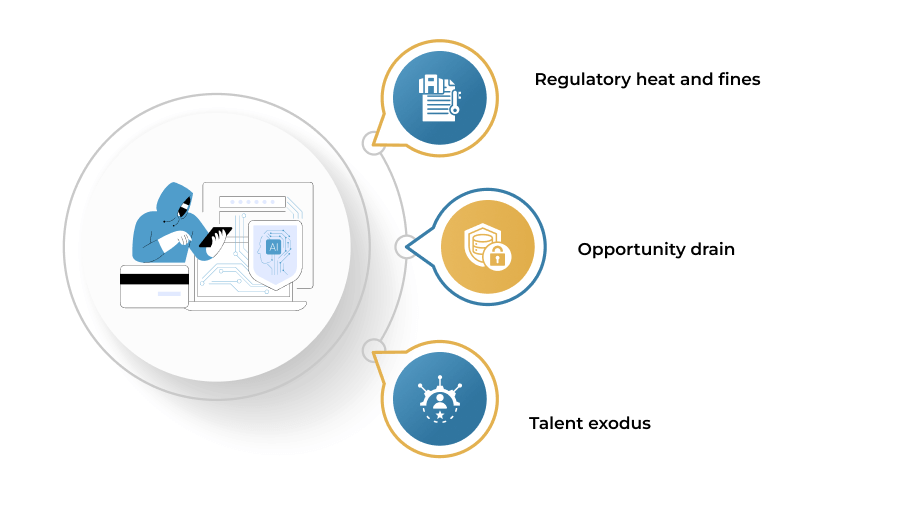
Trust erosion on steroids: False positives delay honest payouts (30 60 days), thus creating a feeling of dishonesty among the users. Misses increase premiums by 10-20% industry wide, thus resulting in a 25% churn rate. Bad reviews lead to a decline in SEO and acquisition costs increase significantly.
Regulatory heat and fines: GDPR, CCPA, NAIC require explainability unproven rules lead to audits. The recent waves have resulted in more than $10M sanctions due to weak controls, in addition to forced overhauls that consume 2- 3 years of the IT budget.
Opportunity drain: Firefighting takes the money from innovation new products getting stalled, CX upgrades being paused, expansions being canceled. Rivals with AI gain 2-3x share, thus leaving laggards in margin squeezed dust.
Talent exodus: Overworked SIU pros are moving to fintechs with smart tools. Retention costs are increasing by 50%, as top talents are demanding augmentation instead of exhaustion.
Data Silos: Blind Spots in a Connected World
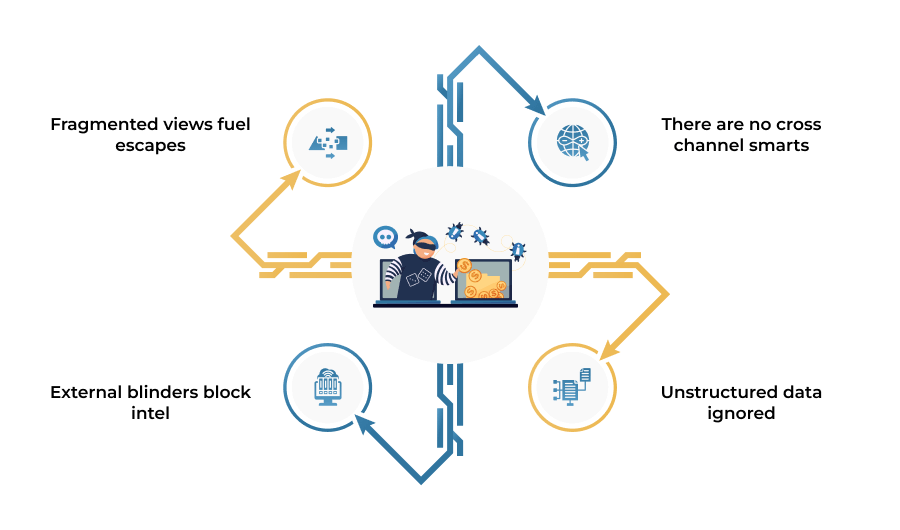
Fragmented views fuel escapes: Legacy systems such as CoreLogic, Guidewire, and FIS analyze claims in isolation. They fail to connect related claims across shared garages, IP addresses, or device fingerprints. As a result, organized fraud networks can steal millions before insurers detect the pattern. a person filing a claim connected to 20 “unrelated” accidents through shared garages, IPs, or device fingerprints. Organized networks can accumulate millions of dollars before anyone realizes the connection.
No Cross-Channel Intelligence: Fraudsters move seamlessly between mobile apps, call centers, agent portals, and web channels. Siloed systems fail to track this activity across channels. As a result, insurers miss fraud patterns and lose revenue.
External Blind Spots Block Intelligence: Without real-time DMV records, social signals, or sanctions data, insurers miss critical warning signs. Fraudsters often receive payouts before investigators identify suspicious patterns. This problem becomes even more serious in high-velocity fraud environments.
Unstructured Data Goes Unused: Insurers collect emails, notes, photos, and other unstructured data, but many legacy systems cannot analyze it effectively. Without NLP and image analysis, they often miss forged PDFs, recycled damage photos, and organized fraud rings.
Predictive AI: Shifting from Reaction to Prevention
Predictive AI basically changes the fraud scenario. Instead of going after traces of a fire that has already happened, it prevents the fire from starting in the first place. Fraud detection is no longer a reactive intervention of a disorganized game of whack a mole; rather, it is a proactive fortification, evaluating every quote, claim, or payout in milliseconds for concealed risks that humans fail to notice.
Executives, picture the situation where you are able to reduce losses by 40–60% while at the same time making the process of legitimate claims three times faster. This is the AI powered shift that changes fraud from being a ‘profit vampire’ to a ‘contained blip’.
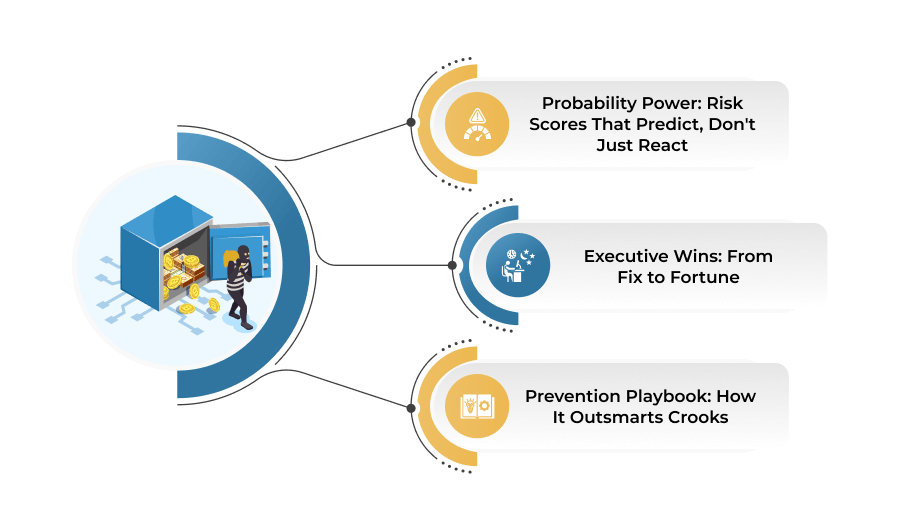
Probability Power: Risk Scores That Predict, Don’t Just React
Every event under the microscope: Quotes, policy changes, claims, and payments are promptly scanned by AI, which assigns fraud probability (e.g., 85% risk on a “small” fender-bender linked to shady garages). Prevention begins at hello; there’s no need to wait for warning signs.
Learns your world’s “normal”: compares baseline categories, such as urban millennials with rural fleets, using years’ worth of data, including claims history, behaviors, and third-party intelligence. identifies anomalies, such as a beginner policy that is overflowing with add-ons.
Dynamic evolution: Unlike static rules that rot in place, models self-update every week with new fraud intelligence to stay ahead of deepfakes or ring pivots.
Executive Wins: From Fix to Fortune
Losses crushed, margins freed: Industry estimates show that fraud can consume around 5–10% of premiums in some markets, and advanced analytics/AI can significantly reduce these losses and improve loss ratios.
SIU supercharged: Risk-ranked alerts reduce inquiry time by 70%, and teams concentrate on high-stakes issues rather than noise. Each case now costs $150 instead of $500.
CX rocket fuel: Low-risk? Approve automatically in a matter of seconds. Sincere consumers like speed; when friction disappears, NPS increases by 20–30 points.
Prevention Playbook: How It Outsmarts Crooks
Pattern hunting on steroids: Graphs link stores, devices, and claimants, revealing rings prior to the third claim. Pauses are caused by behavioral drifts, such as claim spikes following a policy purchase.
Tiered turbo workflows: Green = pay now; yellow = quick doc check; red = SIU deep dive. Scales to millions without breaking.
Feedback loop magic: Every day, investigator verdicts retrain models, increasing accuracy by 15–25% every quarter. Your data turns into a moat that stops fraud.
How Machine Learning Identifies Hidden Patterns in Claims
Machine learning models for fraud detection benefit from a high number of patterns and their variety. These models take into account many more signals than the traditional systems, they can use both structured and unstructured data to reveal the links, which are not visible in the individual screens or spreadsheets.
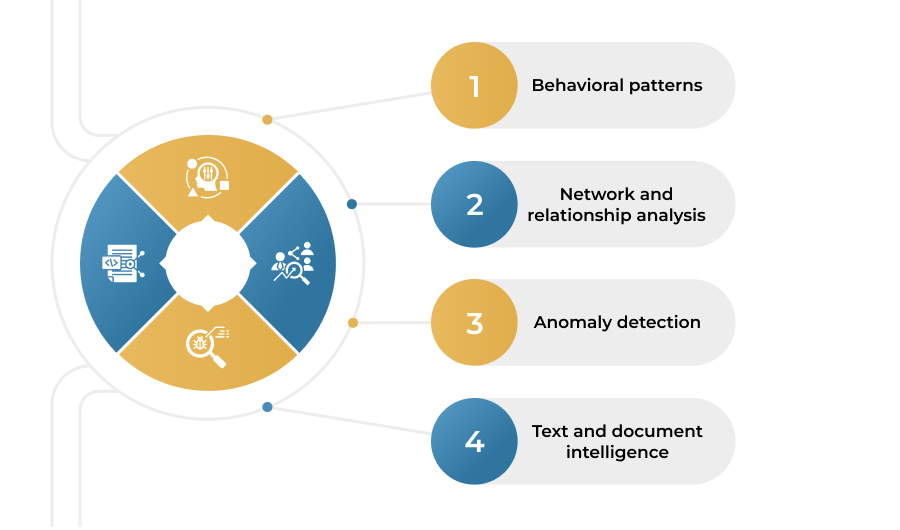
Key elements include:
Behavioral Patterns: Machine learning analyzes claimant behavior over time. It evaluates claim frequency, channel switching, policy timing, and unusual coverage changes. By comparing each claimant with similar customer groups, AI can identify suspicious behavior and detect organized fraud earlier.
Network and Relationship Analysis: Graph-based models map relationships between people, addresses, vehicles, devices, repair shops, and medical providers. They uncover hidden fraud rings by identifying repeated links among witnesses, service providers, claim handlers, and claimants.
Anomaly Detection: Unsupervised and semi-supervised learning automatically identifies unusual claims without requiring predefined labels. These models detect anomalies in claim costs, procedures, timing, and documentation. They are especially effective at identifying emerging fraud patterns with limited historical examples.
Text and Document Intelligence: Natural Language Processing (NLP) extracts insights from adjuster notes, claimant statements, invoices, and third-party reports. Computer vision analyzes submitted images to detect forgery, duplicate damage photos, and reused evidence across multiple claims.
By combining these signals, predictive AI generates a risk score and explains the reasons behind it. SIU analysts can use these insights to approve claims, pause payments, request additional information, or escalate investigations with greater confidence.
Real-Time Detection: Catching Fraud Before It Escalates
In today’s world of threats, it is time that often separates a situation of heavy losses from that of a risk which can be managed. Fraud detection pipelines that use AI and work in real time are able to identify the events that happen within a few milliseconds, thus they are able to score claims, payments, and policy changes even before the money goes out of the organization.
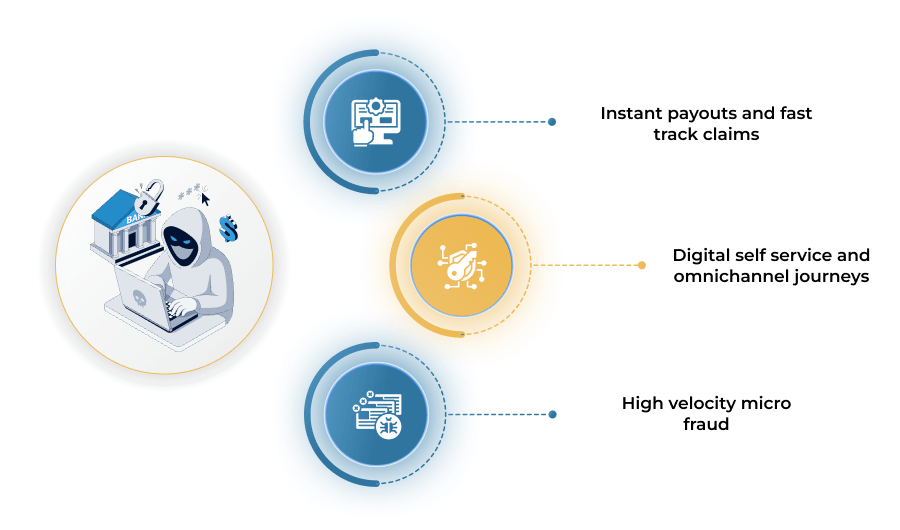
This is especially critical for:
Instant payouts and fast track claims: Many insurers now offer same-day or instant claim settlements to improve customer experience. Without real-time AI, however, fraudsters can exploit these fast processes to bypass manual reviews.
Digital self service and omnichannel journeys: Customers submit claims through mobile apps, web portals, call centers, and partner channels. Real-time, unified fraud scoring across every channel helps insurers detect suspicious activity and stay ahead of fraudsters.
High velocity micro fraud: Instead of submitting one large fraudulent claim, attackers often file many smaller claims to avoid detection. Streaming AI models identify these patterns across entities and over time. This allows insurers to stop fraud before multiple payouts occur.
Real-time fraud detection reduces financial losses and improves the customer experience. Low-risk claims can receive automatic approval with little or no manual intervention. At the same time, insurers can route high-risk claims for additional verification, document checks, or human review.
Reducing False Alerts with Intelligent Automation
One of the frequently asked questions by the executives is whether the increase in AI will lead to the increase in noise. It is a fact that in badly adjusted systems, the number of alerts can be doubled: simple models can just substitute a unit for another, without solving the problem. However, smart automation is an AI application that aims at minimizing the noise level and thus making it possible for humans to intervene in the most valuable areas of work.
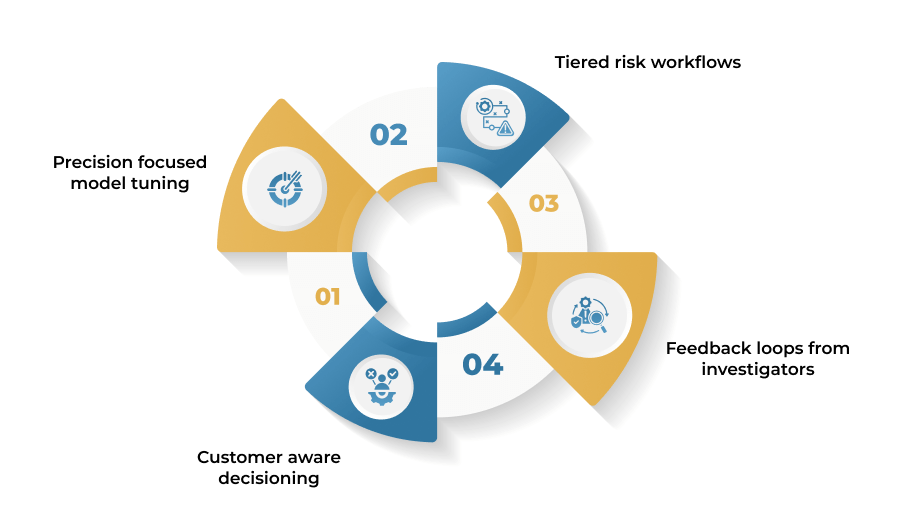
Key levers include:
Precision focused model tuning By optimizing their models for both precision and recall, and also by calibrating thresholds per product, region, and channel, companies are able to reduce the number of false positives that result from their systems substantially while at the same time they keep strong detections.
Tiered risk workflows Predictive AI enables the use of graded responses instead of binary “alert/no alert” ones. The responses could be, for example, auto approve, auto decline, request additional documents, specialized SIU teams routing, or pattern evolution monitoring. This way, only the most complicated or high impact cases are sent to senior investigators.
Feedback loops from investigators Every decision made by an investigator confirmed fraud, cleared case, escalated suspicion is communicated to the models to make the future predictions of the system more accurate, thus the number of false positives is slowly being reduced as the system is continually adapting to local realities.
Customer aware decisioning People can be part of the decision logic used by systems through their value, tenure, and historical honesty which allows the system to create smoother paths for low risk segments and still keeps the control.
As a result, the fraud engine becomes one that enhances the capabilities of human teams rather than overwhelms them, thus the substantial productivity gains and faster, more accurate decisions become possible.
Case Example: Predictive AI Preventing Multi-Level Fraud
Think about a composite scenario that was developed based on the actual deployment of the systems in the insurance and financial services sectors. An insurer providing auto and health products was experiencing increasing loss ratios and therefore, it was guessing that there was an organized fraud with the involvement of staged accidents and inflated medical claims, but the insurer could not verify the fraud.
By implementing a predictive AI platform, the insurer:
Truly connected data encompassing policy, claims, payments, and a variety of external enrichment sources to build a complete 360° entity and network view.
Rolled out graph based models such as those that outlined the connections between claimants, repair shops, attorneys, and medical providers.
Brought in instantaneous scoring at the time of first notice of loss (FNOL), pre payment, and post settlement stages.
Within months, the AI uncovered:
Clusters of claims that have the same repair shops and medical providers with unusual treatment patterns and cost profiles.
Repeat involvement of the same witnesses and intermediaries in the chain of different, but apparently, non related accidents.
Suspicious timing patterns, whereby a large number of claims were filed very shortly after the policy inception and with similar narratives.
The insurer took apart a number of fraud rings that caused the insurer to lose money by cabling and researching such high risk clusters, which led to the reduction of fraud related losses and consequently the improvement of combined ratios. Meanwhile, direct processing rates for low risk claims were also elevated leading to quicker payouts and thus higher customer satisfaction.
Building Ethical, Transparent, and Scalable AI Systems
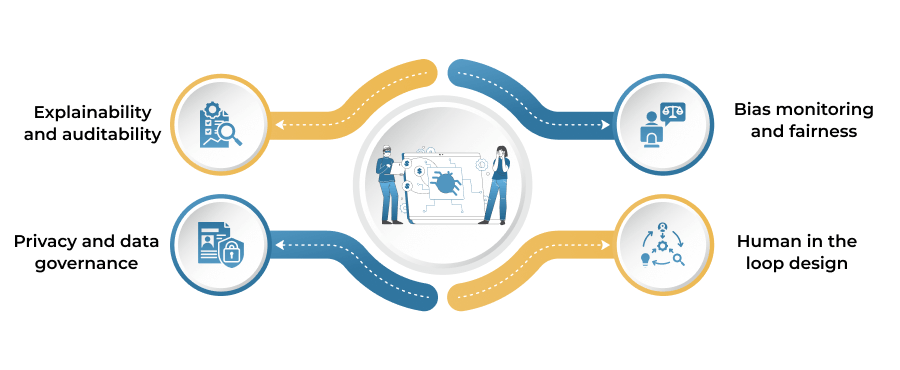
For executives and regulatory authorities, the AI conversation has moved beyond “Can it work?” The real question is whether AI can operate fairly, transparently, explainably, and at scale. Ethical AI helps organizations build customer trust, meet regulatory requirements, and align risk, legal, and business teams around responsible decision-making.
Foundational principles include:
Explainability and auditability Models are required to deliver explicit reasoning signals e.g., main factors contributing to a risk score so that investigators, auditors, and regulators get a grasp of the decision making process. In addition, logging, versioning, and traceability of model changes play an indispensable role in audits and dispute resolution.
Bias monitoring and fairness AI systems ought to be continually tested to ensure that they do not exert unfair influence over different demographics, products, or regions, and that governance frameworks for such systems set standards for acceptable behavior and handling of any violations. Attributing decisions to certain accounts or activities and then evaluating the impact of those decisions in facilitating access to insurance, claim settlement, or pricing is where fairness matters the most.
Privacy and data governance Fraud models are data hungry by nature; however, their operation must be in line with privacy regulations, consent frameworks, and internal policies. Several privacy respecting strategies, e.g., data minimization, role based access control, and secure model operations help to lower privacy risk.
Human in the loop design The purpose of AI is to support rather than substitute expert judgment, especially in the case of high impact or ambiguous scenarios. The existence of clear escalation routes and override mechanisms ensures that accountability is maintained, even when the benefits of AI speed and scale are leveraged.
Scalability is enabled by modular architectures, API first integration, and cloud infrastructure that has the capability to manage peak loads without a decrease in performance. Predictive AI, with this base, becomes a strategic risk capability rather than a tactical tool.
Conclusion
Fraud no longer hides in the shadows. AI-powered fraud attacks now operate at scale and can drain billions without organizations noticing. Many insurers still rely on outdated rules and manual processes. As fraud evolves, losses increase, customer trust declines, and operating costs continue to rise..
Predictive AI gives risk, data, and product teams the power to detect fraud before it causes damage. It identifies suspicious activity at the quote level and blocks fraudulent claims before payout. At the same time, it speeds up legitimate claims processing. This can reduce fraud losses by more than 50%, increase Net Promoter Score by up to 30 points, and accelerate business growth.
Organizations no longer need to react after fraud occurs. Ethical, explainable, and enterprise-scale AI continuously adapts to new fraud patterns. It protects businesses with faster, auditable decisions while delivering a better customer experience and helping insurers stay ahead of evolving threats.
Invisible fraud refers to subtle, low signal schemes such as padded claims or synthetic IDs that evade rules, thereby silently draining 5 10% of premiums while mimicking legitimate activity.
Why do traditional systems fail?
Traditional systems fail because they employ rigid rules that cannot detect the adaptive tactics used by fraudsters, thus generating 70% false positives, and are not capable of scaling to petabyte data or real time threats.
Is AI reducing false positives?
Yes, definitely precision tuning and tiered workflows reduce noise by 70%, thus SIU are free only for high impact cases.
How much do traditional rules cost the insurers yearly?
Traditional rules cost insurers billions of dollars in missed fraud plus the 70% false positive waste, which inflates ops costs by 40% and raises premiums for honest policyholders.
Can small insurers use predictive AI?
Small insurers can certainly use predictive AI as cloud based SaaS is much cheaper than a custom built solution and can scale the ROI via pay per transaction to match volume growth.
How long does it take to deploy AI fraud detection?
An enterprise pilot can be launched within 30 days, a full rollout can be done in 90 days, and Day 1 ROI can be achieved via real time scoring and auto workflows.
Is AI helpful in internal fraud like employee collusion?
A behavioral analytics system monitors the access patterns, case assignments, and overrides of employees and thus, it is able to identify insider risks before they happen.
Quickly scale your development capabilities by hiring pre-vetted tech experts who align perfectly with your project goals, timeline, and company culture.
What to expect after you reach out?
1. Share Your Requirements
Tell us your project goals, tech stack, and resource needs for a perfect talent match.
2. Talent Shortlisting
We screen and shortlist top-tier professionals based on your exact technical and cultural fit.
3. Interview & Selection
You interview the candidates and select the ones that align with your expectations and company values.
4. Onboard & Integrate
Seamless onboarding process to ensure smooth collaboration with your in-house team from day one.
5. Monitor & Scale
We assist with performance tracking and help you scale the team as your project evolves.