From Manual Processes to Smart...
22 Oct 2026


In rapidly changing digital economies, sustainability has passed the stage of just being a buzzword, it has become a strategic imperative. Environmental concerns being under scrutiny with regulatory controls tightening, businesses are innovating methods of cutting their carbon footprints without compromising on their efficiency. Microsoft Power Apps, with the backing of AI-driven carbon footprint analytics, jumps in. This low-code application allows for the easy tracking of emissions and the reduction and reporting thereof, thus paving the way for sustainable logistics.
The global green logistics market size was valued at $1.3 trillion in 2022, and is projected to reach $2.9 trillion by 2032, growing at a CAGR of 8.3% from 2023 to 2032.
Environmental monitoring calls for concrete, time-sensitive data so as to effectively reduce carbon emissions. Power Apps has transformed the way emissions are monitored by bringing in diverse data sources, fleet systems, energy meters, and logistics partners into bespoke low-code applications. This real-time information permits operators to see fuel consumption, mileage, toughest routes, or energy consumption as they happen, instead of relying on land-based estimates. This immediate access to granular data allows businesses to:
Power Apps automates workflows, turning insights into actions, reducing emissions, errors, and inefficiencies for greener, smarter logistics operations.
Consider these practical applications of workflow automation:
Power Automate triggers routing adjustments to reduce mileage and fuel consumption based on traffic data, weather, and delivery schedule. This can be interfaced with mapping services and fleet management systems to automatically dispatch optimized routes to the drivers.
The workflows can be automated for energy conservation in warehouses, for example, lighting and HVAC systems will be adjusted automatically through occupancy sensors or according to operating hours. Warehouse managers will be presented via Power Apps an interface for monitoring the systems and to override the automation whenever necessary.
Power Apps analyses vehicle sensor data to predict when maintenance will need to be carried out and therefore schedule it proactively. Well-maintained vehicles tend to save fuel and emit less emission levels. The maintenance team and the fleet managers can be notified via automated alerts.
Workflow can be designed to facilitate communication and data exchange with suppliers in respect of their sustainability practices; this could mean auto-requests for carbon footprint data or alerts on those suppliers who do not comply with certain environmental criteria.
Instead of having to hand over reports to bodies competent in regulations or to stakeholders internally, Power Automate can automatically put together reports on carbon emissions from the data collected and make these reports available for the proper authorities to reduce costs and increase transparency simultaneously.

>>>>>>>>>>>>>>>>AI enhances green logistics by analyzing vast data, recognizing patterns, and offering predictive insights, enabling continuous optimization and major emission reductions beyond the capabilities of real-time tracking and automation alone.
AI analyzes historical traffic patterns, weather conditions, delivery schedules, and driver behavior to identify the most fuel-efficient route. As a result, businesses reduce fuel consumption and lower carbon emissions.
Unlike traditional shortest-path algorithms, AI also considers elevation changes, traffic congestion, and average vehicle speeds. Therefore, it recommends routes that improve fuel efficiency instead of simply reducing travel distance.
For example, AI may recommend a slightly longer route with fewer stops and smoother traffic flow. Consequently, vehicles consume less fuel and produce fewer emissions than they would on a shorter but congested route.
Demand forecasting powered by AI optimizes inventory levels, thereby cutting down on expedited shipping, and wastes incurred from overstocking or obsolescence. When AI predicts correctly with regards to what products will be needed, by whom, and at which time in any given place, it can effectively streamline the entire supply chain into fewer unnecessary movements and, hence, lower emissions.
Knowing that AI can watch out for vehicle performance data (telematics, lesser engine diagnostics) to foresee breakdowns or inefficiencies will enable coordinated maintenance activities that ensure vehicles run in optimal fuel efficiency and minimize an otherwise hard-down delivery that offers hardly any rush-room for an efficient delivery. The AI can assist in further optimizations related to vehicle allocations, matching the vehicle size and type fitting the respective delivery dimension for good under-utilizations or overloading.
Warehouse energy consumption patterns can be learned by AI and opportunities can be identified for optimizations. This also involves the intelligence of lighting, heating, ventilation, and air-conditioning systems according to occupancy, weather interactions, and operational schedule. The charging cycles of electric forklifts and equipment could be interjected to alleviate demand during peak load, while the one-third price of electric charges can be further saved by AI.
The AI analyzes environmental performance data of suppliers so that businesses are able to make better decisions concerning procurement. This allows companies to choose those suppliers who have lesser carbon footprints or better sustainability practices, thereby building a greener supply chain right from buying.
Power Apps and AI simplify carbon reporting by automating data collection, improving calculation accuracy, and delivering actionable sustainability insights.
Automated Data Aggregation: Going away from disconnected spreadsheets and manual entry, Power Apps acts as a central repository for carbon-related data. It automatically collects information from fleet telematics, energy meters, utility bills, supplier systems, and employee travel records. As a result, businesses create a consistent and reliable carbon dataset while reducing manual work and reporting errors.
Standardized Calculation Methodologies: AI models embedded within Power Apps apply recognized carbon accounting frameworks such as the GHG Protocol. They convert raw activity data, including fuel consumption and electricity usage, into accurate CO₂-equivalent emissions. Consequently, organizations improve reporting consistency, regulatory compliance, and decision-making.
Customizable Reporting Dashboards: Power Apps enables organizations to create dashboards tailored to different stakeholders. Compliance teams receive detailed reports, executives gain strategic insights, and sustainability teams monitor progress toward ESG goals. Furthermore, interactive visualizations make complex carbon data easier to understand and analyze.
Audit-Ready Data Trails: Every data entry and calculation is securely recorded to create a complete audit trail. This transparency simplifies regulatory audits, supports carbon footprint verification, and builds trust with customers, investors, and government agencies.
Scenario Planning and Forecasting: AI-powered forecasting helps businesses predict future carbon emissions under different operational scenarios. For example, organizations can evaluate the environmental impact of electric vehicle adoption, renewable energy investments, or supply chain changes. As a result, decision-makers can set realistic carbon reduction targets and develop effective sustainability strategies.
Power Apps and AI help organizations automate carbon reporting, improve data accuracy, simplify compliance, and support better sustainability decisions. By adopting these technologies, businesses can reduce reporting complexity, achieve ESG goals, and build a more sustainable future.
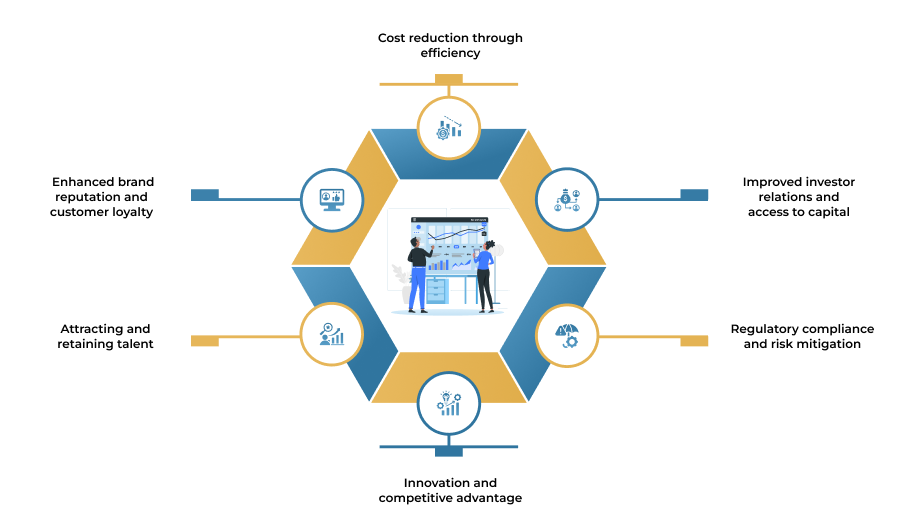
Green initiatives are naturally generating savings. Routing optimization levels down to the areas consuming fuel-the warehouse efficiencies cost less energy to put into practice-predictive maintenance keeps expensive breakdowns at bay. Identifying and removing waste along the logistics chain ensures operating costs remain low. Power Apps gives visibility to track actual savings against emission reductions, thus proving a financial return from sustainability investments.
Customers are becoming more and more aware of the environmental impact considerations that go into the production of goods and services they purchase. The building of stronger brand loyalty while attracting new customers falls upon businesses that can own the green mantle. Power Apps assists in producing attractive reports and dashboards that position market green.
Employees, especially young people, have often been attracted by industries or organizations that align with their ethical and environmental values. Creating a sustainable logistics strategy with the help of Power Apps shows that company is future-oriented and socially responsible, thus ensuring the attraction and retention of young talent. It helps in the propagation of sustainability towards the organizational culture.
ESG, increasingly, is a criterion for investors. The better the ESG ratings go for the companies, the lesser their cost of capital and these companies have garnered higher levels of interest from the socially-responsible investment funds. Transparent reporting of carbon-oriented data through Power Apps offers the investors the transparency necessary to gauge sustainability performance, which may result in improved access to capital and valuation.
The regulatory environment governing carbon emissions and environmental damage continues to evolve. Proceeding with carbon footprint management programs implemented with Power Apps helps you in staying in line with regulations, both existing and in potential future ones, so as to pre-empt the costs of fines and penalties and renouncement. Hence, the traditional reactive approach to compliance is based upon an active step.
Green logistics may drive corporate innovation. Sustaining the design of new processes or equipment such as Power Apps and AI offers opportunities for new business models, new services, and new competitive advantages in the market.
Achieving green logistics goals is no longer optional, it’s essential for future-ready businesses. With Power Apps and AI-driven carbon footprint analytics, companies can modernize their logistics strategies, align with ESG standards, and reduce their environmental impact in measurable ways.
From real-time emission tracking to AI-powered optimization and seamless carbon reporting, Power Apps is transforming how enterprises embed sustainability into their logistics DNA.
Ready to future-proof logistics with sustainable innovation? Contact us today and discover how our Power Platform solutions can empower green transition.
24 Aug 2026
15 Jun 2026
25 May 2026