Why Today’s Customers Expect Insurance...
12 Oct 2026

A domino effect from a logistics disruption, such as a delayed shipment, is when one disruption in the supply chain creates multiple consequent disruptions throughout the entirety of the chain. Inventory, transport, warehousing, and order fulfillment disruptions can seriously detract from a business as a whole. Today, businesses use tools that track the logistics chain in real time and apply predictive analysis in order to reduce or eliminate disruption across the chain.
Delays in older logistics systems were often treated independently. In contrast, supply chain modern systems recognize that every operation is interrelated. A single disruption will create numerous downstream issues in every operation.
Consider the following:
These kinds of issues arise in companies when the issue spreads rapidly across the entire company. Problems like these become even worse in time-oriented industries. Time-oriented industries are those like health care, manufacturing, retail, food delivery, and eCommerce. In these industries, delays of just a couple of hours can result in lost sales, downtime in manufacturing, and waste in inventory.
Today it’s critical to meet modern customer demands. Customers expect shipment the same day with time-based updates. During the distribution of products customers tend to trust the business. The moment trust is broken, customers are unable to trust the business.
Modern logistics systems are learning that operational efficiency alone is not enough if customer expectations and delivery experiences continue to suffer. The delay is not the fundamental problem, trust is. Disruptions need to be addressed faster and contained before they spread to an uncontrollable extent.
The repercussions of delivery delays extend far beyond mere transportation schedules. They considerably impact the function and reliability of a supply chain as a whole.
Consider some of the most consequential operational effects: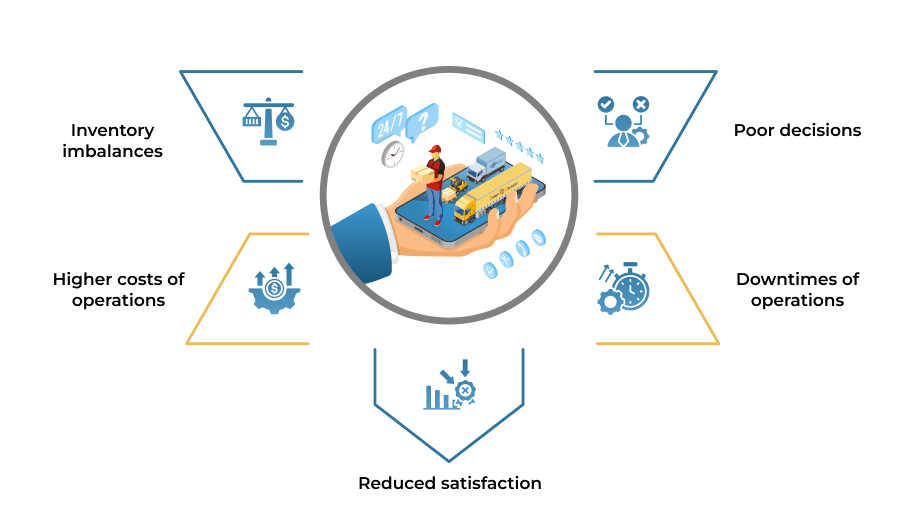
The highly interdependent and interconnected logistics systems of the new age mean firms that adapt the quickest, are the most resilient and outperform those reliant on manual and segmented systems.
One of the biggest reasons for delivery interruptions in modern businesses is inefficient logistics network coordination. Supply chains today have real-time collaboration of manufacturers, transport services, warehouses, distributors, and teams that handle customer interactions. When all these parties work with fragmented systems or lagged forms of communications, any problem can easily get magnified across the entire logistics system. The results of poor coordination are delayed shipments, inefficient operations, mismatched inventories, and loss of customer satisfaction.
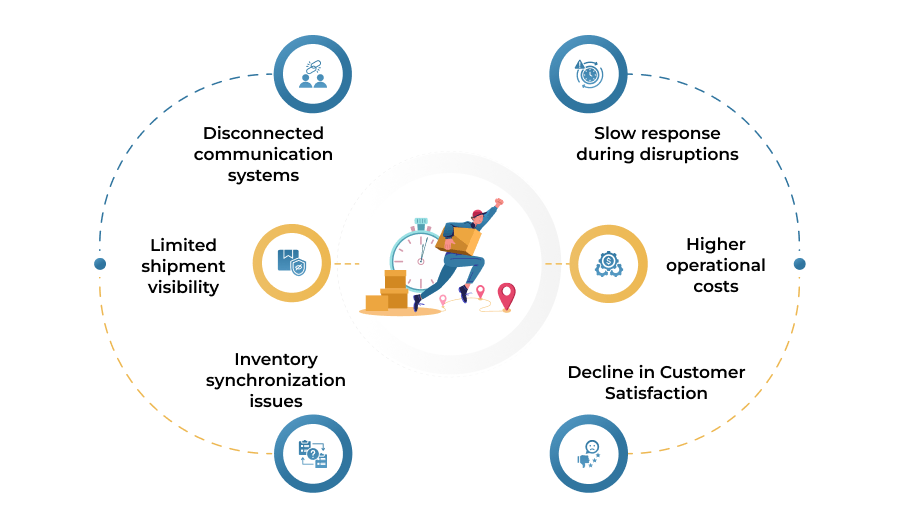
Disconnected Communication Systems Numerous logistics teams continue updating information manually and coordinating via emails and disconnected platforms. When teams fail to share enterprise data in real-time, delays become increasingly difficult to recognize and control between teams.
Limited Shipment Visibility Without relying on centralized tracking systems, companies cannot view shipments in real time, resulting in a lack of transparency to stakeholders. As a result, operational decisions are delayed when disruptions occur.
Inventory Synchronization Issues Inefficient coordination between the warehouse and the transportation team can lead to either stock shortages or excess stock. Both scenarios can increase costs, negatively impact order delivery accuracy, and ultimately diminish the quality of customer service.
Slow Response During Disruptions When logistics partners are not connected through automated workflows, businesses take longer to respond to route changes, transportation failures, or supplier delays.
Higher Operational Costs Poor coordination increases emergency transportation expenses, manual intervention efforts, and delivery recovery costs. Studies show delivery disruptions can raise logistics costs by nearly 15–25%.
Decline in Customer Satisfaction Customers begin to distrust companies that deliver their packages late and give them inaccurate updates. Studies show that nearly 57% of companies have poor delivery performance because they do not have coordination and/or real-time visibility.
A common issue in contemporary enterprise logistics is poor communication across networks. The supply chain is a network of suppliers, warehouses, transporters and distributors, and good supply chain management requires that these elements work in unison. Poor communication results in operational problems that can escalate and infuriate customers.
Real-time collaboration is difficult in systems reliant on manual updates. Shipment delays and inventory discrepancies are common when fragmented systems are used, and operational response to disruptions is slow.
Decision-making is critically impacted due to adverse visibility within the supply chain operations. To counteract this, businesses have established automated alerts for centralized tracking. These allow businesses to capture the delays and take corrective measures before disruptions occur.
Poor coordination results in operational cost increases and negative impacts on delivery performance and customer satisfaction. Supply chain disruptions increase logistics costs by 15-25% in many cases, while 57% of businesses suffer delivery performance problems from a lack of visibility and communication.
One major problem in current logistics operations is missing real-time tracking and alerts. Many businesses are still using legacy systems and manually report information, allowing small disruptions to become large problems. When a team is finally made aware of a delivery problem, it has often already disrupted inventory, changed transports, and updated schedule deliveries.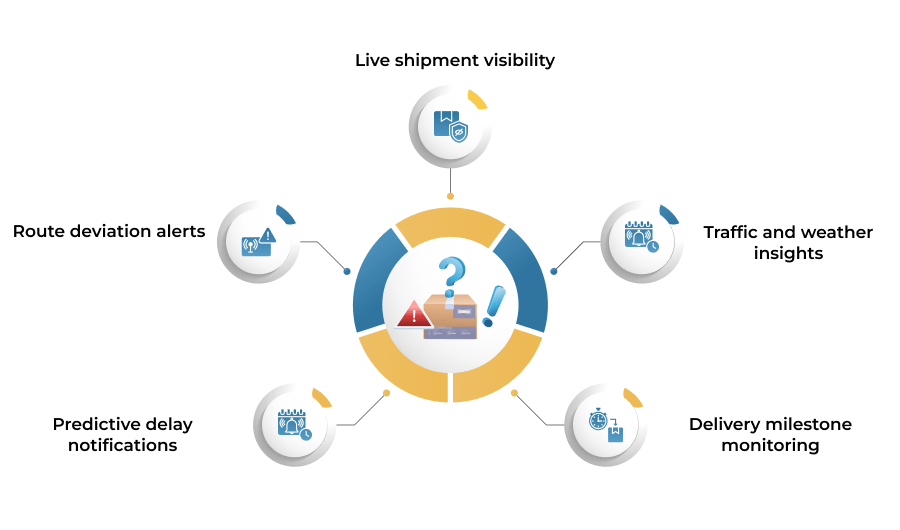
Research proves that the real time visibility of logistics systems can deliver a 20-30 percent increase in internal delivery and shipment disruptions, while externally disrupting customer complaints.
Logistics management that uses big data is crucial for businesses to be more operationally robust and to mitigate disruption in deliveries. Collection of data from multiple sources like GPS, IoT devices in warehouses, management systems for fleets and deliveries, and even the customers, allows organizations to view the supply chain with better clarity.
Analyzed properly, logistics data provides businesses with the potential to mitigate disruptions in their operations. Predictive analyses can identify and quantify the probability of congestion in any delivery route, lateness of suppliers, worker delay, and increased demand. With this information at hand, enterprises can be proactive and devise mitigation strategies to effect delivery on time.
Logistics intelligence driven by AI makes businesses more skilled in making less costly and better delivery decisions. Safe delivery to customers, resource allocation, time of delivery, and the order in which deliveries are made are all made better by the real-time operational intelligence that the AI provides. Uncertainty is minimized more than is possible with strategic decisions, thereby increasing supply chain performance.
Predictive logistics improves business operations immensely. Research indicates that logistics drives a cost recovery of almost 15%, on-time delivery is improved by 20%, and disruption is managed much more efficiently.
To minimize delivery disruptions and maximize supply chain efficiency, collaboration and connectivity across stakeholders is of utmost importance. With modern logistics networks, connected communication and shared operational visibility across suppliers, warehouses, transporters, distributors, and customer service teams are essential. Without these, even minor disruptions can affect the entire logistics chain.
Benefits to the supply chain with connected shipment visibility:
Transparent Shipment VisibilityStakeholders can see the shipment’s progress in real-time using centralized shipment visibility monitors. This reduces confusion and enables disruption to be addressed more swiftly.
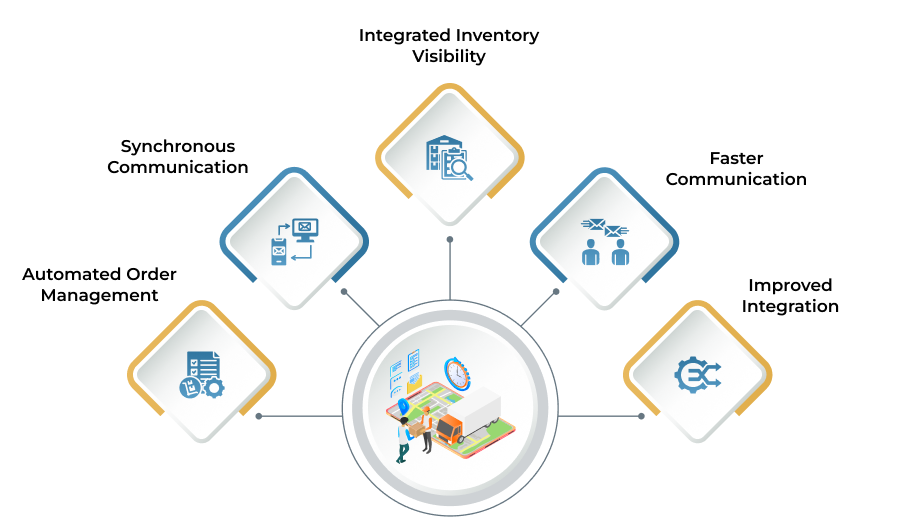
Automated Order Management: Automated systems share operational order management updates to every department Interruption in the order management updates reduces the need for coordination, thus improves accuracy of response in case of disruptions.
Synchronous Communication: Synchronous systems allow logistics teams to update their trade partners in order to share disruptions on the route, issues with inventory, and transport issues.
Integrated Inventory Visibility: Combined inventory networks allow warehouses, suppliers, and distributors to share visibility of changes within their systems more efficiently.
Faster Communication: Operational disruptions are addressed faster as teams are alerted and notified of changes more quickly.
Improved Integration: Digital collaboration and optimization enable more efficient coordination of transport and delivery systems.
Improved operational efficiency is possible through digital collaboration and better trade systems.
To prevent cascading failures in logistics, companies need to implement advanced operational frameworks that prioritize prevention, rather than reaction, in the face of disruptions. Modern supply chains are dynamic. Even a slight disruption can cause a ripple effect, impacting the entire supply, transport, storage, and delivery sequence to the customer, across various points of the chain.
A key operational strategy to overcome this limitation is the diversification of your supply chain and logistical transport. Multiple simultaneous suppliers and partners effectively lower the risk of operational disruptions, allowing businesses to continue delivery in a seamless manner.
Furthermore, advanced warning automation of centralized visibility and control along the entire logistical network provide optimized inter-partner control delivery via automated real-time status updates to counter disruptions along the shortest route, employing full network visibility and control.
Predictive Supply Chain Management and logistics systems, when used in tandem, have shown to lower disruptions and delays substantially, and boost the supply chain efficiency of the entire business operational system by approximately 1/4.
Managing delays with a proactive approach improves positive outcomes in the supply chain. Through real-time tracking with the advanced use of predictive analytics and automated alerts, managers of future facing supply chains can understand their risks and respond to them quickly and begin to avoid the damaging effects of delays to multiple levels of critical operational processes.
Faster response times create operational stability which improves the likelihood that delivery disruptions will be avoided. Real-time tracking provides logistics the transparency that allows disruptions to be negatively counteracted with immediate actions.
Risk of higher operational costs can be avoided in the early stages of delay which improves costs of operations. The use of predictive logistics systems allows firms to be 15 – 20% lower in costs associated with the planning of disruptions and the costs of recovery and emergency transport. Reverse logistics visibility and connected workflows are becoming essential for improving supply chain efficiency.
Stronger trust and satisfaction in customers is positively correlated with improved outcomes in predictive delivery logistics and communication systems. Firms with advanced transparency in their logistics systems enjoy a 30% increase in post rating customer satisfaction when compared to firms with limited predictive systems.
Greater improvement of automation in forecasting along with a decrease in the needs for manual touch is attained in supply systems that are connected and logistics systems that are resilient. These supply systems allow firms to operate in a more efficient and effective manner with an improvement of nearly 25% of the resilient supply chain system.
Many organizations discover that automation alone cannot solve hidden operational weaknesses without intelligent systems For most modern companies, controlling the chain reactions that occur during normal operations is the most difficult aspect of the logistics discipline. Even with the latest technologies, companies often do not detect disruptions until it is too late to prevent their spread throughout the system. For the most part, operational complexity, disconnected systems, and a lack of control cause the failure of logistics systems.
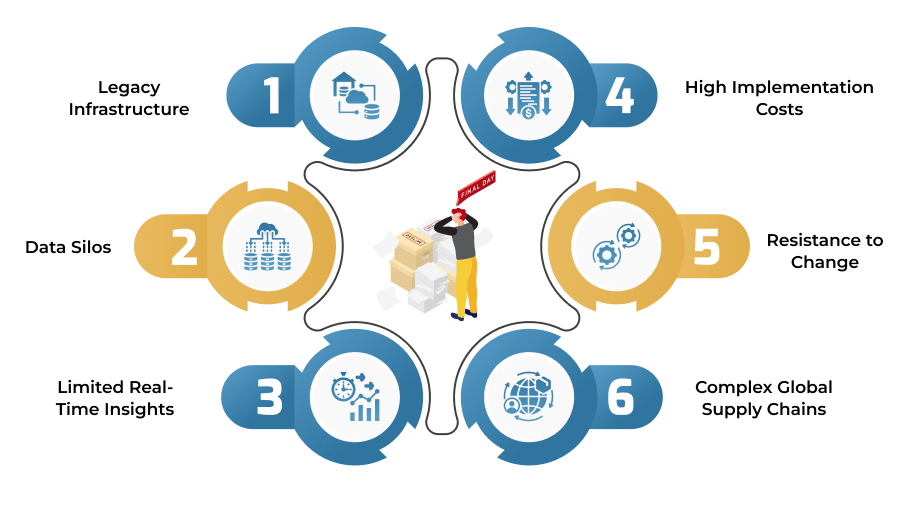
Legacy Infrastructure A many companies’ logistics systems have not kept pace with modern advancements and do not provide real time cross-department operational coordination.
Data Silos Disconnected systems that operate independently of one another cause a lack of visibility and a high rate of inaccurate data. Multiple systems to transfer fragmented supply chain data prevent the rapid flow of decisions.
Limited Real-Time Insights In some cases, companies have done little to adopt advanced tracking and predictive monitoring. Lacking visibility to supply chain disruptions prevents rapid response.
High Implementation Costs Many companies struggle to digitally transform operations due to the high embedded costs of system upgrades, changes to infrastructure, and implementing employee training.
Resistance to Change The new automation of workflows through AI for logistics systems is a fundamental change, and operational teams find this difficult to adapt to and so resist.
Complex Global Supply Chains Good control of global logistics networks is drastically limited by the complexity of supply chain disruptions and the difficulty of managing geographic and regulatory constraints.
About seventy percent of supply chain leaders are in the same situation as the companies with outdated logistic systems and are suffering from similar high operational disruption risks.
The future of delivery systems is intelligent, connected and flexible.
Disruptions in today’s digital supply chain are being handled using Artificial Intelligence (AI) and Adaptive Machine Learning (ML) along with (IoT) and digital twins.
The logistics delivery systems of the future will be capable of:
With digital twin technology, enterprises will be able to simulate logistics disruptions and test operational responses to disruptions before making changes in the real world.
Sustainability goals will also influence delivery systems of the future. These will include transportation systems with optimized routes and reduced fuel consumption and systems with a sophisticated utilization of resources.
Those enterprises that are investing subsantially in intelligent logistics ecosystems today are more capable of meeting tomorrow’s operational challenges.
Delivery delays have always marred company operations. Today, isolated delays have become global disruptions, affecting entire supply chain systems.
Modern delays affect more than one part of a company. They can cascade through every part of the supply chain affecting customer satisfaction, inventory control, even the company itself. Each disruption increases the severity of the delay. There is simply no way for someone outside the shipping company to see the multiple subdued delays.
To counteract delivery delays, businesses need to use logistics that incorporate automation, data, and operational-planning.
If companies combine opacity, automation, and prediction together, they can more swiftly overcome and even compete in once-ahead markets.
Those who see and counter delays in the supply chain most will dominate logistics for years to come.
12 Oct 2026

08 Oct 2026
05 Oct 2026