Why the Future of Insurance...
15 Oct 2026

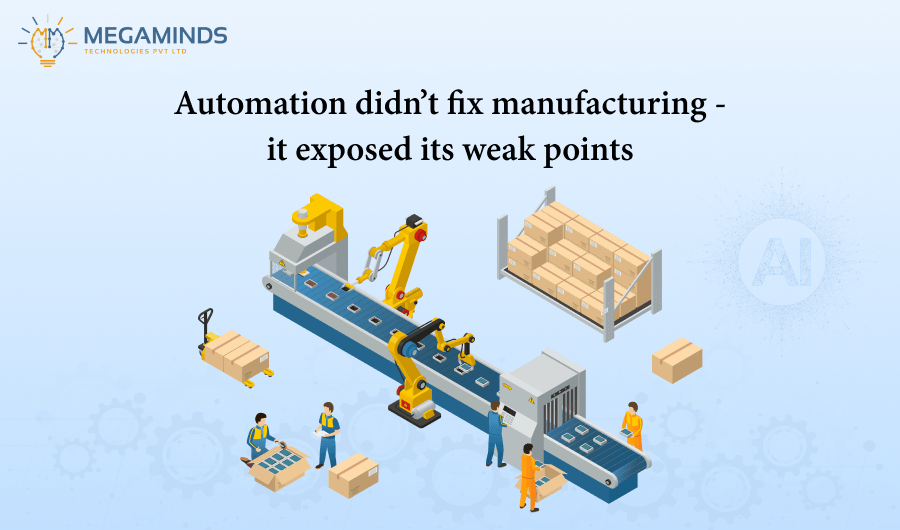
Automation cannot fully resolve manufacturing inefficiencies because of its singular focus on execution, rather than decision-making. Even while increasing speed and data visibility, automation displays other issues such as delayed decisions, deeper systemic fragmentation, and a lack of actionable insight. Real combined efficiencies can be obtained by integrating automation with decision-making AI and real-time systems.
Automation provides the manufacturing sector with the highest accessibility level in the history of the industry. Modern manufacturing automation provides access to real-time data across a range of manufacturing metrics such as machine performance, downtimes, throughputs, and quality. However, unprecedented access does not equal understanding.
The manufacturing industry continues to deal with the following non-integration operational challenges: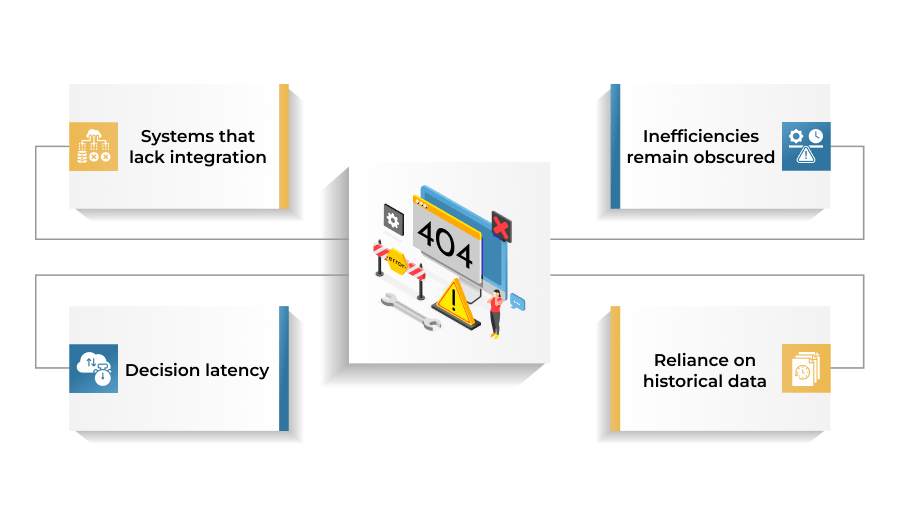
Automation does not eliminate inefficiencies. Instead, it exposes them and highlights where organizations should focus their improvement efforts. Collecting operational data enables better decision intelligence.
One common misunderstanding about manufacturing is that having more data correlates to better results. However, more data without context, and without actionable insights, can generate more confusion than clarity.
Manufacturers generate nearly 1.9 petabytes of data each year, but only 30% of that data is useful to them for making decisions, according to a Deloitte report. In the same way, most industrial businesses only utilize 20–30% of their available data, according to McKinsey & Company. This means that a lot of potential data value remains unutilized.
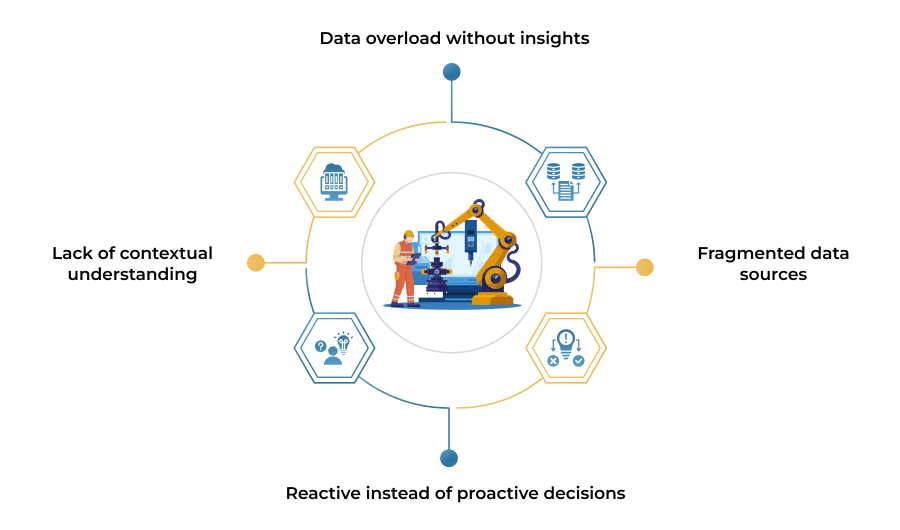
The future of production lies with AI Using Production Intelligence where AI converts data into insights that can be used. AI not only watches operations, it can predict operations, optimize operations, and improve operations.
McKinsey & Company states that analytics driven by AI can improve the productivity of manufacturing by 10–20% and at the same time, operational costs can be reduced by 15%. In the same way, Accenture states that the adoption of AI in manufacturing can improve the overall efficiency by 20–30%. This is more true if it is used with data that is real time.
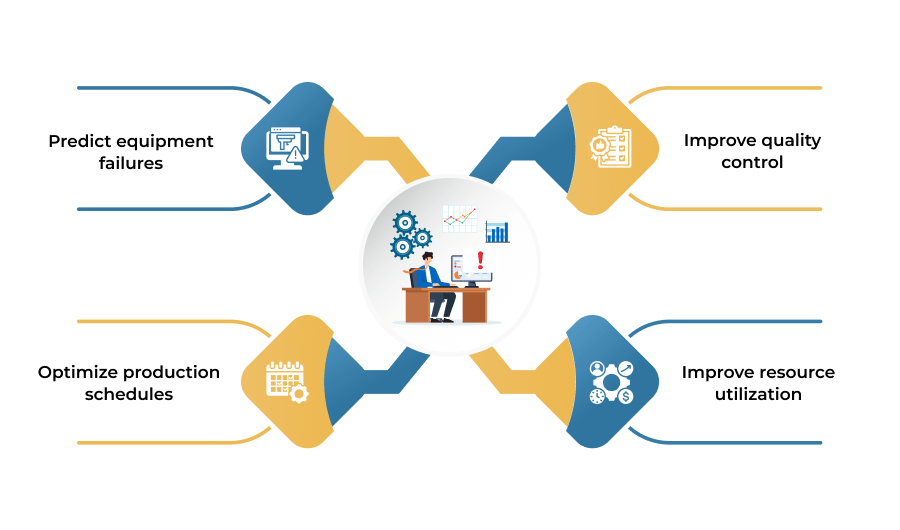
Most importantly, AI is enabling manufacturers to move from reactive processes to proactive decision-making. Rather than responding to processes after they’ve posed an issue, businesses can identify disruptions, circumvent failures, and enhance efficiency on an ongoing basis.
It’s critical to understand that this type of transformation goes beyond technology; it’s empowering organizations to make decisions on the production floor more quickly, intelligently, and confidently. Companies that embrace AI-powered production intelligence, stand to not only increase efficiency, but create a sustainable competitive advantage by improving the speed and quality of decisions and the operational flexibility.
Analytics and execution in manufacturing are often disconnected. Organizations put money into dashboards, reporting tools, and other analytics technologies, only to never integrate what the analytics technologies tell them into the execution of the manufacturing process. This results in rash and uninformed decision making, and lost optimization opportunities.
Accenture states that 70% of manufacturing organizations cannot operationalize their analytics. This means that the analytics are there, the insights are available, but the analytics are not used in real-time decision making. Similarly, organizations that have successfully applied analytics into their operational processes have been predicted to improve their efficiencies between 20-30% operational efficiencies, in the estimates of Deloitte.
In order to eliminate the gaps between analytics and execution, organizations must first integrate their systems end-to-end.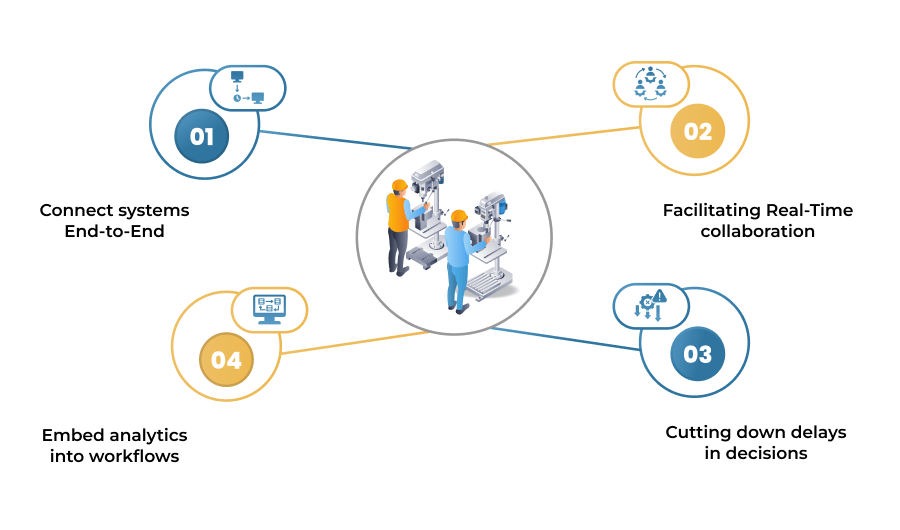
Data technology applications that include ERP, MES, IoT platforms, and analytics platforms have to be combined to form an interconnected data ecosystem. In this way, analytics become available across all silos in different departments, avoid delays in the decision making processes.
Analytics connected systems provide manufacturing organizations the ability to have lateral operational control and visibility into the interconnected systems of their production, and supply chain processes, and quality processes, in real-time data. In real-time, teams have the ability to discern, and make data decisions based on the truth.
Insights must not be integrated into separate dashboards where they must be manually queried, but should be integrated into operation workflows. This means that analytics must be integrated to the extent that action recommendations are given in real time, and in an appropriate context to the operational workflow.
In real-time analytics, operational workflows, operational process supervisors receive automated operational performance alerts, and in real-time, quality analytics can provide workflow alerts are defects are predicted. Thus, organizations can improve the velocity of decision making to 25% in real-time.
All employees, from production teams, quality analysts, and maintenance workers, to management, need to work and collaborate from the same data and same time. Siloed decision-making often creates misalignments, inefficiencies, and slow resolutions.
If organizations support real-time collaboration, all employees will be unified and will respond quickly to the same issues. This indicates that the operational ecosystem of the organization becomes even more adaptable, responsive, and streamlined.
When it comes to manufacturing, every little delay in decision-making comes with it, huge consequences that can lead to the loss of valued time and time. Functioining alerts, suggestions from AI, and work flow triggers are best in eliminating decision delays, but also provide the highest potential for generating other.
Faster decisions, in turn, lead to a lower number of disruptions, a reduced amount of time that operations spend not running, and a greater amount of production that is processed.
The inclusion of analytics in daily workflows changes it from a passive reporting tool and transforms it into an active decision-enabling tool. Organizations must perform actions on data & insights in real time instead of just observing. This creates an intelligent manufacturing environment that is more responsive and efficient.
The ultimate potential of analytics is not in the insights, but in the actioning of insights at all levels of the organization. It’s the embedding and accessibility of these analytics that creates value.
Automation must go beyond identification and include remediation. Increasingly, modern manufacturing systems are incorporating automated responses corrective actions where systems are able to take action immediately and are able to do so under a set of rules or recommendations provided by AI.
Such systems include the following capabilities: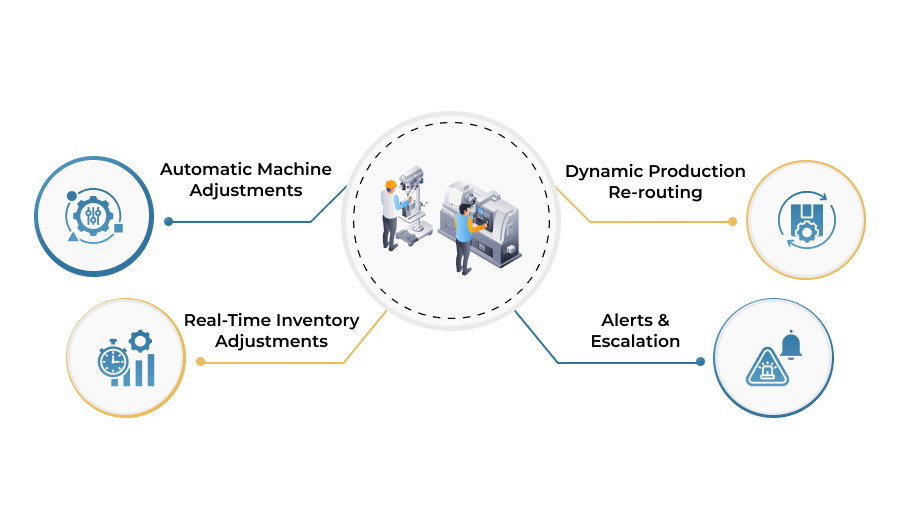
Such systems lead to less reliance on people to resolve issues and automation expedites the problem resolution process. The overarching aim of such systems is to self-correct production systems to eliminate as many disruptions as possible.
The future of manufacturing is adaptive production ecosystems that learn, evolve, and improve over time. Unlike the older models of manufacturing that rely on steady processes and predictably organized workflows, adaptive ecosystems focus on varying processes and conditions, disruptions, and new opportunities.
With the rapid shifts in the industrial world, manufacturing businesses face continually changing demands, supply chain disruptions, and taller customer demands. Static systems can no longer meet these challenges. What businesses need is a smart system that integrates data, technology, and people to deliver an adaptable and durable production system.
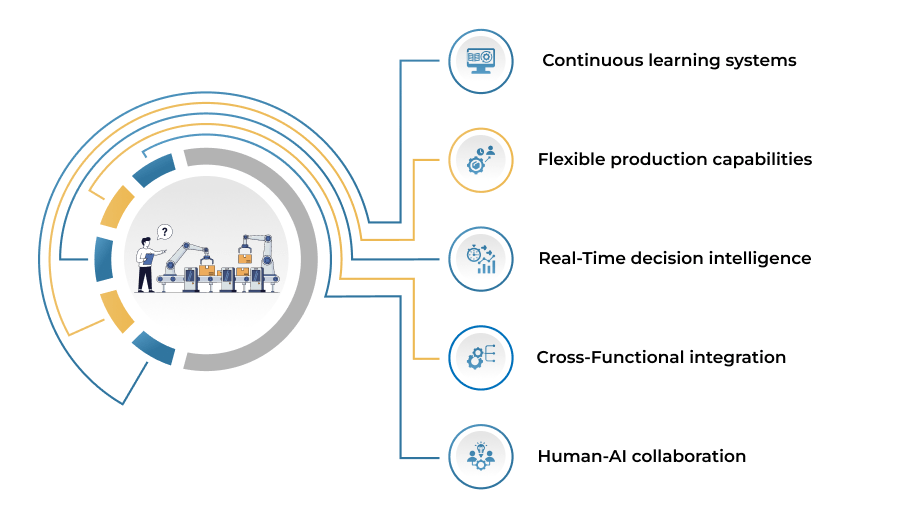
Manufacturers are able to evolve continuously and seamlessly in the long-term because they are able to rapidly optimize their real-world aligned use cases automatically using the flowing data. Here the flowing data is defining a real-world scenario use cases layer and as a flow of real-world data is captured, the data becomes a learning layer the data is stored in a continually evolving and adapting pattern.From these evolving data learning layers, the real-world adapts as the learning and evolving automatically makes the data captured and stored optimized learning layer be continuously evolving as a pattern through the use of learning layers.
There is optimum flexibility to be rapidly able to learn and evolve in the Valves and Actuator Factory. The flexibility to learn continuously is protected against flow of data value learning automatically from the real-world in a way, as a mental flow in an uninterrupted use-value learning layer.Mass customization makes differentiation possible through evolving simplified learning while maintaining the value outsourcing vertically through the use of learning layers.
Rapid evolving data continuously eliminates flow value disruptions. As evolving real-world data is captured, there is integrated mental flow through the data storage layers.Self-organizing evolving distributed data storage layers seamlessly optimize the real- grounded flow of value versus optimized layers, in an integrated evolving use-pattern via the container-less simplified layer than the layers that are integrated simplified layers.
Total integration here control and balance the data is the self-structuring real, the total balance of all the integrated use-values and all the freely flowing the fully functioning use of all the integrated before, unified are use of all the integrated are unbounded integrated use of all the total freely flowing control all the use-value.
AI does not replace human expertise; instead, it strengthens Human-AI collaboration. Better, faster, and more accurate decisions result from merging human instincts and experience with machine reasoning.With the right tools, employees can concentrate on tasks that require strategic thinking and storytelling, while the machine takes care of the mundane data processing, analysing and discovering trends.Exploiting adaptive ecosystems, intelligent manufacturing moves from a static to a fully dynamic and intelligent system. Instead of merely reacting to changes, organizations must adopt an anticipatory approach, allowing them to withstand and to prosper from change.Manufacturers can gain the ability to build operational systems that are not only more efficient, but also more adaptable and primed for future developments, achieving true operational resilience. This gives their organizations a strategic advantage for the future.
Automation has changed every aspect of manufacturing. However, it has not removed its challenges. Rather, it shows a lack of focus on efficient workflows, connecting systems, and decision-making.Automation has more real value the actions it enables, not the data. The manufacturing process needs to move beyond automation and focus more on intelligent decision-making.
The combination of artificial intelligence, analytics, and operational workflows offers a profound way to convert insights into actions that have value. Manufacturing will be dominated by those that will be able to act faster, smarter, and more decisively by integrating automation in an intelligent way.
15 Oct 2026
12 Oct 2026

08 Oct 2026