Why Organizations Invest in Tools but Still Move Slowly
Though most companies have heavily invested in analytics, AI, and low, code platforms, their release cycles still appear to be painfully slow. Gartner predicts, that by 2025, 70% of new apps will be produced through low-code/no-code platforms.”
Despite the introduction of dashboards, the initiation of pilots, and the acquisition of licenses, frontline teams still have to wait for weeks for responses or approvals. The real problem behind such legacy behaviors is the continuation of hierarchical decision, making, risk, averse governance, and segregated ownership of data and processes, which are not technology related. Therefore, without a change in culture, each new tool will not speed things up but rather add another layer to the already overloaded system.
The Tool Trap: Buying Power BI, AI, and Low-Code Without Changing Mindsets
Many businesses make the mistake of believing that investing in cutting-edge platforms will instantly turn them into digital-first businesses, a phenomenon known as the “tool trap.” Industry analysis shows that tools without culture and process change rarely deliver expected transformation outcomes. Fundamental principles of trust, experimentation, and responsibility are maintained even when vendor case studies are distributed inside and licenses are obtained.
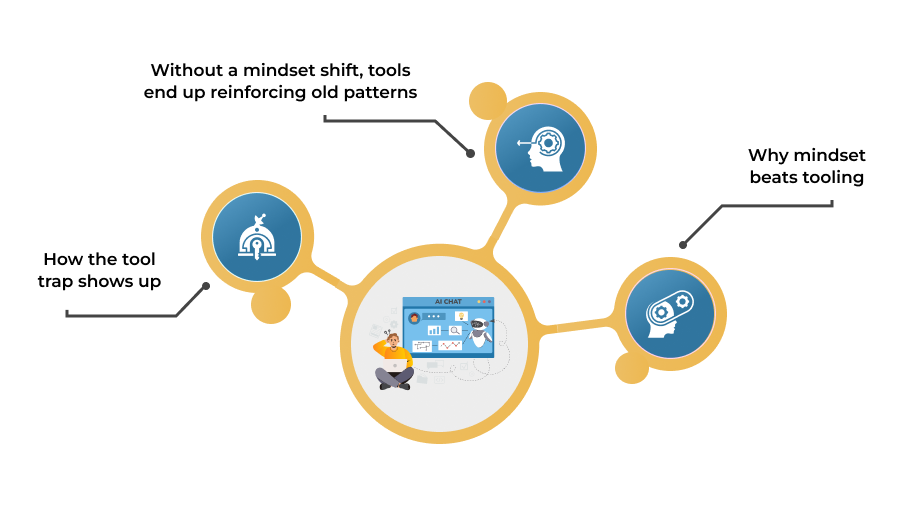
How the Tool Trap Shows Up
Organizations implement tools as one-time projects rather than as part of a long-term operating model.
Central IT manages all system changes, which forces business users to wait for even the smallest updates.
Many organizations use AI models and dashboards only for reporting instead of embedding them into regular business decisions.
Without a mindset shift, tools end up reinforcing old patterns:
Many organizations test AI in limited use cases instead of integrating it into managers’ daily decision-making and performance measurement.
Many organizations restrict low-code platforms to experimental environments instead of using them in core business operations.
Instead of being a real-time decision fabric, Power BI turns into a more attractive version of static monthly reports. Instead of more reports, organizations need dashboards that actually drive decisions and actions.
Why Mindset Beats Tooling
A culture of speed assumes that:
Close to those receiving services, choices gain clarity. Where information lives, judgment improves. Proximity shapes better outcomes
A single purpose drives every useful tool: cutting through clutter instead of adding noise. Smooth progress matters more than extra features piling up.
What counts is how easily work moves forward when obstacles fade away
Frequent attempts matter more than perfection, because insights grow when changes follow quickly after setbacks Where trust runs low, tools add clutter instead of clarity. Speed grows only when shared goals shape how people work together.
How Data Delays and Approval Loops Kill Speed
Speed is rarely lost in coding or configuration; it is usually lost in waiting—for access, for approvals, for someone senior to “sign off” on the obvious.
The Hidden Cost of Data Delays
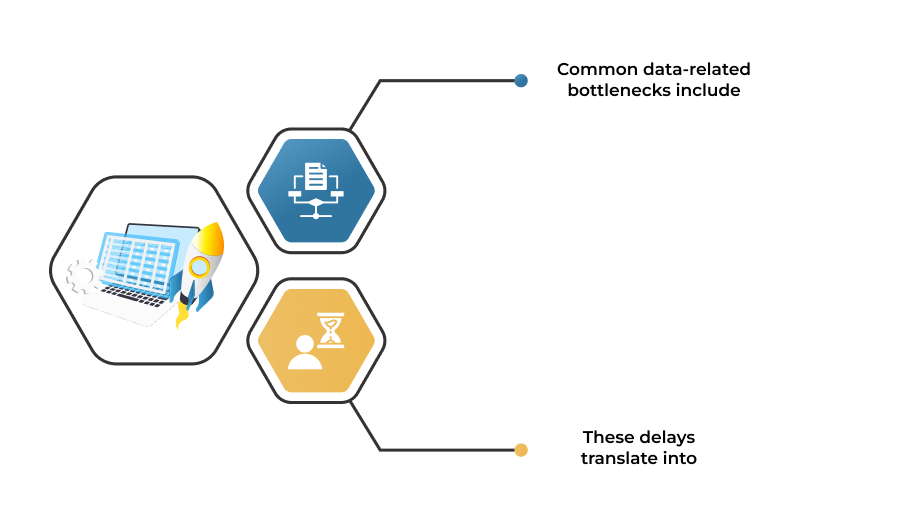
Common data-related bottlenecks include:
awaiting the creation or updating of reports from a central team.
complicated data access procedures that need several permissions for straightforward inquiries.
fragmented data sources that cause even rudimentary analysis to be unreliable and slow.
These delays translate into:
Slower responses to problems with customers or moves by competitors.
Missed chances to run promotions, campaigns, or change prices.
Teams making decisions on gut feel because the data arrives too late to matter.
Approval Loops as Speed Killers
Approval-heavy cultures put layers of sign-off between insight and action.
Typical patterns:
Every dashboard change requires a mini-governance ceremony.
AI or automation changes require executive approval—even for low-risk internal workflows.
Low-code apps built by the business sit in “review limbo” for months.
Research on automation and analytics reveals that companies achieve significant results when they streamline their processes and have just enough governance to enable frequent iterations. Instead of becoming mired in multiple checkpoints, fast-moving organizations develop governance mechanisms that offer clarity and control.
Power BI as a Culture Shift: From Reporting to Real-Time Decisions
When utilized as static reporting tools, Power BI and related BI platforms are not revolutionary; instead, they become transformative when they alter daily decision-making.
From Rear-View Reports to Live Command Center
Traditional reporting:
focuses on the events of the previous quarter or month.
exists in sent PDFs or slide decks.
is typically used by managers during recurring evaluations.
A culture of speed uses BI differently:
Dashboards display indicators that are directly connected to operational levers in real-time or almost real-time.The same analytics are accessed and used by frontline staff as well as leadership.
Discussions on performance shift from “what went wrong last month” to “what can we adjust this hour.”
By seeing problems before they become more serious, companies that use real-time and predictive analytics minimize “speed bumps” in their operations. With this change, BI is no longer a reporting requirement but rather a component of the operational nervous system.
Empowering Non-Technical Teams with BI
When BI is democratized:
Without waiting for end-of-month statistics, sales teams may evaluate the health of the live pipeline and modify outreach goals.
Instead of responding to quarterly KPIs, HR professionals monitor hiring funnels or attrition risk and take proactive measures.
Drill-downs and visual warnings are used by operations teams to address bottlenecks as they arise.
This requires:
instruction on data literacy rather than merely using tools.
Metrics and action thresholds should be clearly owned.
norms that empower teams to make choices without always seeking approval from managers.
To put it succinctly, Power BI only speeds up a business when it establishes a decision culture rather than a reporting culture.
AI’s Real Role: Reducing Uncertainty, Not Replacing Judgment
AI is often marketed as a substitute for human labor, but in high-stakes business situations, its true potential lies in lowering uncertainty to enable humans to make better, quicker decisions.
AI as an Uncertainty Compressor
Research on AI in decision-making demonstrates how AI tools assist managers in navigating challenging, unclear situations. Recent studies show that visualizing AI uncertainty can significantly improve users’ trust and decision quality by:
handling massive amounts of data that are too big for human processing.
supplying probabilistic projections rather than binary responses.
assessing many possibilities in order to assist with strategic planning.
Used well, AI:
identifies the most likely outcomes, hence narrowing the decision space.
draws attention to trends and anomalies that others might overlook when pressed for time.
enables executives to act more quickly and confidently by offering understandable insights.
Augmentation, Not Autopilot
Additionally, research indicates that managers continue to worry about the fairness and bias of AI, which emphasizes the necessity of human control and ethical evaluation.
AI is quickly adopted by well-established businesses as a copilot for analysis and advice rather than a completely independent decision-maker.
A technology that is integrated into sales, HR, operations, and finance workflows to expedite regular choices while people manage trade-offs and exceptions.
Practical examples:
AI prioritizes leads or tickets so that teams concentrate on the most important ones first.
Account managers prioritize the appropriate discussions by using AI to identify churn-risk consumers.
AI helps to simulate the impact of changes to pricing or personnel before decisions are made.
When leaders maintain their own judgment, accountability, and ethical standards while teams use AI to present options and reduce ambiguity, results are accelerated.
Low-Code Platforms: Empowering Teams to Build Without Waiting
Modern low-code and no-code platforms can significantly reduce development cycles. These solutions help organizations deliver applications faster while reducing dependence on centralized IT. As a result, businesses can accelerate innovation and respond more quickly to changing customer and market demands.
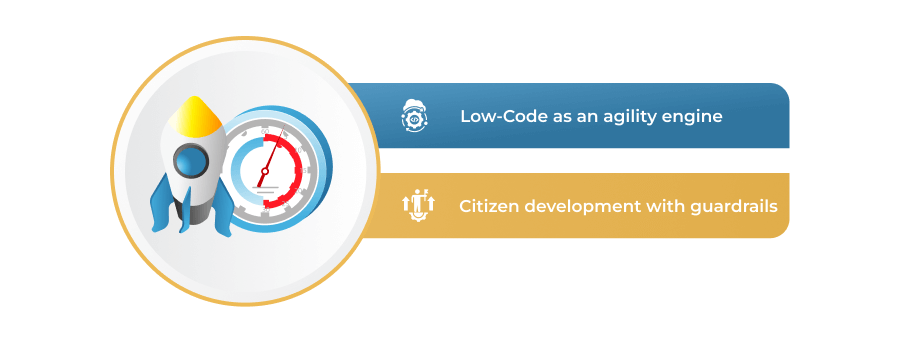
Low-Code as an Agility Engine Industry research highlights:
By 2025, roughly 70% of new applications will use low-code or no-code technologies.
Companies can use low-code or no-code to reduce application development time by as much as 70%.
43% of businesses that use low-code say they are more flexible than they were previously.
These gains come from:
platforms for visual creation that use reusable parts and templates.
quicker cycles for testing, deployment, and prototyping.less dependence on highly specialized, limited development abilities.
Citizen Development with Guardrails Citizen development with appropriate governance is the true unlock for CTOs and CIOs:
Workflows, forms, and apps are immediately created or modified by business teams using low-code technologies.
Rather than manually coding each feature, IT establishes standards, security patterns, and integration frameworks.
With explicit guidelines, a tiered model distinguishes between “business-owned” and “IT-owned” apps.
When culture supports this:
Without having to wait months for IT, sales operations can automate territory changes or quote approvals.
HR doesn’t need to undertake large investments to create onboarding workflows that work with current platforms.
Operations can swiftly and iteratively digitize manual checklists or compliance procedures.
Fundamentally, low-code is a trust technology that only speeds up an organization when managers are prepared to let more individuals create, automate, and enhance their own procedures within carefully thought-out boundaries.
When Data, AI, and Apps Work Together, Speed Becomes Natural
When analytics, AI, and applications are planned to function as a unified flow rather than as discrete projects, speed becomes a feature of the system.
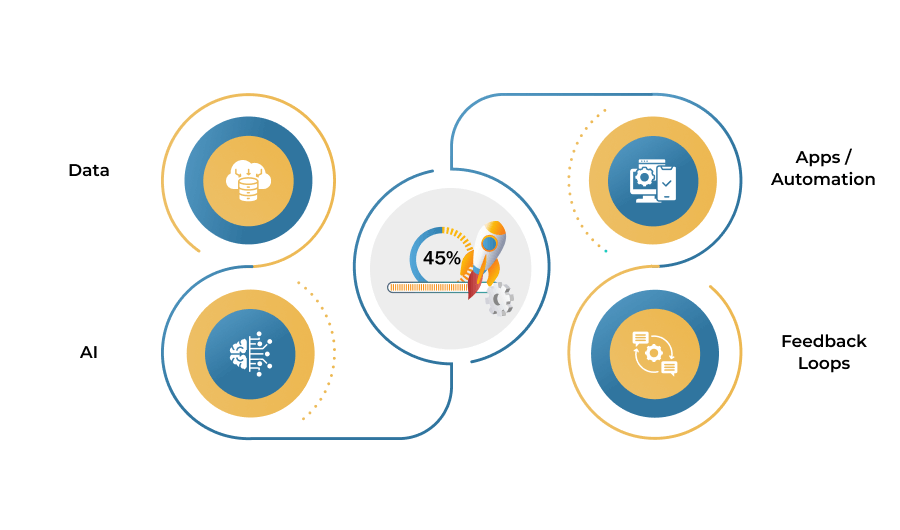
The Integrated Speed Loop A high-speed digital operating model often looks like this:
Data
Data flows into BI platforms in a clear, easily accessible, and almost real-time manner.
What constitutes “good” is determined by shared metrics among teams.
AI
Based on that data, models forecast demand, churn, risk, or anomalies.
Users are presented with recommendations rather than just raw scores.
Apps / Automation
Low-code processes carry out activities, start campaigns, escalate problems, and change thresholds.
Routine tasks are automated; humans concentrate on those requiring a lot of judgment.
Feedback Loops
Results are fed back into data systems.
Workflows are constantly changing, and AI models are constantly retraining.
Because every choice and action becomes a learning opportunity rather than a one-time occurrence, organizations that create this loop experience compounding advantages in speed and scalability.
Culture as the Glue This integrated loop only works when the culture:
promotes cross-functional cooperation between business, IT, and data teams.
avoids “automating chaos” by giving process simplification precedence over automation.
Instead of using tool usage indicators, incentives are linked to outcomes (such as cycle time, customer impact, and time-to-decision).
In these settings, speed is not imposed; rather, it arises organically from the daily interactions between people, data, and tools.
What Fast Organizations Do Differently with Analytics and Automation
Fast firms act differently in terms of how they define work, empower individuals, and gauge success; they are not just more “digital.”
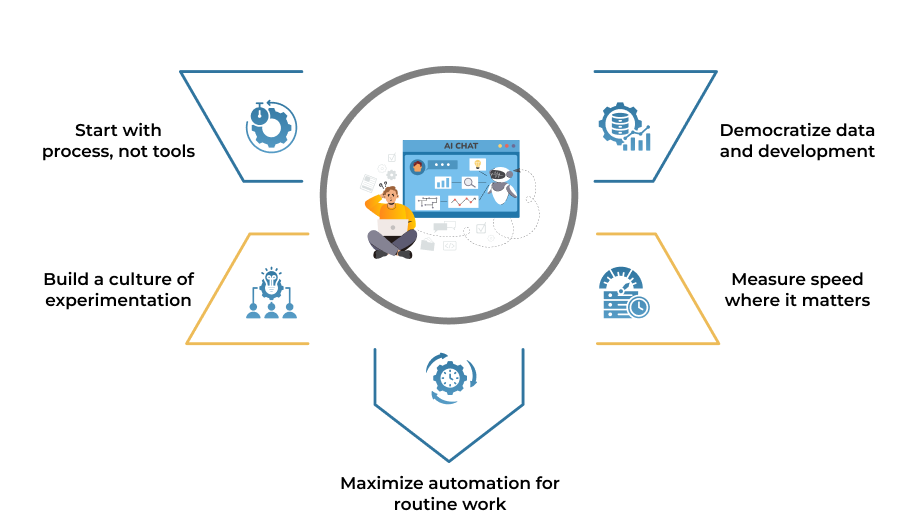
Practices That Enable Sustainable Speed
Start with process, not toolsThey simplify workflows before automating, recognizing that broken processes automated at scale create bigger problems.
Build a Culture of Experimentation: Leaders should encourage teams to ship small changes, learn from data, and iterate quickly instead of relying on large-scale transformations.
Maximize Automation for Routine Work: Organizations should implement automation where it eliminates repetitive manual tasks and allows employees to focus on higher-value work.
Democratize data and developmentData access is broad, within security limits, and low-code tools are widely available with appropriate training and governance.
Measure speed where it mattersMetrics track lead time from idea to production, time-to-decision, and impact on customer experience not just number of dashboards or bots deployed.
When cooperation, shared responsibility, and continuous improvement are ingrained in the culture, speed and reliability increase, according to research on DevOps and automation cultures. AI and analytics systems are based on the same ideas.
Conclusion: Technology Enables Speed Culture Sustains It
Power BI, AI platforms, and low-code solutions are not the source of speed; rather, it stems from a culture that values people, streamlines procedures, and makes decisions based on where the data truly lives. Analytics, AI, and automation can only become accelerators if executives reimagine governance, incentive, and collaboration structures in order to decrease friction, reduce uncertainty, and empower teams. Businesses that start with culture and then integrate technology have a double advantage: they ship faster, but they also learn and change faster, surpassing competitors in every cycle.
Why do companies buy tools like Power BI but remain slow?
Businesses engage in analytics and AI with the expectation of quick speed, yet platforms cannot provide true agility due to fragmented data, permission processes, and archaic attitudes. First, culture needs to change.
What is the "tool trap" in digital transformation?
The tool trap happens when businesses buy low-code or AI platforms without altering their decision-making procedures, which leads to more bureaucracy rather than more efficient operations.
How do data delays impact business speed?
Teams are forced to wait days for insights due to data delays, which causes them to miss out on market opportunities and make snap judgments that slow down customer response times.
What are common approval loops killing speed?
Approval loops turn short solutions into weeks-long procedures that hinder creativity and agility because they require several sign-offs for dashboard modifications or AI adjustments.
How can Power BI drive a culture shift?
By making real-time dashboards available to frontline workers and substituting immediate decisions linked to operational levers for monthly reports, Power BI transforms culture.
Why hasn't AI taken over human judgment?
When it comes to decision, making, AI is more like a co, pilot than an autopilot because it helps to reduce uncertainty by providing projections, however, it still needs humans to oversee ethics, context, and trade, offs.
What role does low-code play in speed?
Low-code allows non-technical users to create apps more quickly, reducing IT bottlenecks for faster workflow automation and cutting development time by 70%.
Quickly scale your development capabilities by hiring pre-vetted tech experts who align perfectly with your project goals, timeline, and company culture.
What to expect after you reach out?
1. Share Your Requirements
Tell us your project goals, tech stack, and resource needs for a perfect talent match.
2. Talent Shortlisting
We screen and shortlist top-tier professionals based on your exact technical and cultural fit.
3. Interview & Selection
You interview the candidates and select the ones that align with your expectations and company values.
4. Onboard & Integrate
Seamless onboarding process to ensure smooth collaboration with your in-house team from day one.
5. Monitor & Scale
We assist with performance tracking and help you scale the team as your project evolves.