From Manual Processes to Smart...
22 Oct 2026

The low-code approach is rapidly becoming the driving force behind enterprise transformation because it allows businesses to break free from lengthy IT-dependency cycles and move toward rapid and innovative development. It allows businesses to quickly deliver applications, automate processes in real-time, and rapidly adapt on a large scale.
For many years, software for business enterprises was fundamentally developed based on the waterfall model. Its pace was predictable, though very slow: first, the business units would deliver very detailed requirements documents; then the IT teams would go into coding sprints; and finally, after many months or even years, the solution would appear. Nevertheless, this traditional method is not only behind the times in the rapidly developing digital era but it can also cause severe problems. The main limitations of that approach are very obvious: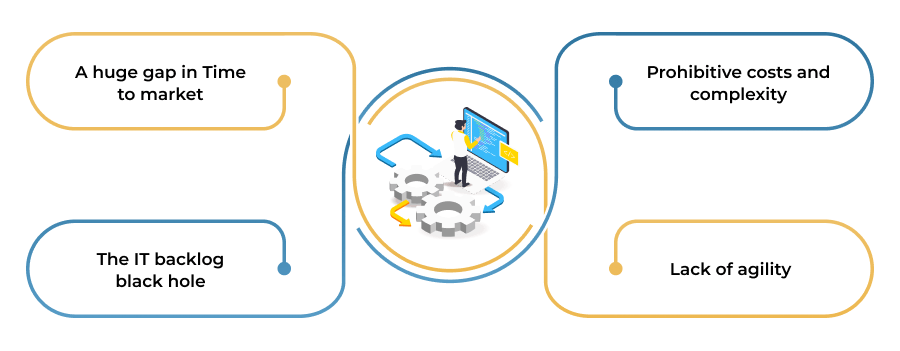
Slow Time to Market
A huge gap in Time to Market: Traditionally, coding moves very slowly. The entire development lifecycle begins with the initial request and ends with the final deployment. This process can take several months or even years to complete. By the time the application is ready, the market opportunity may have changed. A more agile competitor may have already captured it. Therefore, it is the delay that doesn’t allow one to be innovative.
The IT Backlog Black Hole
The IT Backlog Black Hole: Enterprise IT departments are forever carried away by a never-ending stream of requests. This results in the creation of a backlog that looks impossible to overcome. A Gartner study highlights the scale of the problem. For every application an IT department delivers, nearly ten more remain in the backlog. This bottleneck makes business users very unhappy, stops innovation, and promotes the rise of unauthorised “shadow IT.”
Prohibitive Costs and Complexity: Financially, traditional development comes with a huge drain. Organisations need highly specialized developers, and hiring them is expensive. However, the initial development cost is only the beginning. Long-term maintenance and legacy system integration further increase the Total Cost of Ownership (TCO). As a result, many applications deliver a negative return on investment over their lifetime.
Lack of Agility
Lack of Agility: Markets change, customers’ expectations change, and the government regularly issues new regulations. Traditional development models rely on fixed requirements. As development progresses, making changes becomes difficult and expensive. Therefore, the solution is almost always a day-old one on the day of its launch. It is not able to change to the business needs that it was supposed to meet.
Why Speed and Agility Matter More Than Ever in 2026
By the time 2026 rolls around, the landscape of business will be a war zone between hyper, competitive companies and those who are obsessively focused on customers. In such a world, speed and agility are no longer optional ‘nice to have’ features, but rather the main factors for survival and the ultimate winning strategy.
Low-code development platforms make it easier to do software development in a traditional way.Instead of writing thousands of lines of code, developers and even non, technical business users use visual, model, driven interfaces that provide drag, and, drop components, pre, built templates, and logic builders.
Think of it as the contrast between making a car from scratch (metal sheet) and assembling a car using first, class pre, engineered parts. Both will give you a car, but one is way faster and much easier.
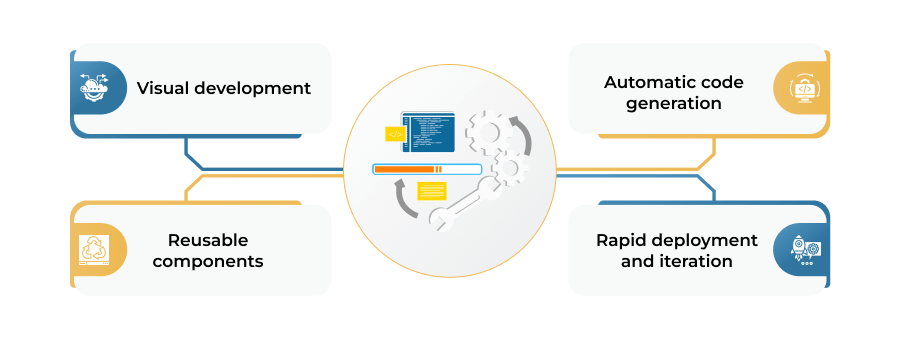
Low-code does not replace professional developers. Instead, it frees them from repetitive coding and allows them to focus on complex integrations, custom logic, and governance. At the same time, it enables business users to contribute through citizen development.
Low, code’s greatest and most profound effect is not on insignificant tasks, but on the core of the enterprise itself. The leading companies are not stopping at just creating simple forms, but they are radically changing their core operations with low code at scale. They do not have to do a costly “rip and replace” of their critical ERPs. Instead, they create agile, user-facing applications with low code that inject new life into their legacy systems. Such a strategy can offer a modern experience while avoiding the considerable risk and cost of a complete system replacement.
Moreover, low-code is extremely effective in integrating complex and cross-departmental workflows. Just imagine multi-million dollar procurement approvals or complex patient onboarding processes, now digitized and turned into one smart flow. Along with launching customer and partner portals, businesses enable self-service options and the real-time availability of supply chains. By solving these vital issues, low-code raises itself from just a tactical instrument to a strategic resource, thus business process automation and operational excellence become its foundation.
The traditional ways of running a business have led to a misleading dilemma: either go fast and cause disorder, or stay in control and become old-fashioned. CIOs are like those caught in the crossfire, where on one hand they have to make innovation possible and on the other, as the executives that keep the company in check, act as a barrier to “shadow IT, “the unregulated applications that bring about security flaws and data chaos.
Low, code presents a solution to this challenge by breaking the traditional view. It offers a new operating model: governed empowerment. In this way, IT is no longer considered a bottleneck but an enabler of innovation without losing security or control.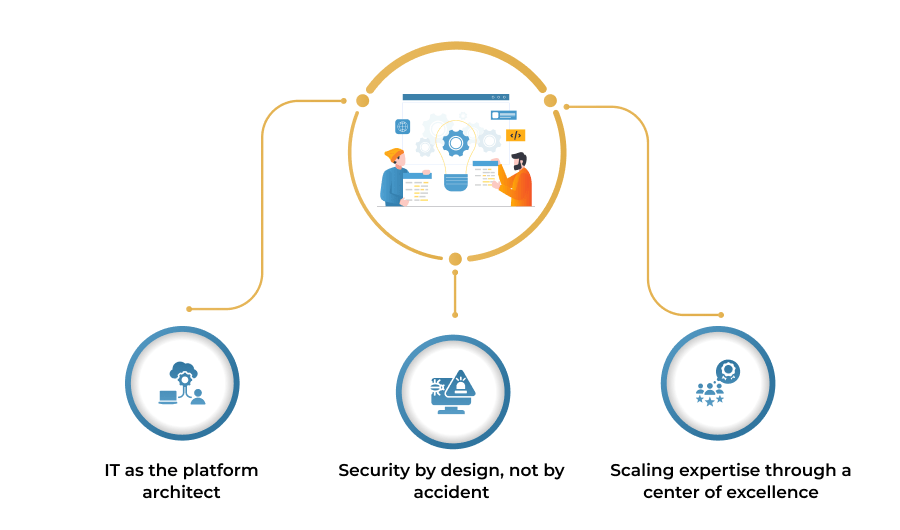
The cooperative approach is essentially about eliminating the barriers between business and IT departments. It allows business teams to fully leverage their business expertise and, at the same time, IT is provided with the tools to effectively manage the whole. Therefore, the entire enterprise turns into a strong, agile, and safe engine for ongoing transformation.
An enterprise platform must not operate in isolation. The top low-code platforms nowadays are designed with integration in mind. These platforms offer a comprehensive range of pre, built connectors for the most important enterprise systems such as Salesforce, SAP, Oracle, and Microsoft 365. Besides, they provide powerful API and webhook features that allow connecting to any custom or on, premise system.
Also, low code has a significant part in making AI and machine learning at the edge more accessible. Using low, code, enterprises are able to create software applications that communicate with AI models for:
This ability to seamlessly integrate data, core systems, and cutting, edge technologies via low, code is turning low, code into a key layer of a role, model enterprise architecture.
Security, compliance, and scalability are the aspects whose importance cannot be questioned for any CIO or CTO. Enterprise, grade low, code platforms are designed to be capable of handling these aspects: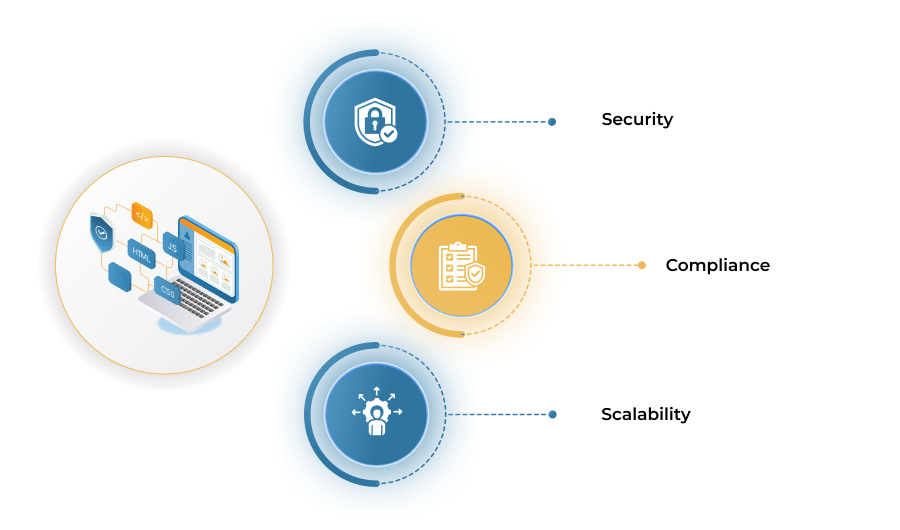
At the end of the day, Technology investments are mostly judged based on the profits they bring to the business. Low code provides a nice return on investment that is so obvious and convincing that one cannot ignore it. Enterprises that are using low-code as the backbone of their transformation from traditional to modern mode of operation disclose: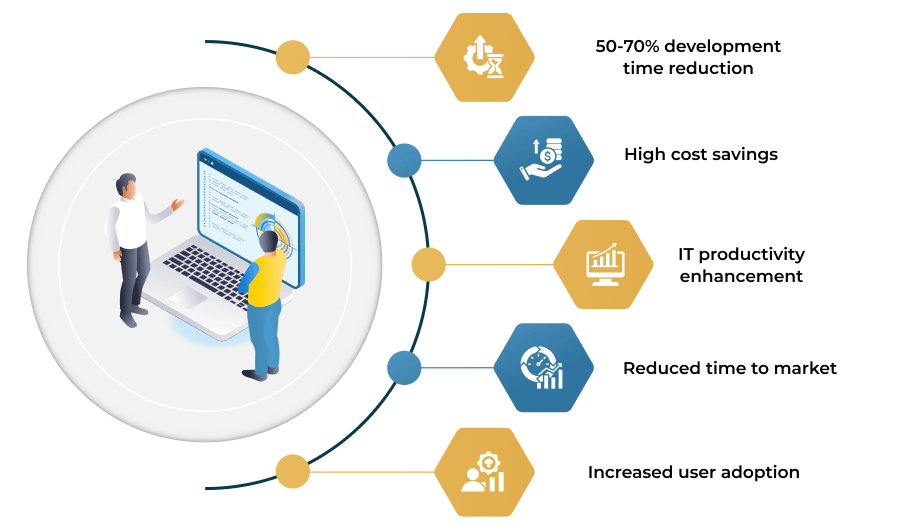
Over time, low-code platforms have evolved from simple point solutions into secure, scalable, and enterprise-ready platforms. They accelerate application development, strengthen IT and business collaboration, and simplify digital transformation. As businesses prepare for 2026 and beyond, the question is no longer whether to adopt low-code, but how quickly they can use it to drive innovation, agility, and long-term competitive growth..
19 Oct 2026
15 Oct 2026