From Manual Processes to Smart...
22 Oct 2026

Smart logistics systems have prioritised operational efficiency over execution reliability and the customer experience. The inability to see and understand customer interactions contributes to the inability to address customer expectations. The unfulfilled promise of logistics ICT innovations, such as real-time tracking, AI, and automation, to deliver fundamental and transformational logistics services on time, remain unfulfilled. The underlying reason is that these systems cannot sufficiently and accurately address the multifaceted constraints inherent to logistics services consistently and predictably.
Today’s customer wants more than just getting a package at their doorstep. Expectations have shifted to demanding an exact, consistent, and fully transparent service. There is an expected reliability and speed requirement when e-commerce is involved that impacts delivery.
The market has shifted, along with the needs of the customer. Unfortunately, many logistics systems still center on achieving operational efficiencies. This has resulted in a many shortcomings of the service delivery systems.
Some of these gaps are highlighted below: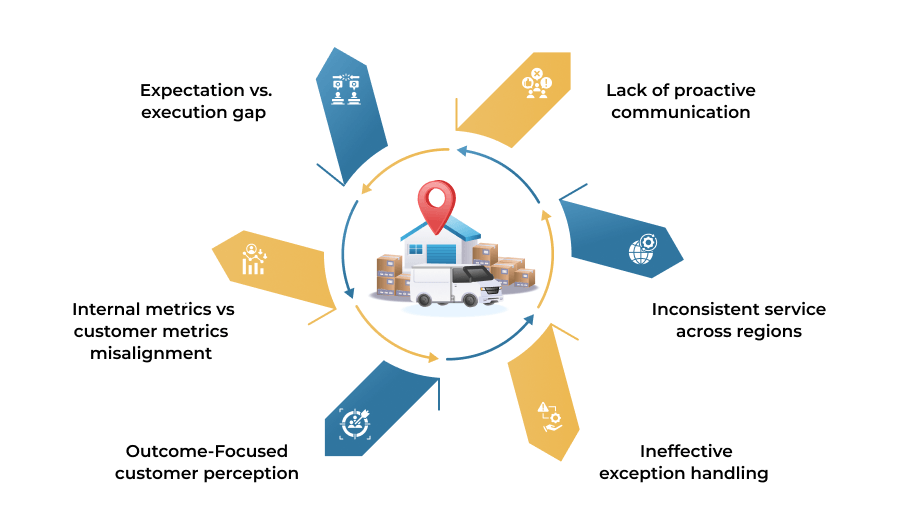
The general understanding that visibility and reliability are the same in logistics is incorrect. Tracking visibility technologies are expensive and do not guarantee to deliver results.
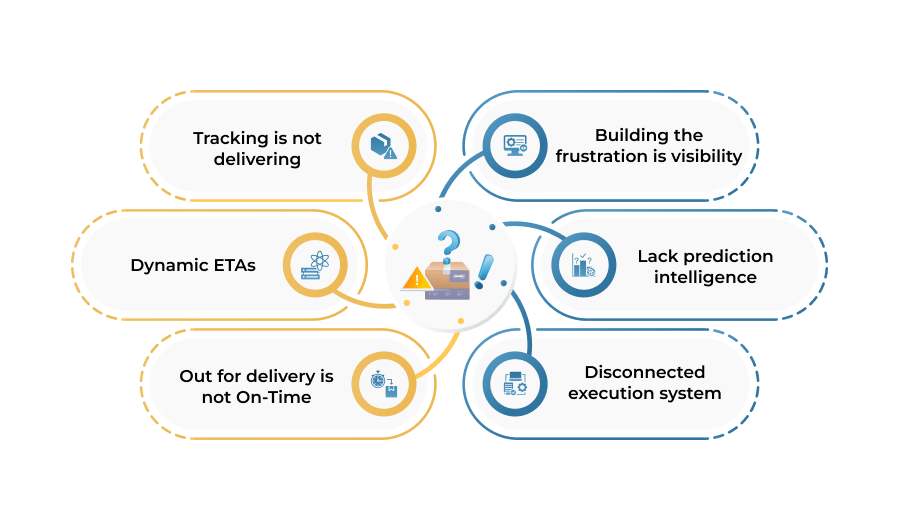
There can be many logistical inefficiencies and supply chain delays that are not easily measurable internally; however, they become highly measurable externally, where customer expectations are high and tolerance is low. Seemingly small disruptions in any area of fulfillment, transport, or delivery can become exponential disruptions that ultimately degrade last-mile delivery performance and reduce customer satisfaction.
Delays in today’s enterprise logistics are not isolated. They are symptoms of interconnected operational bottlenecks in the supply chain. These bottlenecks propagate delays through the chain. Identifying critical failure points is crucial to enhancing the reliability of delivery and the overall resiliency of the logistics system.
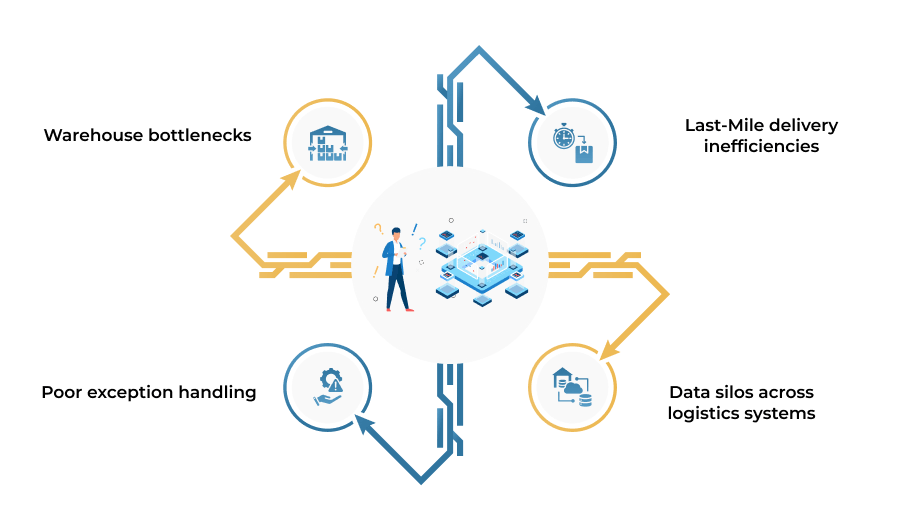
You can see why delays in the supply chain can be caused by even the smallest inefficiencies in warehouse operations. Dispatch delays can be caused by inventory mismatches, slow picking, and wrong packing.
Impact: Delays during the fulfillment of orders negatively impact the on-time dispatch rate and lead to an inability to meet promised delivery time windows.
The final logistics leg is often the most challenging, making it the most costly part. It can account for more than half of the total delivery costs. Last mile logistics is also highly susceptible to external factors like traffic, delivery density, customer availablity, and route changes.
Impact: Problems in last-mile delivery will affect delivery times and alter customer experiences, even if processes in the early parts of the delivery chain improve.
It is impossible to completely avoid interruptions in the supply chain. Issues like delays in weather, vehicle failures, wrong addresses, sudden spikes in demand, etc. Most companies do not have the automated systems to either identify these issues or resolve them in real time.
Impact: Poor exception handling turns small disruptions into significant service outages, resulting in higher customer dissatisfaction and increased operational costs.
Fragmented data environments result from unconnected warehouse management, transportation, and customer service systems. Data fragmentation limits integration and visibility, and ultimately slows down decision-making.
Impact: Lack of transparency creates blind spots for businesses, causing delays that could have been avoided.
When coupled together, these logistical inefficiencies produce a ripple effect in the supply chain. A single delay during warehouse operational, transport, or last mile delivery can propagate the delays to the customer.
To engineer true improvement in customer satisfaction, logistics systems must move from reactive tracking and develop predictive intelligent tracking systems.
With AI-enabled logistics, businesses have the ability to self-correct for disruptions in the supply chain before they even commence. This includes:
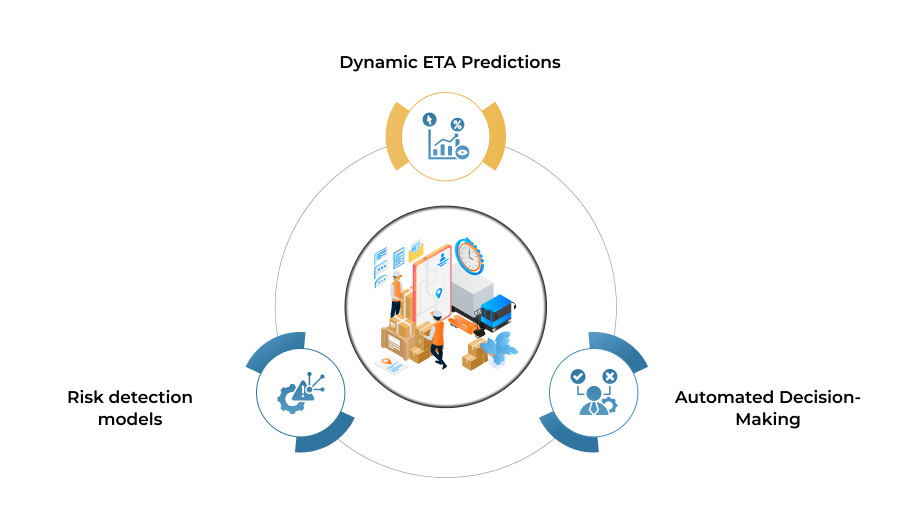
Predictive intelligence asks the question not of “What is happening?” but of “What will happen next?”
Predictive thinking drives the change of decision intelligence in almost all modern businesses. Think of the system that predicts traffic. If a delivery is predicted to be late due to congestion, the system may reroute the delivery to prevent it from causing further congestion. This sort of intelligent behavior has an impact of improving customer satisfaction and reducing customer frustration.
AI is not simply optimizing supply chain logistics; AI is optimizing the entire customer experience, and the principal factor in this enhancement is the contraction of uncertainty. AI is increasingly helping organizations reduce uncertainty and make faster, more confident operational decisions.
The modern logistics system lacks a significant level of integration between operational data and customer data. While shipments are efficiently tracked, customer shipments are not tracked. Customer-centric supply chains develop an opportunity of service level improvement of 20-30% (McKinsey & Company).
Because of value, urgency, preference, etc. customer a need may be more or less time-sensitive, but logistics workflows are largely homogenous across shipments and shipments are treated equally. This creates a lack of synergy and leads to missed expectations. PwC reports, 73% of customer purchase decision consider experience to an absolute and key defining extent.
Customer data integration allows for the proactive communication of personalized options and personalized critical delivery postponement with business communication. This methodology addresses customer dissatisfaction and response abandonment. Poor customer experience drives 32% of customer response abandonment.
The ideal logistics experience is achieved when customer data integration is supplemented with operational synergistic fusion for ease of logistics and firmer primary integration.
While disruptions in logistics systems are unavoidable, customer response strategy can make or break an organization.Efficient returns and reverse logistics processes also play a key role in improving overall customer experience.
Traditionally, logistics systems are reactive and slow. Service recovery begins only after customers support reach out. Then, they have to wait for case updates and deal with arbitrary resolutions.
A modern logistics system should recover from service failures automatically by:
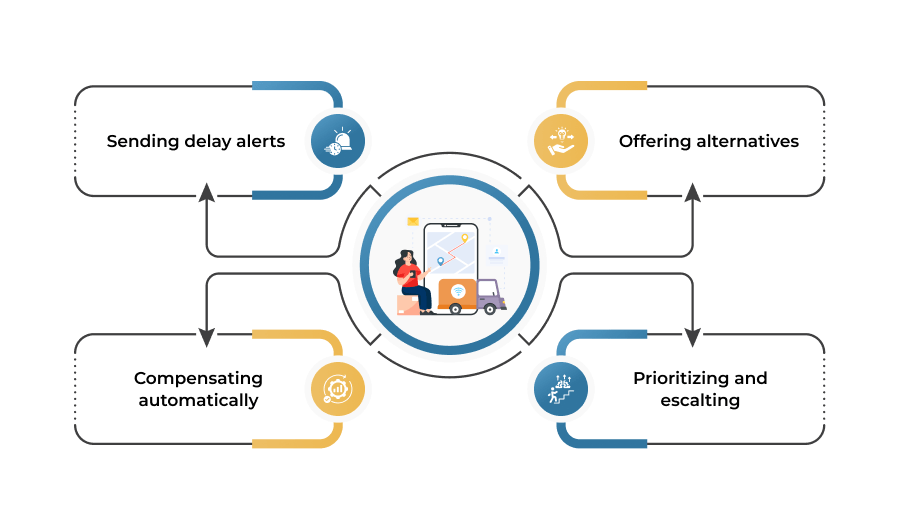
Automation ensures proactive problem resolution, as opposed to escalation.
A recovery process designed holistically can strengthen customer loyalty by creating a positive outcome from an experience that was originally negative.
Complaints are inevitable until companies completely redesign their logistics to prioritize the customer.
This change requires a completely new mindset: operational thinking should be replaces by experiential thinking, which centers the customer in every process.
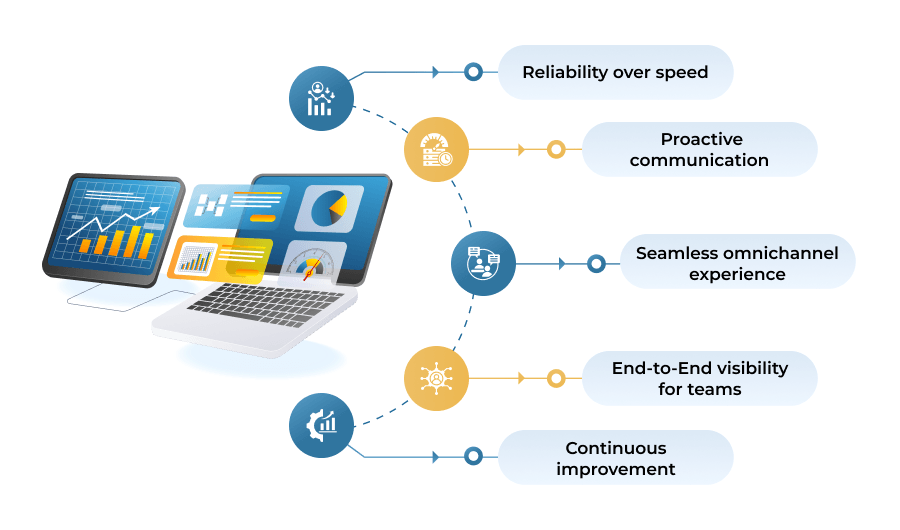
Eradicating complaints begins with redoing logistics to integrate the customer experience. It is about earning customer trust, and not just delivering their goods.
There is no doubt that supply chains have improved through the use of smart logistics technologies. However, technologies on their own are not enough. A modern enterprise that excels is one that demonstrates reliability and delivers consistently and transparently on their promises.
All customers want from a system is that it gets things done. The measure of a smart system is whether it is able to accomplish its objectives and still communicate and provide feedback along the way.
The only way to eliminate complaints is to bring operational intelligence and customer experience together. It requires predictive technologies, integrated and automated processes, and a customer-centric design.
To customers, true innovation is not about having the most advanced logistics systems. It is about having systems that are the most reliable.
19 Oct 2026
15 Oct 2026