How Can AI Help Fintech...
08 Oct 2026

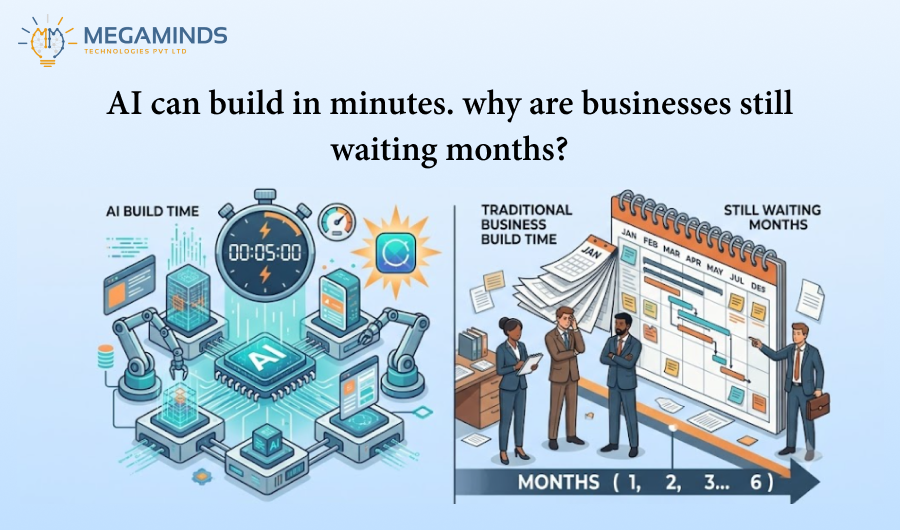
Software development takes a long time because coding is not the only step. Requirements, design, integrations, testing, security reviews, approvals, and deployments can all take significant time.
AI can speed up the coding process, but it will not remove the need to deal with unclear requirements, legacy systems, incoherent workflows, and cumbersome approvals. Innovation will only give a marginal increase in development speed with the employment of AI, automation and modern development methods, and improved collaboration during the whole software development process.
Businesses used to have time to plan and develop with traditional software. Now, with increasingly volatile markets, businesses need to be able to develop quickly to stay competitive. 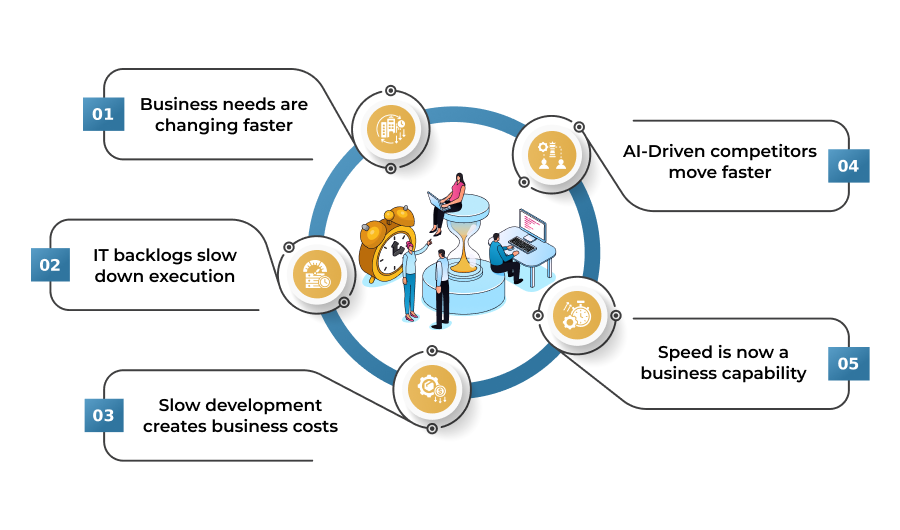
1. Business Needs Are Changing Faster
Speed of development isn’t the only barrier to traditionally developing software. Today’s markets change so rapidly that can even lead to a backlog of IT request. There is a demand for new digital services and solutions.
2. IT Backlogs Slow Down Execution
Compounding the problem of a backlog of IT requests is the long, unpredictable development cycle traditionally associated with software development.
3. Slow Development Creates Business Costs
The traditional development cycle carries many costs on top of those for operations and poor customer experience, such as lost business opportunity and the need for employee engagement in work around.
4. AI-Driven Competitors Move Faster
Traditional development takes even longer than the time between the iterations of competitive solutions and feedback enhancing those solutions.
5. Speed Is Now a Business Capability
Development speed is the new competitive metric. It measures how quickly a business can innovate to stay relevant.
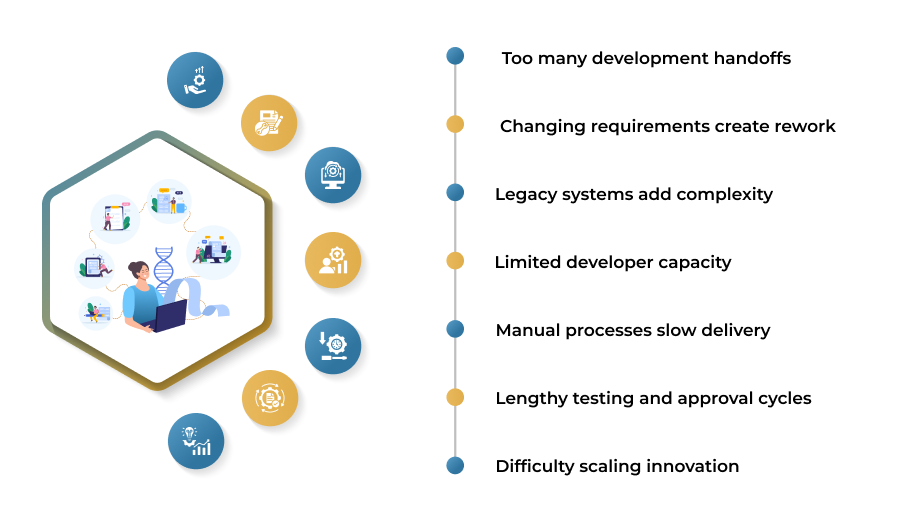
Convoluted development models take a long time due to manual coding and dependence on unrelated teams for approvals. Business requirements changing rapidly can’t be satisfied by methods this slow.
AI has quietly crossed from novelty to infrastructure. Stack Overflow’s 2025 survey of 49,000+ developers found that 84% of developers now use or plan to use AI coding tools, with over half using them daily. The DORA 2025 report found more than 80% of respondents say AI has enhanced their productivity.
The impact shows up in hard numbers:
More importantly, AI is changing what counts as development. Describing an application in plain language and receiving a working draft is no longer science fiction — it’s a Tuesday. AI now generates code, writes tests, produces documentation, and suggests fixes, compressing tasks that once took days into minutes.
The fusion of automation tools and artificial intelligence means low-code platforms can offer reusable templates and modular design elements. These tools decrease the need for manual coding. Combing these with visual development means businesses can turn concepts into fully functioning applications faster than ever.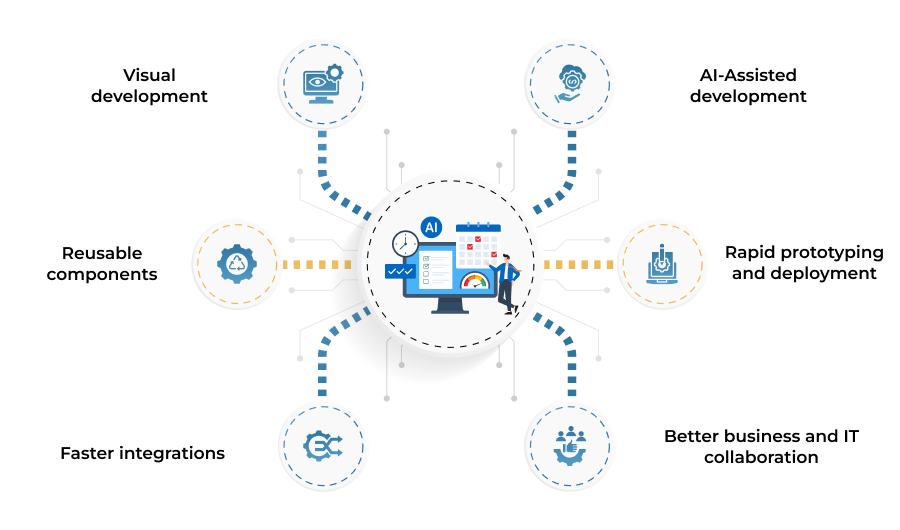
1. Visual Development
With interfaces that allow drag-and-drop, low-code platforms allow businesses to create workflows and applications that do not require coding every element.
2. Reusable Components
With applications that allow modular design and templates, low-code platforms reduce the time it takes to create an applications or workflows.
3. Faster Integrations
With tools that allow workflows and applications to integrate with databases and APIs and other cloud systems, low-code platforms reduce the time it takes to integrate systems.
4. AI-Assisted Development
With low-code platforms, businesses can create elements and logic of applications faster with artificial intelligence that can generate code.
5. Rapid Prototyping and Deployment
Other than the ease of integration, low-code platforms allow businesses to create MVPs faster to test and implement user feedback.
6. Better Business and IT Collaboration
Shared visual artifacts and automated workflows shorten the feedback loop between the people who need the software and the people building it.
Gartner’s most recent Forecast Analysis: Low-Code Development Technologies, Worldwide projects the market will reach $58.2 billion by 2029, growing at a 14.1% CAGR, with agentic AI, citizen development, and governance identified as the primary accelerants through 2029.
Low-code platforms enable faster innovation for common internal applications — dashboards, approval systems, request portals — without replacing traditional development for complex, differentiated systems.
More value is realized when organizations automate the processes surrounding development than when they build faster. .
To illustrate, take a common application release scenario.
The developers may have completed the primary functionality of the application, but release is still hampered waiting on the results of manual testing, configuration of the release environment, security assessment, completion of release documentation, and release approval.
Bottlenecks in this example may be alleviated by automation in any of the following:
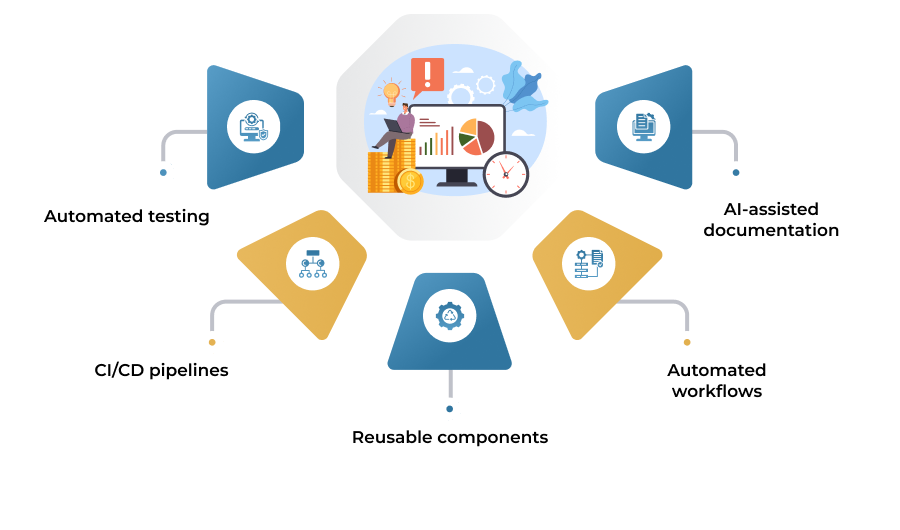
The end goal should not merely be agility in coding. It should be an end-to-end agile process – from business need to measurable business effect.
One of the biggest changes created by AI and low-code development is the shrinking distance between an idea and a working prototype.
Imagine an operations manager identifies a manual approval process that consumes hours every week.
In a traditional environment, the idea might require documentation, IT prioritization, development allocation, interface design, coding, testing, and deployment.
With modern development approaches, the same team could potentially prototype the workflow rapidly, connect required data sources, generate application components with AI, automate notifications, and test the concept with users much earlier.
This changes the economics of experimentation.
Businesses no longer need to treat every application idea like a large software project.
They can prototype quickly, validate early, learn from users, and invest further only when the idea demonstrates value.
That is a major competitive advantage.
Faster application development creates value far beyond the technology department.
When businesses reduce development cycles, they can respond more quickly to customers, employees, operational challenges, and market opportunities.
Potential benefits include:
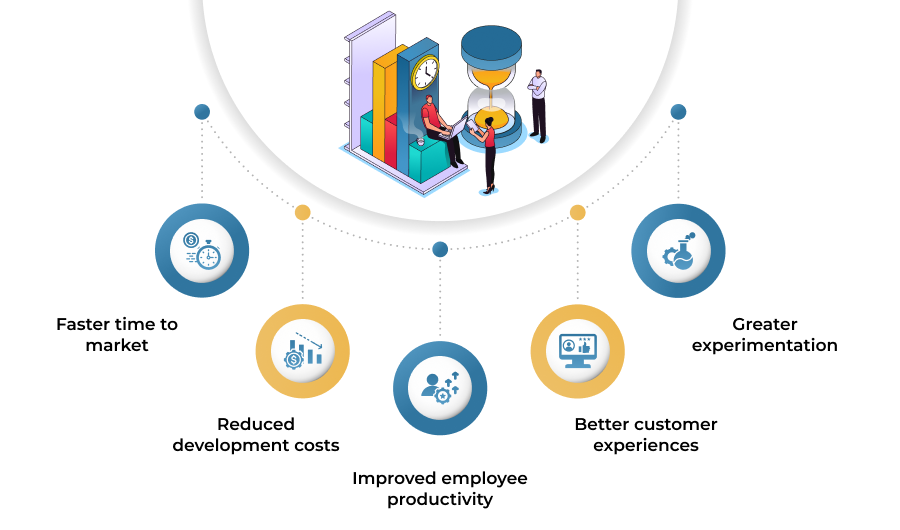
A 2024 Forrester Total Economic Impact™ study commissioned by Microsoft modelled a composite organization of 30,000 employees adopting Microsoft Power Platform and reported a 224% three-year ROI, $82 million in net present value, and a payback period of under six months. A companion TEI study on Power Automate found a 248% ROI and a 20% reduction in the time required to develop workflows.
The broader lesson is clear: development speed becomes valuable when it translates into faster business outcomes.
Forward-thinking companies are using AI, automation, and low-code technologies to accelerate development while keeping human expertise at the center of strategic and critical decisions.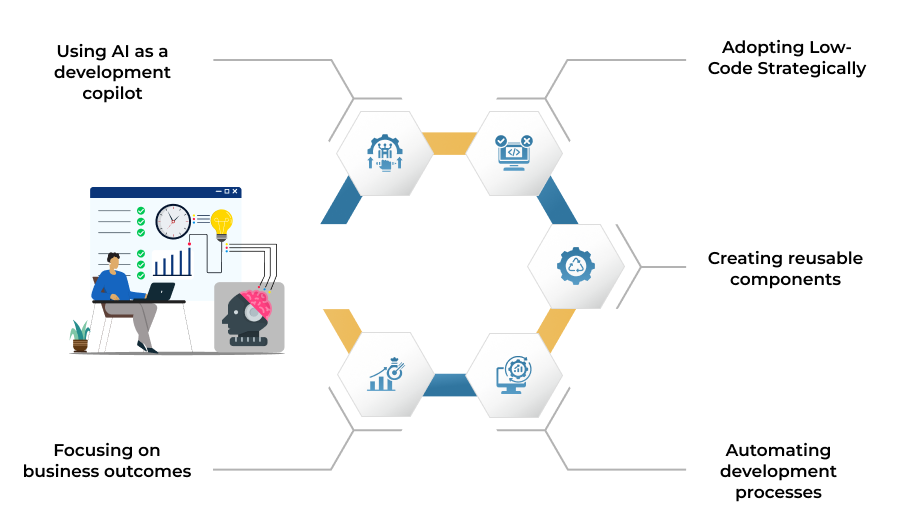
1. Using AI as a Development Copilot
AI accelerates coding, debugging, testing, and documentation while developers focus on architecture, security, and complex decisions.
2. Adopting Low-Code Strategically
Low-code platforms help teams rapidly build internal applications, workflows, prototypes, portals, and process-focused solutions.
3. Creating Reusable Components
Reusable templates, APIs, modules, and workflows reduce repetitive development and make future applications faster to build.
4. Automating Development Processes
Automated testing, deployment, documentation, and CI/CD pipelines reduce manual effort and shorten development cycles.
5. Focusing on Business Outcomes
Companies measure success through faster time-to-market, improved productivity, customer value, cost savings, and greater adaptability.
This approach turns software development into a faster and more flexible engine for continuous business innovation.
AI can accelerate development, but businesses will still face delays if outdated processes, manual workflows, and long approval cycles remain unchanged.
By combining AI, low-code platforms, automation, modern DevOps, and human expertise, companies can move from idea to application faster while maintaining quality and scalability.
In an AI-driven market, competitive advantage belongs to businesses that can turn ideas into real business value faster than their competitors.

08 Oct 2026
05 Oct 2026
01 Oct 2026