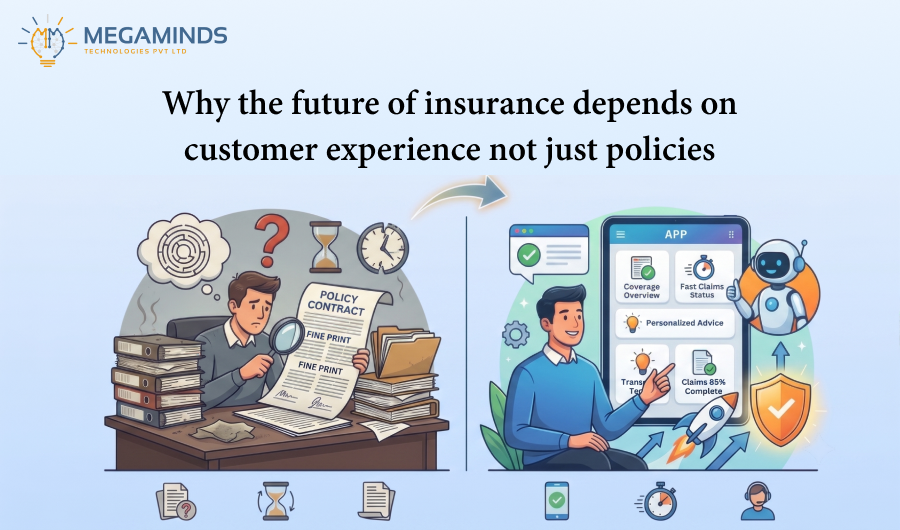
Why the Future of Insurance...
15 Oct 2026

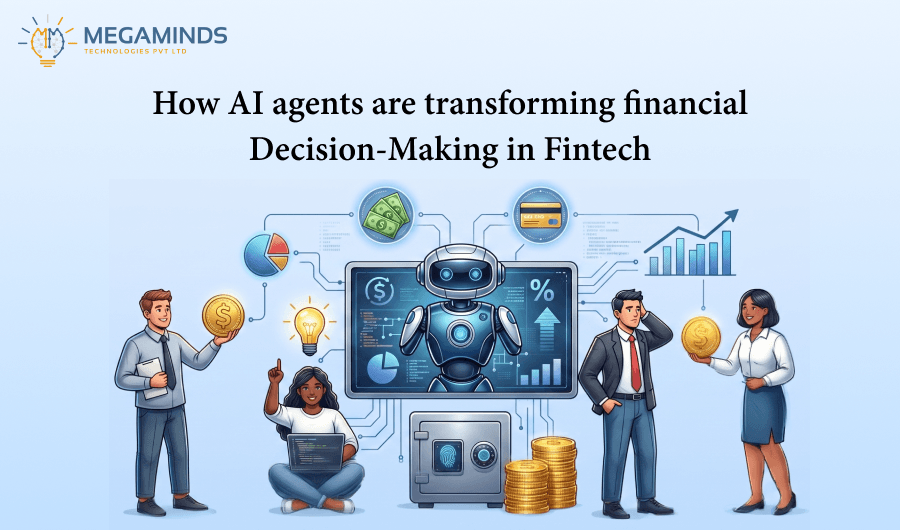
Financial technology (fintech) is being revolutionized by AI agents with smart, rapid, and personalized financial processing capabilities. Previous technologies relied on a fusion of static rules and manual research. AI agents process information and identify trends. They improve systems further with intelligent, predictive insights based on behavioral patterns. AI augments systems in processing personalized investment and lending decisions and improves fraud detection. Ultimately, these technologies drive the operational costs lower and uphold customer loyalty.
AI agents are systems that, with little to no human oversight, collect data, understand its meaning, make decisions, and take actions. Within the fintech ecosystem, AI agents improve the speed and efficiency of the financial process. AI agents learn from their interactions with data to provide better, more accurate financial solutions.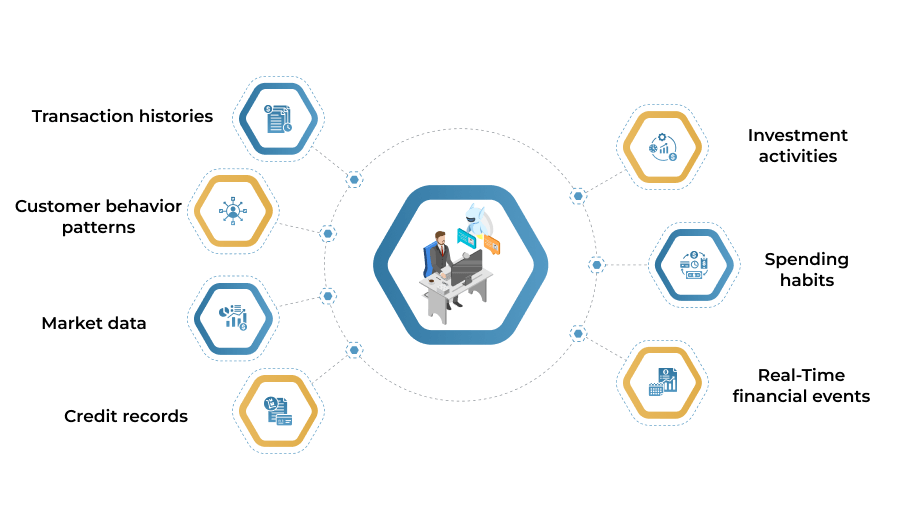
People’s finances are always in flux. Whether it is in response to changing markets and preferences, the data that relates to most people’s financial behaviors tends to be complex and large scale. Analyzing it using legacy systems is often difficult and staffing it with large teams is often inefficient.
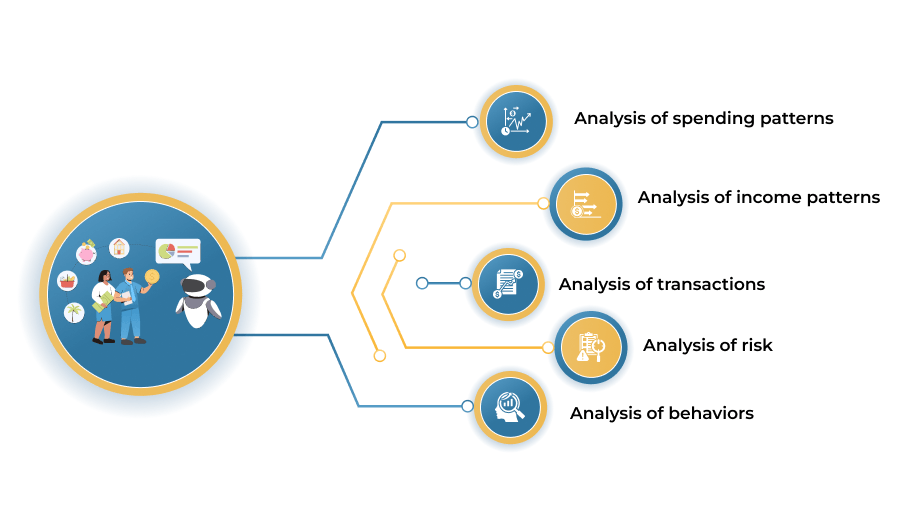
How AI Analyzes Customer Spending Patterns
Analysis of spending patterns: AI looks at purchase patterns, season spending behaviors, and customer lifestyle patterns. From these analyses of behavior, firms can better understand financial behaviors and provide personalized spending and budgeting advice.
Analysis of income patterns: Fluctuations in income can have major effects on financial decisions. AI is able to analyze the patterns firms’ income and cash flows to determine likely future financial positions and the risks that may accompany them.
Analysis of transactions Modern fraud-prevention systems use predictive AI to identify suspicious activities before they become major financial threats. This matters more than ever: 79% of organizations experienced attempted or actual payments fraud in 2024, up from 65% two years earlier, according to the Association for Financial Professionals. Proactive anomaly detection has become a major competitive advantage in fraud defense
Analysis of risk AI signals on late payments, and other financial stress indicators take the guess work out of risk management and default decisions .AI is helping organizations reduce uncertainty and make more confident decisions in high-risk environments.
Analysis of behaviors The combination of financial histories and behavioral modeling can make very accurate predictions of customer financial decisions. AI enables fintech firms to deliver financial services ahead of the competition.
As an example, an AI agent may identify that customers tend to spend more just before holiday seasons and may recommend different savings strategies. Rather than building financial strategies based on reactive decision making, such as returning savings to customers and risking liquidity pre-holidays, fintech companies get predictive insights to design better and more informed financial strategies.
AI agents are set to revolutionize investment and personal finance management services. Unfortunately, this revolution will only offer consumers the advantages of even more options to manage their finances. Because AI technologies are continuing to more completely dominate the fintech industry by delivering even more sophisticated financial planning tools, consumers’ expectations and requirements will keep growing and evolving at a commensurate pace. Why should they be forced to rely on a stultifying financial services regime? Consumers would rather use intelligent AI services that analyze their financial goals, market behavior, and provide them with personalized recommendations.
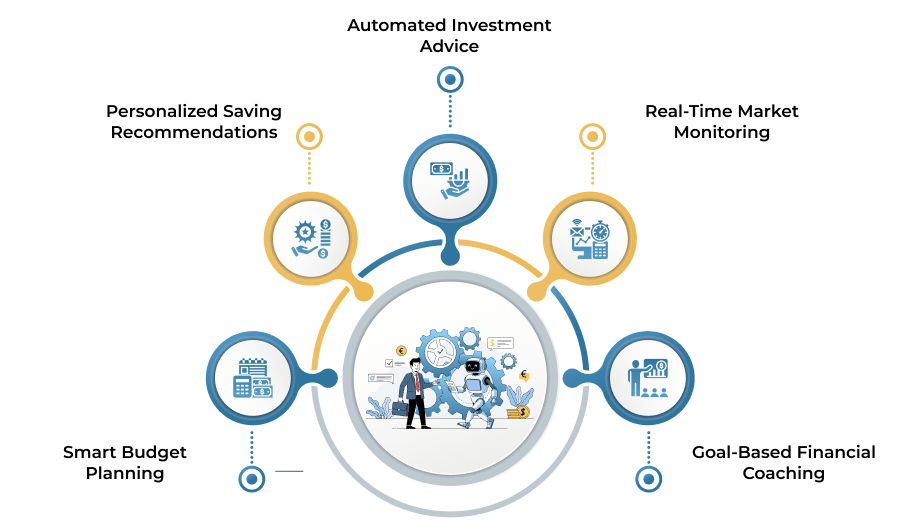
Benefits of AI Agents in Personal Finance
Using AI-powered robo-advisors is becoming an increasingly popular tactic for investment platforms. According to Statista, assets under management in the robo-advisory market are projected to reach about $2.06 trillion globally in 2025, climbing to roughly $2.38 trillion by 2029. Demand for smarter and cheaper investment solutions continues to drive this growth. As technology matures, personal finance and investing solutions will become more predictive, personalized, and convenient for end users. Role of Autonomous Decision Systems in Modern Fintech
Autonomous decision systems represent a major evolution in financial technology. Advanced analytics platforms are helping organizations improve visibility into risk, performance, and strategic opportunities. Instead of simply assisting humans, these systems execute financial actions independently based on predefined goals and live intelligence.
Examples include:
These solutions combine:
For instance, an autonomous lending system can analyze customer credit history, transaction patterns, employment data, and alternative behavioral indicators within seconds.
Decisions that previously required days now happen instantly.
This speed creates competitive advantages while improving customer experiences.
The current consumer demand for personalized financial services is substantially different from what has previously been offered through traditional financial services. As digital financial services become even more ubiquitous, consumers will want to have access to tools that help facilitate decision making and manage their finances. Traditional financial advice relies on time-consuming meetings and manual financial assessments to provide actionable advice.
Real-time financial advice can now be delivered through artificial intelligence (AI) and behavioral finance. Financial AI is capable of delivering advice that is tailored to the financial actions of the consumer and is real-time actionable. Financial AI also has the ability to adapt its advice over time.
Here are some of the advantages of using financial AI.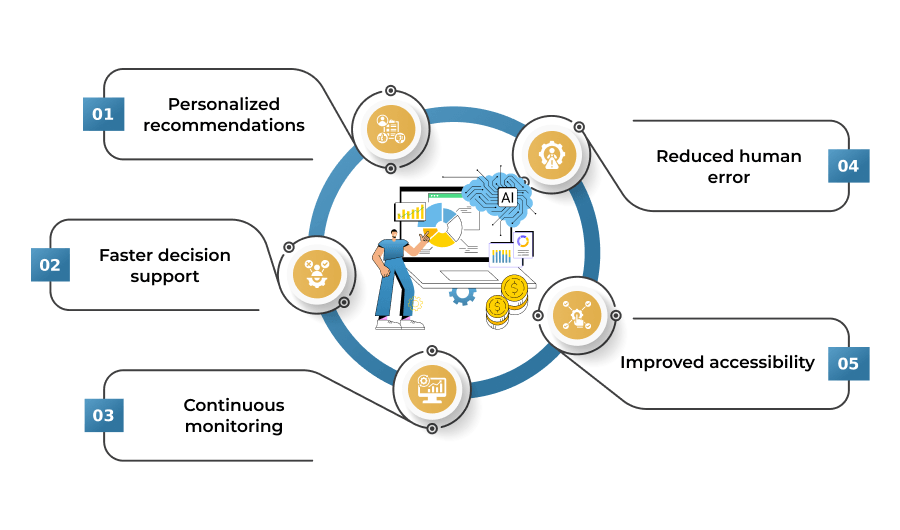
Personalized RecommendationsAI is capable of analyzing behavioral finance patterns and delivering personalized recommendations based on an individual’s financial behavior and preferences.
Faster Decision SupportAI is capable of processing large amounts of data in real-time and offering recommendations instantaneously. Better decision-making often starts with better visibility, actionable insights, and real-time business intelligence. This greatly helps accelerate the decision making process when it comes to finance.
Continuous MonitoringAI is capable of passively and constantly monitoring financial behavior in order to provide recommendations and suggestions.
Reduced Human ErrorAI mitigates the manual processing errors and inconsistencies that traditional financial assessments suffer from.
Improved AccessibilityAI democratizes the access to quality financial advice. Compared with conventional periodic assessment financial services, AI supports continuous decisions and real-time intelligence. Consequently, users can have more confidence, control, and personalization of their financial services that adjusts dynamically to their evolving needs.
Though AI agents fundamentally change and develop an approach to handling financial decisions, organizations grapple with complex challenges while working with advanced AI-based tools. Financial decisions carry immense consequences and autonomous AI decisions can lead to loss of an organization’s key asset, its clients, if accuracy, reliability, and trust are not maintained.
Artificial Intelligence employs various tools and techniques; high quality data and reliability are of utmost importance while designing AI based systems. The success of AI initiatives depends heavily on strong, accurate, and well-governed data foundations. Inadequate data leads to diminished accuracy and undesirable outcomes. Inadequate supervised learning incurs Al’s bias and can result in unfair outputs in lending and related decisions.
Excess adoption of automation in AI systems may also result in the loss of human discretion in the cases which need contextual informed judgment. Additionally, the financial market is dynamic and constantly changing, which can cause model drift and reduce efficacy of A.I. systems.
Financial organizations are also required to meet stringent regulatory and statutory requirements of a high degree of transparency and accountability. Well-established governance frameworks, effective oversight, and continuous system updates enhance the trust and reliability of AI-based systems.
In digital finance, customer trust is often built or lost based on how decisions are communicated and explained. AI will be disruptive in most industries, and financial services will be no exception. What’s holding back industry-wide adoption is that, unlike most other industries, there is a much greater need for customer trust in this industry. AI is already speeding up lending, investment recommendations, and insurance approvals, and is also supporting the assessment of risks. The expectations of many customers are fast results and an understandable reasoning process for the AI systems. The reality is that most advanced AI systems are still operating as “black boxes.” This results in further concerns relative to transparency as the processes become more and more opaque.
In an effort to increase customer trust and mitigate concerns, Responsible AI and Explainable AI (XAI) are becoming the standards. Explainable AI promotes transparency and visibility in decision-making.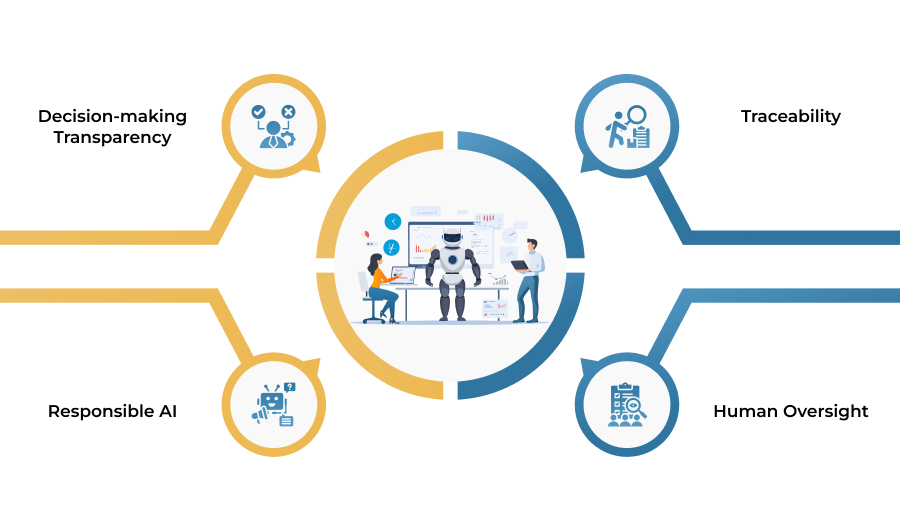
Decision-making TransparencyTrust and confidence is built in users with understandable reasoning behind financial recommendations and outcomes.
TraceabilityAI activities and decisions must leave a permanent record to reassure trust and meet regulatory requirements.
Responsible AIEliminate bias in decisions and enhance fairness, transparency, and responsibility.
Human OversightAI and human judgment are combined for decisions that require discretion and understanding of context.
Trust and confidence in financial services are predicated on the ability to explain the reasoning behind AI decisions. This is especially urgent given that more than half of fraud now involves the use of artificial intelligence — through deepfakes, synthetic identities, and AI-powered phishing according to Feedzai’s 2025 report.
Empirical evidence of AI agents creating a positive impact on the Fintech industry is already available. Financial institutions are implementing these systems to increase their efficiency and provide their customers with improved service, along with the ability to make quicker decisions. With the advancement of technology, AI provides many of the essential services in the contemporary digital financial world.
Fraud prevention is one area that AI has made a large impact on. AI is capable of identifying anomalous behavior and transaction patterns, ultimately preventing the financial institution from incurring a loss. AI is also capable of improving credit scores through alternative data and/or additional data, thus forming a more exact assessment for the lending decision.
AI’s impact on customer service is also very large. AI customers’ service agents have the ability to answer the majority of financial queries that the customers pose. Enhancements in AI have the ability to automatically effect the optimum methodology for the management of the investment portfolio. The use of AI also enhances the insurance industry through the faster processing of claims and the prevention of fraudulent claims.
The use of AI technology in financial technology has created faster, more efficient systems that greatly enhance the experience of the customer.
AI agents offer both users and financial institutions the ability to make faster, smarter, and more efficient decisions. Given the increasing volumes of both data and customers, financial institutions leverage AI to transform sophisticated data into insights to make decisions while improving the efficiency of the operation.
Efficiency of AI means quicker access to financial insights as it allows the processing of huge data to make faster decisions. AI also means greater personalization as it allows tailoring services based on both the behavioral and the financial preferences of customers. In addition, AI systems enhance risk prediction by spotting the signs and supporting the interventions.
AI helps minimize manual work and decreases costs of operation while overall efficiency of the institution increases. Customers benefit even more from instant assistance and financial advice. AI also means scalability that allows financial institutions to successfully operate when there are greater volumes of transactions and changing demands.
Autonomous and intelligent systems will dominate the future of fintech.Low-code platforms are accelerating the development of intelligent business applications and AI-powered workflows. These systems will be able to understand context, make predictions, and take actions with little human interference. The evolution of AI will lead to the development of financial systems that will be proactive, dynamic, and tailored to the individual. Instead of simply reacting to financial events, the future of AI will be to anticipate the needs of the customer and automate decisions for an effortless financial experience.
There are several advancements that will likely shape the future of intelligent financial systems: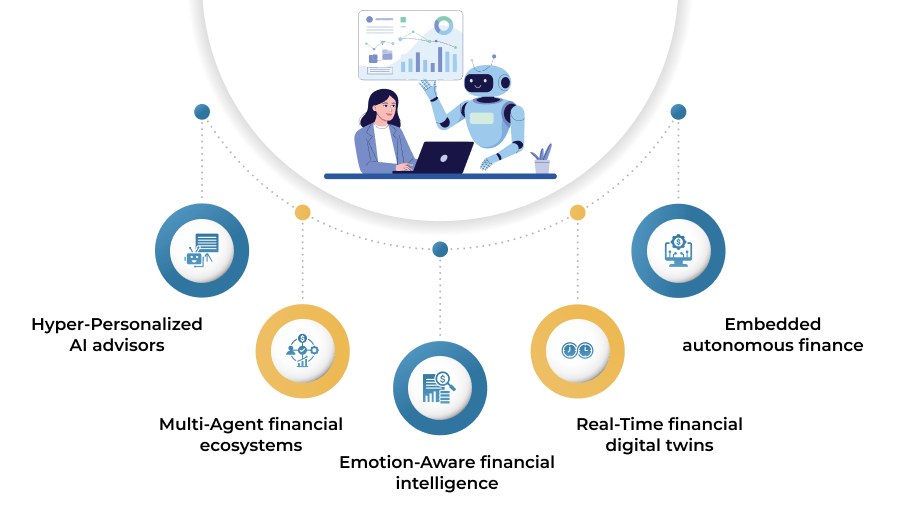
Analysts predict that intelligent decision-making systems will be the primary AI systems used to offer financial services. The organizations that will adopt these systems early will be able to offer innovative services to their customers effectively.
The days of slow financial decision-making dependent on historical information and reactive measures are over. Thanks to AI agents, fintech is now an ecosystem where real-time information drives smart and rapid decision-making. Businesses can now analyze spending, assess investments, detect fraud, and lend autonomously, all thanks to predictive analytics and tailored algorithmic messaging.
While technology is critical, too much focus on it will be detrimental. Innovation in AI will dictate the future of finance, but only if combined with transparency, trust, governance, and ethics. Intelligent automation and the ethical use of technology will build greater customer relations and increase the long-term success of the organization.
As Fintech develops, AI agents will migrate further from automation to fully-integrated decision-making. Companies that invest in AI technologies today will be the first to build and operate innovative financial systems for the future.
15 Oct 2026

12 Oct 2026

08 Oct 2026