From Manual Processes to Smart...
22 Oct 2026


A lot of AI projects fail not on account of their algorithms, but because of the quality of their data and how they are spread out. Bad, inconsistent, and disconnected data leads to unreliable AI which erodes trust and stops any potential uptake. Those organizations that create a foundation to govern their data and build single sources of truth are the ones that succeed in their AI projects.
Pattern recognition drives artificial intelligence; these systems detect relationships within past and current information. When inputs contain errors, distortions, or gaps, each forecast, suggestion, or output inherits such issues. Reality, as seen by machines, stems directly from the examples they study – shaped entirely by what they’ve been shown. What goes in shapes how decisions emerge later.
For business leaders, this means AI outcomes are constrained by:
Faster deployment often follows when companies build strong data workflows alongside consistent validation steps. Accuracy in artificial intelligence improves under these conditions. Surprises tied to opaque system behavior become less common once structured frameworks are in place. Semantic consistency plays a role just as much as reliable infrastructure. Results tend to stabilize when both elements support ongoing operations.
The majority of “AI failure” post-mortems read more like “data failure” reports. Regardless of whether teams create their own models or employ pre-made ones, the same trends emerge across industries.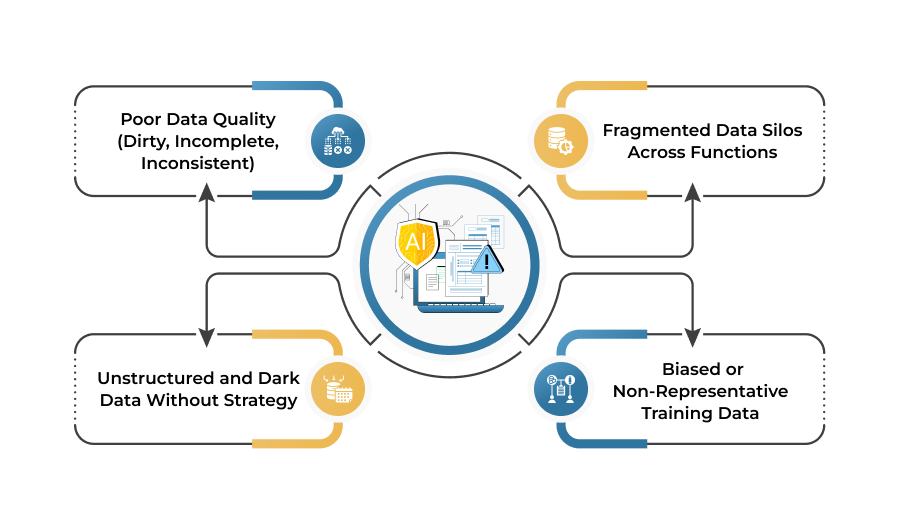
Approximately 40% of business efforts fail due to flawed information, according to Gartner. A typical organization loses about $12.9 million yearly when data lacks accuracy. In artificial intelligence systems, poor inputs result in unreliable outputs
Should such information enter training or inference stages, model responses may shift unpredictably – yielding erratic forecasts, unforeseen slants, even illogical suggestions. These outcomes tend to weaken confidence among users, slowing acceptance over time
Data sits separated in CRMs, ERPs, marketing tools, data warehouses, and business apps – integration often weak or missing. Reality appears fragmented because each platform captures only a slice. AI efforts such as forecasting customer loss, suggesting product matches, or improving logistics lack full context.
This break creates:
Documents, tickets, conversations, phone transcripts, PDFs, and media files make up an increasingly large portion of unstructured enterprise data. In healthcare, unstructured data like patient records and clinical notes is now being transformed into actionable insights using AI-driven systems. Although this content can now be operationalized using generative AI and retrieval-augmented generation (RAG), most businesses handle it as “black data” with no access strategy, taxonomy, or quality assurance.
Without structure and governance, organizations face:
NIST is among the industry and regulatory organizations that have emphasized how biased data might result in dangerous or discriminatory AI outcomes. Models consistently perform poorly or make biased conclusions for segments that are underrepresented in training datasets.
In business settings, this often shows up as:
The idea that “better models” or “GenAI magic” can somehow fix poor data is a common misconception among leadership teams. Advanced algorithms can’t create ground truth that doesn’t exist; in fact, they amplify both signal and noise.
When machine learning models find biased, flawed, or incomplete patterns in data, they reproduce these patterns without deviation. While regularization, robust loss functions, and synthesized data may mitigate some of the potential problems, they cannot compensate for:
Another level of risk is introduced by generative AI, which can generate confident but inaccurate narratives when underlying documents are out-of-date, inconsistent, or incorrectly classified.
Starting too fast on models or GenAI tests often leads to trouble when data prep is ignored. Problems pop up like wasted effort and repeated fixes
For this reason, several specialists view data engineering, quality, and governance as where most work – and impact – lies within AI projects, rather than in the last few percent devoted to refining models.
One of the top reported obstacles to the scalability of enterprise AI from isolated pilots is siloed data. Without an integrated single point of truth across core entities, each AI use case is based on differing versions. Addressing data silos is imperative in healthcare and similar industries that benefit from real-time analytical optimization of patient throughput and efficiency of operations.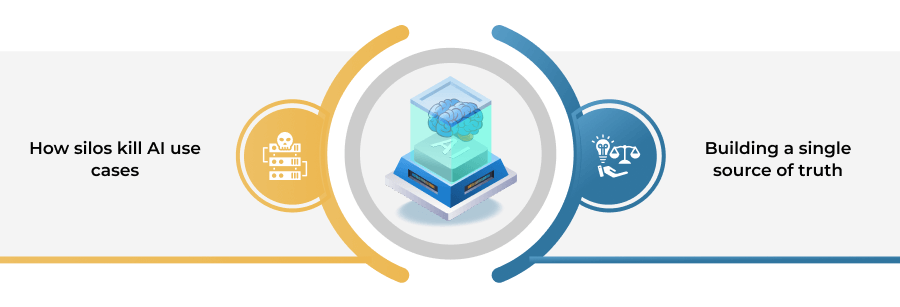
Classic data silos arise from historical system purchases, M&A, different business units, or regional autonomy. For AI, this directly undermines:
When each team trains models on their own silo, predictions conflict, and governance bodies struggle to approve enterprise‑wide deployment.
Modern data warehouses, lakehouses, or data meshes are common ways for high-performing companies to invest in shared data platforms that standardize and consolidate core entities. Key procedures consist of:
This “single source of truth” does not mean one physical database but a logically consistent, well‑governed layer of data products that AI and analytics can rely on.
Therust in AI is contingent upon trust in the underlying data. The questions of where this data came from, who authorized its use, and how we know it stays accurate over time are becoming more and more common among regulators, consumers, and internal stakeholders.
NIST and other authorities emphasize the fact that aspects such as governance, explainability, and provenance are equally as important to trustworthy AI as the models themselves. Efficient AI data governance comprises the following: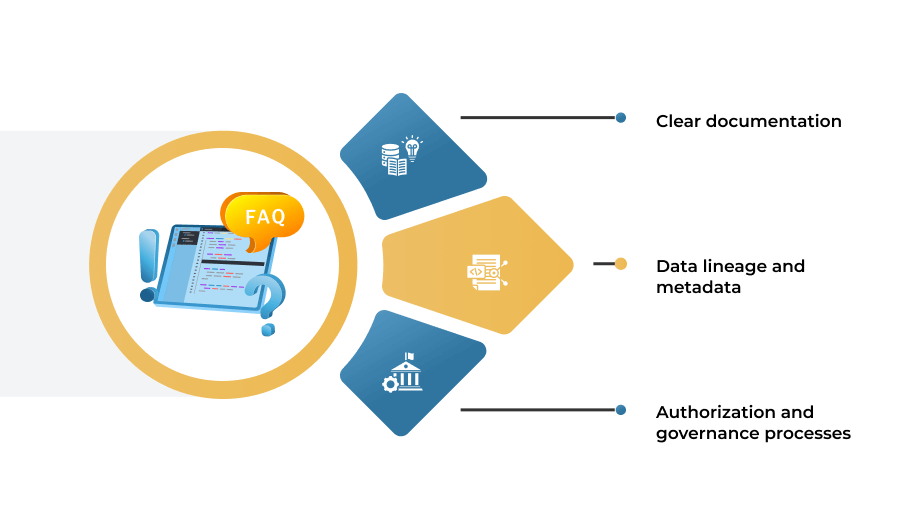
Without this, organizations risk regulatory breaches, reputational damage, and internal resistance that stalls deployments—even when models are technically strong.
McKinsey and others have noted that even high‑performing companies struggle when data responsibilities are fragmented or unclear. Leading organizations clarify roles such as:
The RACI-style clarity enables AI teams to quickly escalate and resolve data concerns instead of addressing them through model code or ignoring them in production.
When companies invest in solid data systems, their artificial intelligence efforts tend to boost income, lower expenses, and spark new ideas much more effectively. Research after research reveals that businesses using data wisely attract clients more easily, keep them longer, yet also achieve better financial returns compared to those slow to adopt data practices
At a minimum, a robust data foundation for AI includes: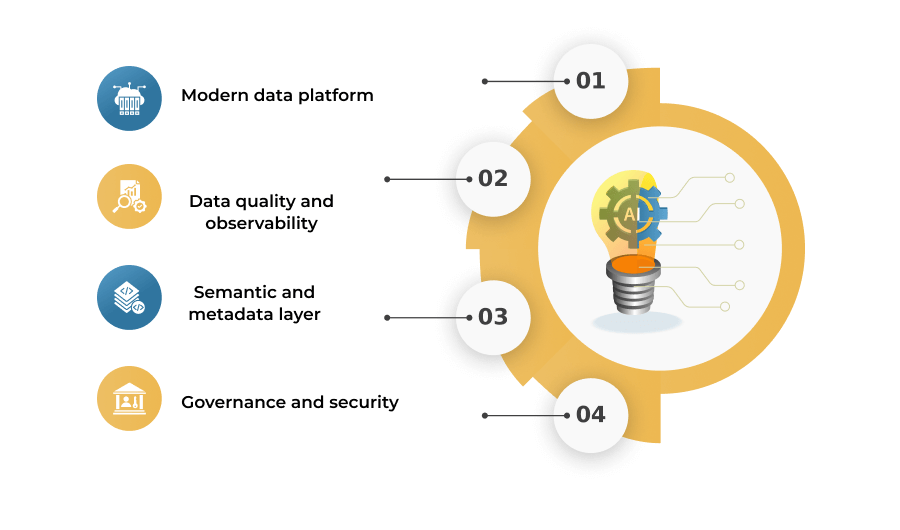
With all the above, AI personnel can spend more time on feature engineering and better models and less time hunting, cleaning, and debating data.
Firm data underpinnings allow companies to move AI reliably past trial phases, delivering real-world impact through operational workflows – such as these
From carefully selected collections of documents, knowledge helpers pull up correct information when it is needed most.Organizations guided by data tend to outperform others when it comes to keeping customers and staying profitable, according to McKinsey’s research.
A handful of firms stand out as genuine AI leaders – these operate with a distinct edge in how they handle data and artificial intelligence. Profits in such companies often trace back to smart AI integration. They see real gains not just in invention but also in shaping better interactions with customers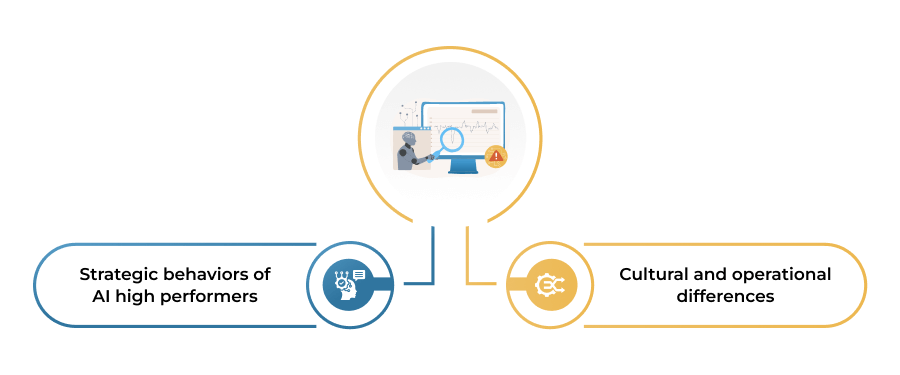
A closer look at top AI systems reveals something similar every time
The most crucial aspect is that these companies closely connect AI projects to measurable business results, which influences data choices and progress tracking techniques. But focus on specific goals, not just technology, provides direction.
Top teams pay attention to more than just technology aspects. They develop cultures in which understanding data is at the core of everything. A great thing about them is their collaborative decision, making based on strong evidence.
Fueled by alignment across data, artificial intelligence, and practical choices, this unified method transforms solid information bases into lasting edge. Though built on coherence, its strength lies in consistent application over time.
For executives planning to scale AI over the next 12–24 months, the most leveraged move is to clarify and fund a data‑first strategy. This does not mean delaying all AI experimentation but ensuring that pilots directly inform and stress‑test the data foundations you are building.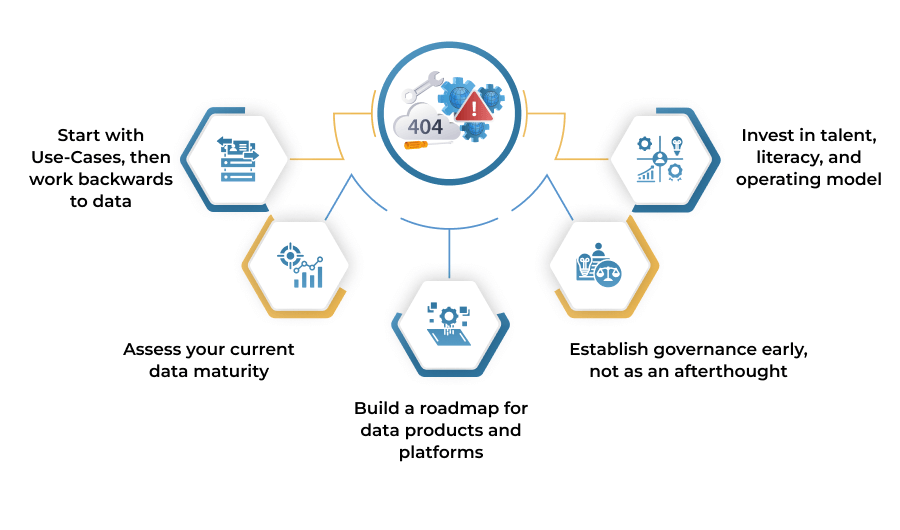
Instead than trying to accomplish everything at once, pick a few key goals. Pay attention to particular outcomes, including raising income, reducing costs, or lowering risks. Choose three to five areas where AI could be most helpful. Describe the necessary steps for each after that.
When real-world demands take precedence, tech-only spending is avoided. Every stage of using data is shaped by business objectives.
A starting point might be mapping how data flows through systems, followed by checking consistency and accuracy of information. Where practices stand today becomes clearer when examining oversight methods alongside team capabilities. One consideration is whether decisions rely on insights drawn from evidence.
This helps pinpoint basic weaknesses likely to disrupt your planned AI applications while offering clear support for funding requests to leadership
Start by turning assessment findings into a step-by-step plan for building your data platform and core data offerings.
Once the fundamental elements are solid, subsequent stages may use knowledge networks, unstructured data systems, or intricate machine learning procedures.
Governance should progress alongside your data platform rather than lagging behind. The initial actions include:
Faster scaling is made possible by these safeguards since stakeholders have faith in the system and know how choices are made.
Strong data foundations require both general literacy and expertise. Companies preparing for AI on a broad scale ought to:
This operational architecture guarantees that data additions are ongoing rather than one-time initiatives, minimizes handoffs, and speeds up learning.
It is not faulty algorithms that lead AI to fail, but rather fragmented, low-quality, and inaccurate data. High-performing businesses, on the other hand, put more money into modern data platforms, governance, and culture before adding AI to them. They consider data as a product rather than a byproduct and closely integrate AI activities with well-understood datasets and business results. Before scaling copilots or predictive models, executives should examine the maturity of their data, address the underlying issues, and establish ownership. If your business is ready to start creating a data-first AI strategy that actually provides value, get in contact with us right now.


19 Oct 2026
15 Oct 2026