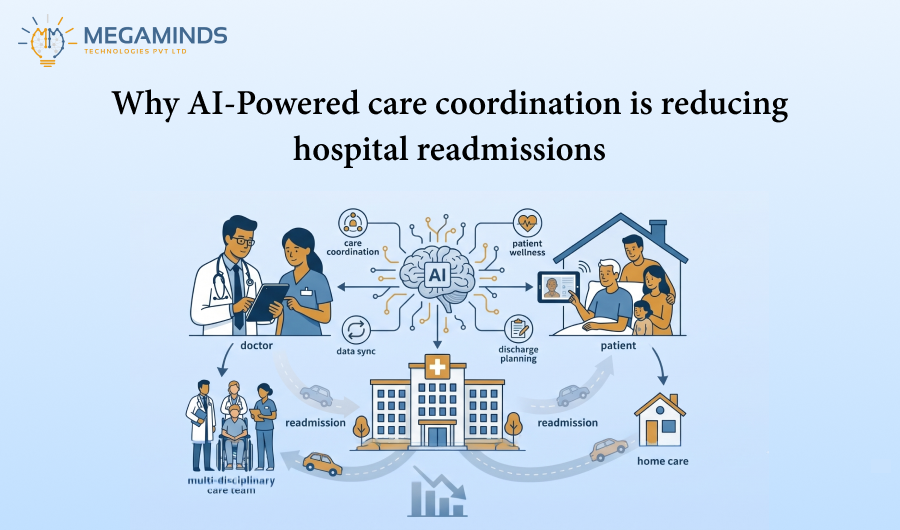
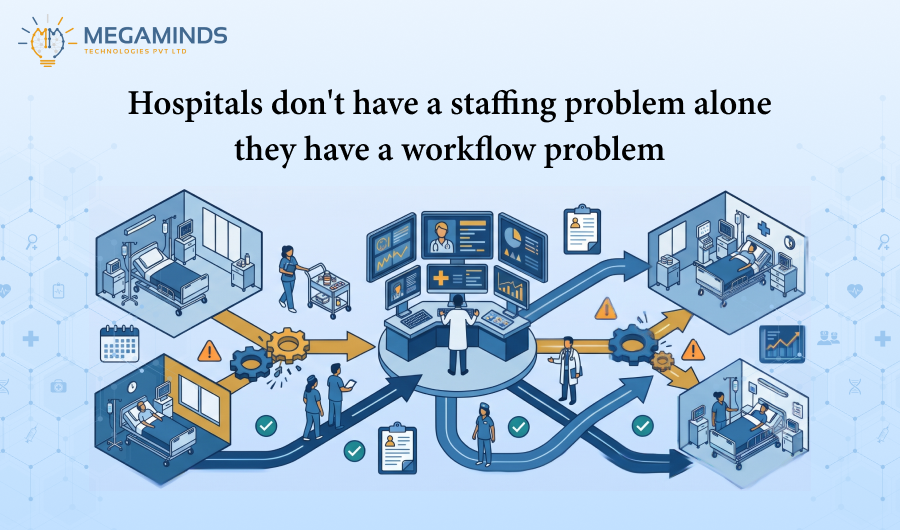
Hospital rooms are evolving from traditional care spaces into intelligent, connected environments. As healthcare organizations focus on safer, more efficient, and patient-centered care, smart hospital rooms are becoming a key part of digital transformation. These rooms combine AI-powered technologies, IoT sensors, real-time data, and intelligent automation to improve clinical workflows and enhance the patient experience. As a result, hospitals can increase operational efficiency, deliver higher-quality care, and build future-ready healthcare facilities.
Key features: Advanced Sensor Networks, Real Time Patient and Room Monitoring, Adaptive, Patient Centric Environments
Smart hospital rooms are designed to enhance both patient care and clinical efficiency. They create a personalized environment where AI, IoT sensors, and connected medical devices adapt to each patient’s needs. For example, intelligent systems can automatically adjust lighting, temperature, and other room settings to improve comfort and support recovery. As a result, patients experience safer, more personalized care while healthcare providers deliver better outcomes through connected, patient-centered technology.
Advanced Sensor Networks
A smart hospital bed is only one part of an intelligent patient room. Advanced sensors and monitoring systems continuously track patient movement, vital signs, and environmental conditions while maintaining privacy and security. As a result, healthcare providers can detect potential risks early and respond more quickly to patient needs, improving both safety and quality of care.
Smart monitoring systems automatically track medication schedules and patient activity, helping clinicians deliver timely care while giving families greater peace of mind.
Digital room displays provide caregivers with essential patient information while protecting privacy, enabling staff to respond more efficiently and improving the overall patient experience.
Real Time Patient and Room Monitoring
Smart hospital rooms enhance patient safety through continuous, real-time monitoring. Connected medical devices securely track vital signs such as heart rate, oxygen levels, temperature, and respiratory rate. As a result, clinicians can monitor patients remotely and respond quickly to critical changes, whether they are on-site or off-site. Automated alerts for falls, abnormal vital signs, and other emergencies enable faster clinical intervention and improve patient outcomes.
AI-powered monitoring dashboards provide healthcare teams with a centralized, real-time view of patient conditions, enabling faster and more informed clinical decisions.
Secure telehealth solutions allow doctors and patients to conduct virtual consultations while maintaining high standards of communication, privacy, and continuity of care.
Adaptive, Patient-Centric Environments
These rooms use technology as a friend, not a foe. By voice or touch you can change the lighting, the temperature or even the music thus creating your own sanctum for recuperation. Digital signage is greeting your caregivers and educating you about your treatment so that you are always aware of what is going to happen next. Healing doesn’t have to wait for a single solution anymore; adaptive environments even understand your moods, your beats, and your requirements for a quicker recovery and real comfort.
Using voice commands to switch on the lights and climate control is a way to create a cocoon of privacy that helps reduce stress and improve sleep quality.
On demand access to music, movies, games, and interactive apps between treatments brings solace, happiness, and the power of choice back into the patient experience.
The smart hospital market has a worth of more than $63.99 billion in 2025 and is anticipated to increase at a rate of nearly 19.9% CAGR. The integration of state of the art sensor networks and AI powered monitoring is enhancing patient safety, decreasing the incidences of medical errors, and shortening the response times. North America is the leader in adoption, while Asia Pacific is quickly making it possible for hospital stays to be more personalized, connected, and secure than ever before.
Patient Safety Improvements: Fall Detection, Infection Control Automation
High Tech Fall Detection
Pressure sensitive beds and floor mats constantly watch over a patient’s movements and to detect dangerous behavior and possible falls in a timely manner.
These machines have been able to reduce the number of fall incidents at the bedside by up to 83.33% compared to traditional methods.
AI powered surveillance evaluates real time patient movements, thereby providing preventive warnings and incident prevention through causal analysis.
The market for smart fall detection devices was estimated to be worth USD 1.41 billion in 2025 and is anticipated to expand rapidly due to aging populations and advancements in AI accuracy.
Automated Infection Control
UV-C Disinfection Robots: UV-C robots automatically disinfect patient rooms to reduce harmful pathogens and support infection prevention. As a result, hospitals improve hygiene and reduce the risk of healthcare-associated infections.
Smart Environmental Monitoring: AI-powered sensors continuously monitor air quality, temperature, humidity, and CO₂ levels. This helps maintain a safe and comfortable environment for patients, staff, and visitors.
Digital Infection Control: Automated cleaning records and patient transfer notifications improve compliance with infection prevention protocols and simplify hospital operations.
Predictive Safety Monitoring: AI identifies potential safety risks and equipment issues early, enabling hospitals to respond quickly and minimize disruptions.
Staff Empowerment: Faster Response Times, Digital Tool Integration, and Beyond
Decision Support and Alerts
Real-Time Clinical Monitoring: Mobile applications and centralized dashboards collect real-time alerts from EHRs, connected medical devices, and IoT sensors. As a result, healthcare teams receive immediate notifications about changes in patient conditions and can respond faster.
AI-Powered Alert Prioritization: Intelligent triage systems prioritize critical alerts and reduce unnecessary notifications. Consequently, clinicians can focus on high-priority cases, reduce preventable incidents, and improve patient safety.
Clinical Decision Support: AI-powered decision support systems provide real-time insights and actionable recommendations. This enables healthcare professionals to make faster, more informed decisions while improving care quality and operational efficiency.
Integrated Digital Tools
Connected Medical Devices: Hospital management systems integrate medical devices such as IV pumps, patient monitors, and smart beds to automate data collection. As a result, clinicians spend less time on manual documentation and more time delivering patient care.
Streamlined Clinical Workflows: Automated data integration reduces administrative tasks and improves communication across care teams. Consequently, healthcare professionals can focus on patient interactions while enhancing care quality and operational efficiency.
Virtual Nursing: Virtual nursing enables experienced clinicians to monitor patients remotely, support bedside staff, and provide specialist guidance when needed. This improves patient monitoring, expands access to expert care, and helps hospitals manage workforce shortages more effectively.
Empowerment through Flexible Work Processes
Studies prove that healthcare workers given the liberty to alter workflows perform up to 30% better, which in essence means that frontline personnel have the power to change the flow of work dynamically to deliver the patient care in the best way possible.
According to the survey data, healthcare workers granted such authority exhibit improved job contentment, psychological health, loyalty, and thereby create the positive sector which also combats the burning out and changing of the job profession phenomenon.
Performance Based Incentives and Motivation
The provision of rewards and recognition based on performance measures further elevates the staff esprit de corps and fosters their inclination to excellently adhere to best practices.
Health care teams “on fire” with motivation are the key cause of the two primary goals of hospitals better patient outcomes and improved efficiency of operations.
Continuous Learning and Skill Development
Availability of ongoing educational and skill development programs staff wise is very effective in equipping the personnel to confidently cope with newly introduced technologies and complex situations of patient care.
Healthcare professionals have access to on demand digital learning that allows them to stay clinically proficient and versatile, which is necessary given the rapid transformation of the medical field.
Collaborative Team Environments
Intelligent hospitals facilitate the collaborations by providing interconnected communication tools, that enable instant dialog among different specialist groups.
By skillfully integrating the collaboration, the decision making clinically gets faster and more thorough; at the same time, the patient care becomes more holistic and coordinated.
Addressing Cybersecurity and Interoperability Concerns
Securing Patient Data
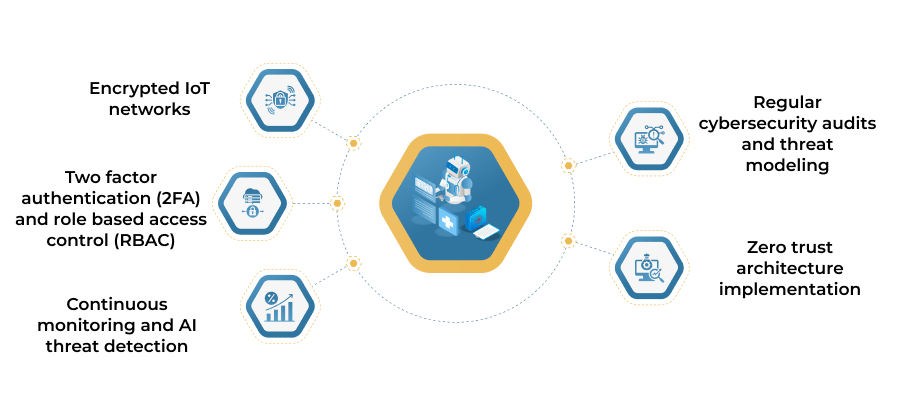
Encrypted IoT Networks: Any data sent from smart hospital rooms are wrapped in layers of encryption with sophisticated protocols, thereby, transforming them into a digital safe to impede unauthorized interception or tampering in a silent manner.
Two Factor Authentication (2FA) and Role Based Access Control (RBAC): Patient data access is guarded through multi factor authentication and permission based control which only authorized people are given the right to see or make changes to the sensitive records.
Continuous Monitoring and AI Threat Detection: Artificial intelligence powered real time surveillance can spot network activities that are abnormal and thus, gives the opportunity of threat removal at a high speed before a breach is made.
Regular Cybersecurity Audits and Threat Modeling: Hospitals perform ongoing risk evaluations and develop the scenarios of their attacks to anticipate new vulnerabilities and hold tight to the regulations like HIPAA, GDPR, and HITRUST.
Zero Trust Architecture Implementation: Zero Trust goes beyond the traditional perimeter defense and enforces the policy of ‘never trust, always verify’ which checks users and devices regularly thus, cyber risks are reduced to a great extent and operational continuity is guaranteed.
Interoperability for Seamless Operations
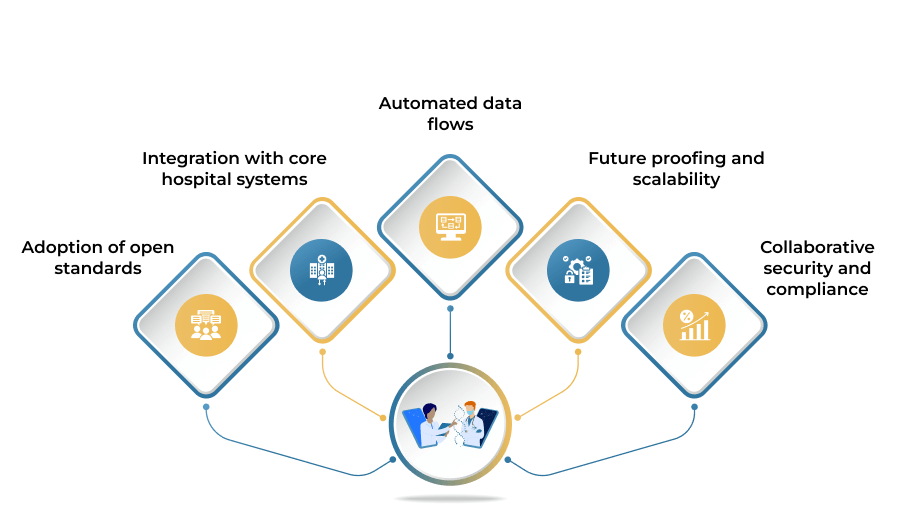
Adoption of Open Standards: Employing HL7 FHIR, DICOM, and other healthcare interoperability standards allow various devices and systems that are built by different vendors to communicate without any compatibility issues.
Integration with Core Hospital Systems: Intelligent room systems link up effortlessly with EHRs, PACS, laboratory information systems, and hospital management software to facilitate integrated workflows.
Automated Data Flows: The process of manually entering data is completely removed, thus mistakes are lessened and the whole procedure of, for instance, patient admissions, diagnostic imaging, and clinical documentation is accelerated.
Future Proofing and Scalability: Hospitals that use standardized interoperability frameworks are able to bring in the latest digital health technologies, AI tools, and telehealth applications without having to change their existing operations.
Collaborative Security and Compliance: The coordination of security measures across devices and platforms guarantees the accuracy, confidentiality, and compliance with regulations of the data, thus it contributes to patients’ safety and the hospital’s good name.
Sustainability Initiatives in Smart Hospital Design
Energy Efficiency
Smart HVAC Systems: Smart hospital HVAC systems automatically adjust heating, ventilation, and air conditioning based on real-time occupancy and patient needs. As a result, energy consumption decreases while patient comfort improves.
Intelligent LED Lighting: LED lighting integrated with occupancy sensors automatically dims or switches off in unused areas. Consequently, hospitals reduce electricity consumption while maintaining a comfortable environment.
Smart Water Management: Advanced water monitoring systems track consumption, detect leaks early, and optimize water usage for sanitation and facility operations. This helps reduce water waste and operating costs.
Intelligent Waste Management: Smart recycling bins and waste management systems use sensors to identify, separate, and monitor waste. As a result, hospitals improve recycling efficiency and reduce their environmental impact.
Predictive Maintenance: AI-powered predictive maintenance identifies equipment issues before failures occur. Therefore, hospitals reduce emergency repairs, lower energy consumption, and extend equipment lifespan.
Green Building and Resource Management
Sustainable Hospital Design: Modern hospitals incorporate modular construction and sustainable materials, including recycled steel, low-emission finishes, and eco-friendly flooring. As a result, they reduce environmental impact while creating flexible, future-ready facilities.
Automated Resource Management: Automation of cleaning and supply delivery improves resource utilization and minimizes unnecessary material and chemical consumption.
Green Building Standards: Many hospitals pursue LEED certification and other sustainability standards to demonstrate environmental responsibility and improve their reputation among patients and staff.
IoT-Based Energy Monitoring: IoT-enabled systems monitor energy, water, and material consumption in real time. Consequently, facility managers gain actionable insights to improve efficiency, reduce costs, and achieve sustainability goals.
Renewable Energy Adoption: Hospitals are increasingly adopting solar power, geothermal systems, and rainwater harvesting. These technologies improve energy independence while supporting long-term sustainability and operational resilience.
By implementing smart green technologies in their facilities, these hospitals are not only decreasing their environmental footprints but also constructing attractive healing spaces that accelerate patient recovery and are supportive of staff welfare, thus proving that smart hospitals can be both green and cutting edge.
Emerging Trends: Robotics and AI Driven Room Management
Autonomous Robotics in Operations:
As part of hospital automation, autonomous robots perform tasks such as medication delivery, patient transport, and room disinfection. As a result, hospitals reduce manual effort, minimize errors, and lower infection risks. Healthcare professionals can focus on patient care while improving overall operational efficiency.
AI Driven Resource Optimization:
AI analyzes real-time hospital data to optimize resource allocation, predict patient demand, and improve workforce planning. Consequently, hospitals reduce delays, improve patient flow, and help clinicians spend more time with patients instead of administrative tasks.
Personalized Treatment Suggestions:
AI-powered clinical decision support systems analyze medical history, genetic profiles, and real-time health data to recommend personalized treatment plans. As a result, clinicians make more informed decisions, reduce trial-and-error treatments, and improve patient outcomes.
Shift from Reactive to Predictive Care:
Predictive AI enables healthcare providers to identify risks such as sepsis, cardiac arrest, and respiratory failure before symptoms become critical. Therefore, hospitals can intervene earlier, improve patient outcomes, and reduce emergency care requirements.
Predictive Superintelligence and Disease Elimination:
Advanced AI models can identify early disease indicators and estimate individual health risks using predictive analytics. In the future, these technologies will support preventive healthcare by enabling earlier interventions and reducing the likelihood of serious illnesses.
Ethical and Training Considerations:
As AI adoption grows, healthcare organizations must prioritize ethical AI, data privacy, and workforce training. Furthermore, collaboration between clinicians, IT teams, and policymakers ensures AI supports healthcare professionals rather than replacing them.
Operational and Patient Experience Benefits:
AI-powered technologies improve hospital efficiency by reducing costs, enhancing patient safety, and streamlining clinical operations. Ultimately, patients benefit from faster services, better care experiences, and improved treatment outcomes.
Conclusion
Healthcare is being revolutionized by smart hospital rooms that are providing safer environments, more efficient workflows, and improved patient experiences. MegaMinds is leading the way in providing health systems with the means to integrate solutions, expert design, and on the ground guidance for facility transformation for the future. Get in touch with us if you want to create, implement, and secure the future of your hospital with safe and smart patient care.
Smart hospital rooms employ various technologies such as AI, IoT, and automation to give healthcare providers real time updates about patient status and to make hospital processes highly efficient and safe with the minimum staff input required.
How do sensor networks improve patient care?
By reporting on the patient’s health and surroundings continuously, sensor networks make it possible for healthcare workers to be the first to recognize any situation that may worsen the patient's condition, and to adjust the patient's care specifically to his/her comfort and safety.
What role does AI play in smart hospital rooms?
AI works as a patient data analyst for early warning signals, as a response system to the alert automation, as a decision making assistant, and as a resource allocation optimizer, thus, the state of care changes from reactive to proactive.
How does fall detection technology work?
Hospital staff get notified immediately with visual, aural or vibration alarms, when any movement of patients on beds or floors detected by sensitive and intelligent devices is followed by a fall. Consequently, the number of fall accidents on hospital wards has been cut down by 88% approximately.
What infection control measures do smart rooms include?
By giving precise disinfecting information to the hospital staff through frequent surface UV irradiation and other proactive air handling measures that are controlled automatically with sensors, digital alerts are raising the level of infection control by reducing the chances of contamination.
How do smart hospital rooms empower medical staff?
With the help of digitized instruments, healthcare workers' burden from the sheer amount of mental work and multitasking is brought down significantly by means of alert unification, automatic data entry, and virtual nursing possibilities, which frees the workforce for direct patient care and increases the efficiency of the team.
What cybersecurity measures protect smart hospital data?
Some of the security measures for private health data in smart hospitals include: highly secure and encrypted IoT networks, two factor authentication, monitoring of security situation on a continuous basis, and security audits which are conducted quite regularly.
Quickly scale your development capabilities by hiring pre-vetted tech experts who align perfectly with your project goals, timeline, and company culture.
What to expect after you reach out?
1. Share Your Requirements
Tell us your project goals, tech stack, and resource needs for a perfect talent match.
2. Talent Shortlisting
We screen and shortlist top-tier professionals based on your exact technical and cultural fit.
3. Interview & Selection
You interview the candidates and select the ones that align with your expectations and company values.
4. Onboard & Integrate
Seamless onboarding process to ensure smooth collaboration with your in-house team from day one.
5. Monitor & Scale
We assist with performance tracking and help you scale the team as your project evolves.