From Manual Processes to Smart...
22 Oct 2026

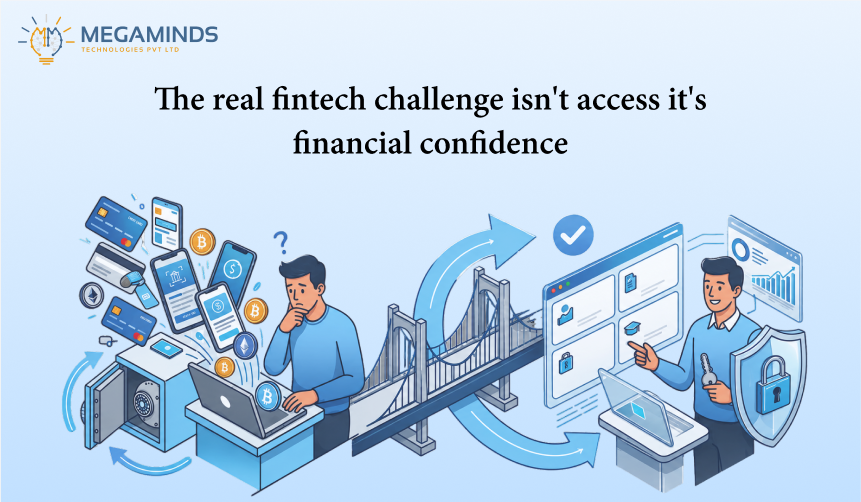
Users need confidence when making financial decisions, as well as access to digital financial services. This need elevates financial confidence to a critical level in modern fintech. Simplifying services in one area of fintech doesn’t reach the entire population, because many users still struggle with evaluating choices and the risks that come with selecting options.
The scale of that gap is measurable. In the OECD’s 2025 report on digital payments and digital financial literacy, 40% of adults across 39 economies who bought goods and services online failed to reach the minimum target digital financial literacy score. Access has clearly outpaced understanding: 96% of adults across OECD countries made or received a digital payment, yet the average digital financial literacy score across surveyed economies sat at just 53 out of 100.
Fintech companies that integrate insights, tailored recommendations, and clarity around user decisions are in a better position to make decisions easier while building trust and improving financial outcomes.
The fintech industry has succeeded at improving financial access. Banking, lending, investing, and payments can all be done in moments. But people don’t feel empowered to make financial decisions just because access is easy. Modern financial platforms are evolving from simple automation to decision intelligence that helps users make smarter choices.
Consumers are now asking a different set of questions: Are we making the right investment? Are we buying the best insurance plan? Are we borrowing within budget?
The industry is moving away from access-driven finance and toward confidence-driven finance. Confidence-driven finance requires that users understand their options and that uncertainty around decisions is minimised. Platforms that provide personalised guidance, AI-enabled insights, and embedded financial education are more likely to meet customer demand and be rewarded with trust and better retention.
The data supports the shift. Accenture’s Global Banking Consumer Study 2025, which analysed 49,300 customers across 39 countries and 700 banks, found that 73% of customers now engage with multiple banks beyond their main provider, and 58% bought a financial product from a new provider in the previous 12 months. Loyalty built purely on access is no longer sticky.
Although the speed of Fintech innovation has some people excited for its potential, not enough people feel safe enough to make big financial moves. Multiple factors play into how comfortable people feel about managing their finances.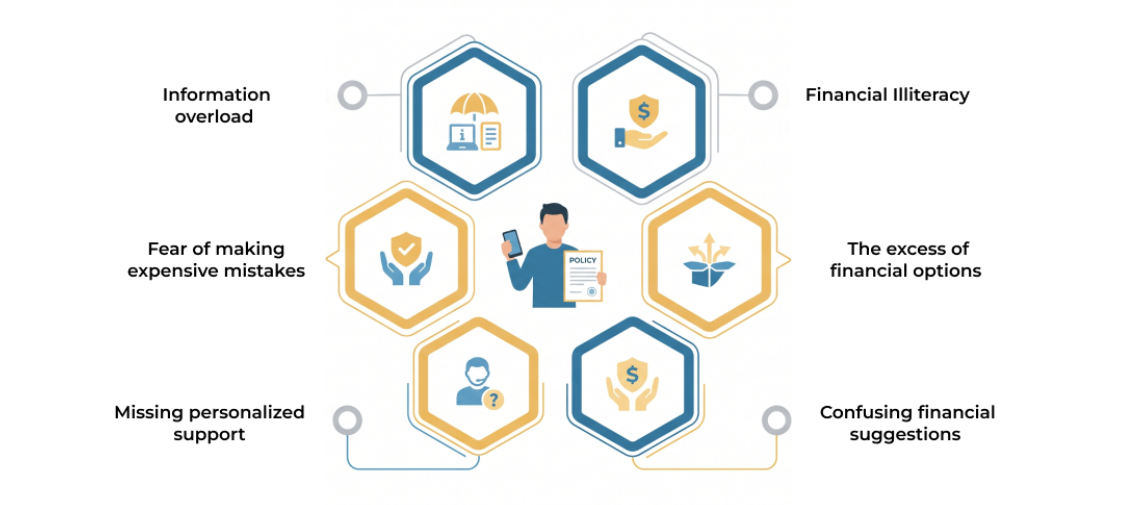
Information and Knowledge Challenges
1. Information Overload
Being bombarded with suggestions to invest, gamble, join, or buy something brings users nothing but confusion. It’s almost impossible to sift through promotional material to find legitimate advice, so most customers throw up their hands and give up the search.
2. Financial Illiteracy
Basic financial advice like knowing the difference between savings and compounding interest or knowing taxation and insurances is lost to many customers. There are no basic explanations to financial products and therefore no incentive to buy.
3. Fear of Making Expensive Mistakes
The stakes in financial decisions don’t come cheaply. Going for a loan, investing a life savings, or choosing which insurance to take can all result in losing money and for that many customers would rather pass on the whole thing. Predictive AI helps users and financial institutions reduce risk by detecting fraud before it leads to financial losses. .
4. The Excess of Financial Options
There are many modern fintech solutions with options for investments, all sorts of savings, credit cards, loans, insurances, you name it. Too many options can make people feel less sure about what the right choice is, even if in general making choices is good.
5. Missing Personalized Support
Most recommendations aren’t relevant to the individual receiving them. MX’s 2025 consumer research found that 67% of consumers expect their financial provider to know them — up sharply from 54% the year before. Expectation is rising faster than delivery.
6. Confusing Financial Suggestions
There are many modern fintech solutions that will suggest an action. Most of them won’t even try to explain to the user why they are making the suggestions they are. This lack of transparency will usually resonate as a lack of trust in the suggestions.
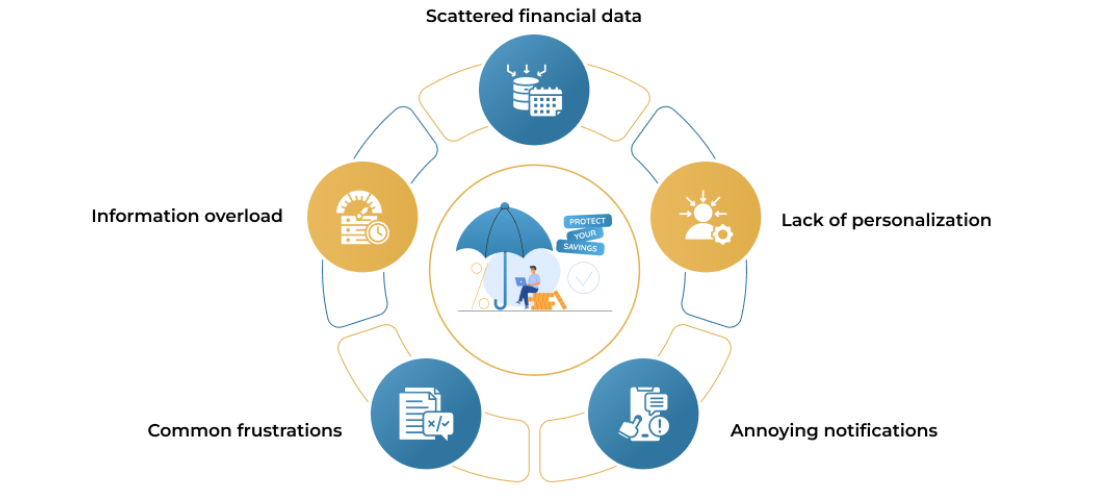
Digital financial tools give users more control over their money. However, the proliferation of financial apps offers a new set of obstacles. Going from one app to another to access banking, payments, investing, insurance, and budgeting means financial information becomes scattered. The purpose of simplifying financial management is lost, instead, the user becomes more confused and uncertain.
Data Management and Information Challenges
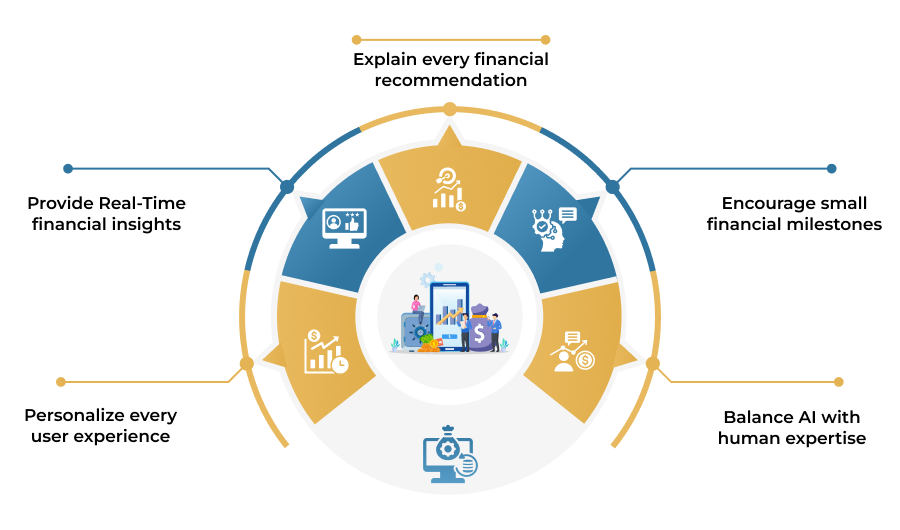
Fintech platforms have begun moving beyond transactional models with the use of Artificial Intelligence. AI-powered financial decisions help users understand complex choices, build trust, and make more confident financial decisions. These models offer consumers personalized financial advice. With the ability to analyze spending patterns, earnings, savings, as well as future goals, AI can simplify budgeting, investment, and overall financial planning. Per McKinsey and Company, there is a positive correlation between the use of AI in the personalization of services and customer satisfaction as well as an increase in revenue. As a result, personalization of services with AI is one of the leading factors for customer trust and overall engagement.
AI also encourages the proactive financial decisions of users. The technology is able to monitor and highlight negative patterns in a user’s finances, such as overspending, poor savings, and more. The focus of AI and technology-based personal financial assistants is on real-time edge case responses. As the AI learns, so does the accuracy of the suggestions, and therefore the perceived personalization of the service.
Confidence grows with the right kind of guidance. Balances and transaction histories aren’t enough. A platform earns loyalty when it interprets the detail and recommends a logical next step.
Trust is the foundation. According to the 2025 Edelman Trust Barometer’s financial services report, global trust in financial services rose two points to 64% and the sector was trusted in 17 of 28 countries surveyed but it still ranked toward the bottom of the 17 sectors measured. The 2026 edition puts the figure at 63%, up 10 points over five years, making financial services the only sector with double-digit trust growth since 2021.
That trust translates directly into commercial outcomes. Accenture found that banks in the top 20% for customer advocacy grew revenue 1.7x faster than peers and 2.6x faster in North America. Advocates hold on average 17% more products with their primary bank, producing a 5–30% boost in share of wallet across product lines.
Good advice is also timely. Warning users about an upcoming payment, reminding them of a deadline, or nudging them toward a savings goal are concrete examples. AI-driven guidance paired with education builds the kind of trust that converts into engagement and better financial outcomes.
It is no longer sufficient for contemporary financial technology platforms to provide digital financial services. Low-code platforms help fintech companies rapidly build personalized financial experiences and intelligent customer journeys. They now have the obligation to equip users to make sound financial decisions. Financial technology firms can establish trust and increase customer engagement and loyalty by optimizing their use of artificial intelligence, design, and personalized financial insights.
Improve Financial Transparency and Decision-Making
The use of Artificial Intelligence is changing the financial services industry, but helping customers to make sound financial decisions is still difficult. Fintech firms need to be innovative, but they also need to comply with regulations. Customer confidence must also be maintained. It is essential that designers and developers of Fintech services and advanced financial products think carefully about how to use AI responsibly, and design their products in a way that aids the understanding of the complex recommendations offered to customers.
Fintech services also need to recognize the complexities of providing for low, moderate, and high income customers that have, or that are studying to have, different levels of education and also different levels of understanding of financial concepts. Students, workers, entrepreneurs, and retirees, for example, all will need different recommendations. It is essential that the services offered are trustworthy, transparent, secure, and do not incorporate decision-making biases. The Edelman Trust Barometer for the year 2025 says that trust will be the most important factor when customers are deciding whether or not to use a digital service. Responsible AI and customer transparency will be essential for Fintech services to be successful in the market.
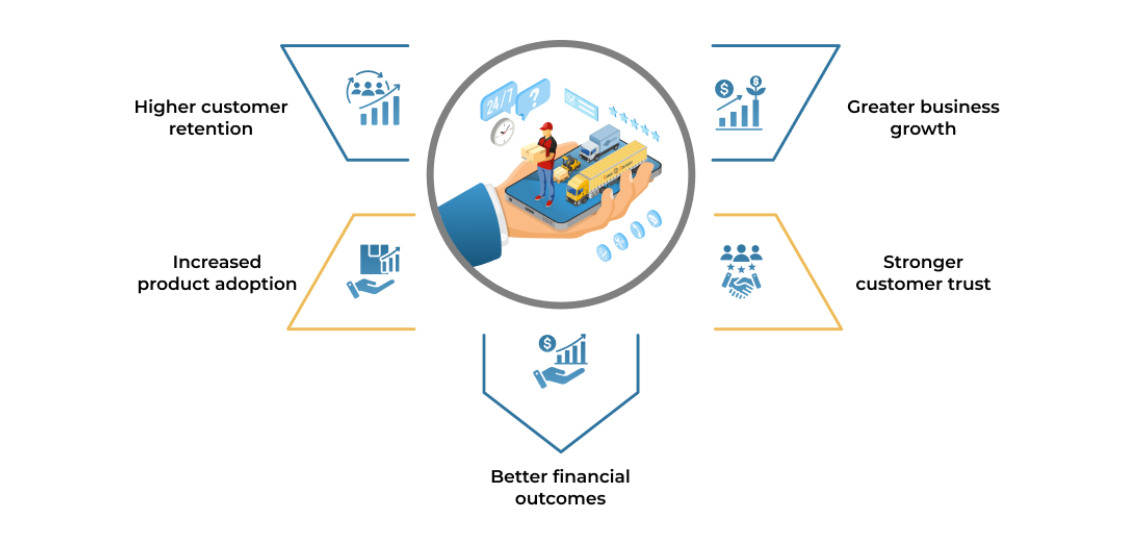
Companies focusing on financial confidence build long-lasting relationships with their clients which in turn builds healthy and sustainable business growth.
Key benefits include:
The future of fintech extends far beyond digital payments or faster transactions.
Tomorrow’s platforms will function as intelligent financial partners. AI agents are transforming fintech by providing proactive financial guidance, automation, and intelligent decision support.
Several trends will shape this evolution:
With the rise of open banking and real-time data integration, we can expect to see an appreciation of the value of interconnected financial services. Transaction offerings will no longer suffice as many consumers will expect integrated financial services to provide proactive, personalized support, and recommendations, which are perceived to be in the customer’s best interest.
The organizations which manage to integrate advanced analytics, ethical AI, intuitive design, and ongoing financial education will likely be the most successful in developing and maintaining long-term customer relationships. Organizations will build and sustain competitive advantage in the market through their customers’ ability to effectively and confidently make financial decisions.
While previously financial access has been the biggest problem for fintech, today it is financial confidence. Digital banking, payments, lending, and investing have become increasingly available to the consumer. However, there is still a need for guidance on financial decisions. Transparency, personalization, insights, education, and the right AI can provide the needed confidence.
The fintech advantage that gives the user the most knowledge and confidence is providing the most guidance. Creating a platform that breaks down complex decisions and promotes trust will allow for the most engagement and loyalty, and therefore the most business. The company that realizes financial services aren’t the only thing they provide, and that people are looking for the confidence, knowledge, and control of their finances, will be the one that wins.


19 Oct 2026
15 Oct 2026