How Can AI Help Fintech...
08 Oct 2026

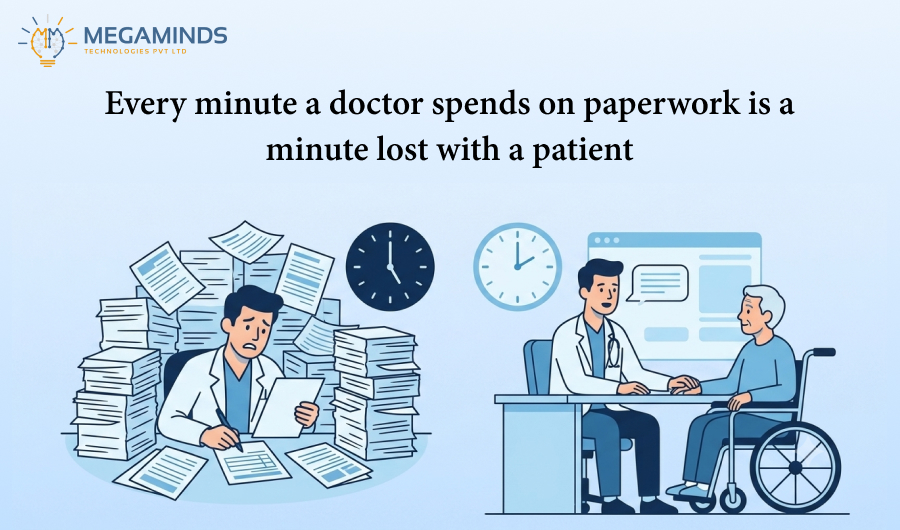
Administrative tasks take time away from patient interaction. According to the American Medical Association’s 2024 Organizational Biopsy data, physicians work an average of 57.8 hours per week but spend only 27.2 hours less than half on direct patient care. The remainder goes to indirect patient care (13 hours) and administrative tasks like prior authorization and insurance forms (7.3 hours).
Manual documentation can lead to:
We shouldn’t get rid of health care documentation. We need to think of better ways for health care professionals to easily capture and update pertinent health care document information to reduce repetitive work, e.g. by using AI-enabled documentation and workflow automation systems, to allow for more time be spent on patient care by health care professionals.
Digital healthcare transformed the nature of administrative tasks for doctors.
Today, doctors have to juggle EHRs, insurance documentation, prior authorizations, clinical messages, compliance with numerous digital systems, and so many more things.
The AMA estimates that, in 2024, increasing time spent on indirect patient care, including order entry, documentation, result interpretation, and referral completion, averaged 13 hours per week. Also, 7.3 hours per week were spent on prior authorizations and documenting insurance forms.
This creates a difficult cycle:
More patients → more documentation → more administrative work → less available clinical time.
Healthcare leaders can no longer solve their staffing issues by simply focusing on hiring additional personnel. Although administrative hiring will provide some relief, leaders must also try to identify if there are ways to use technology to completely digitize repetitive work.
An innovative solution is to reassess workflows to allow physicians to have greater clinical decision-making time and less input time.
Manual documentation extends straightforward patient visits. Here are four ways it impacts the healthcare field. 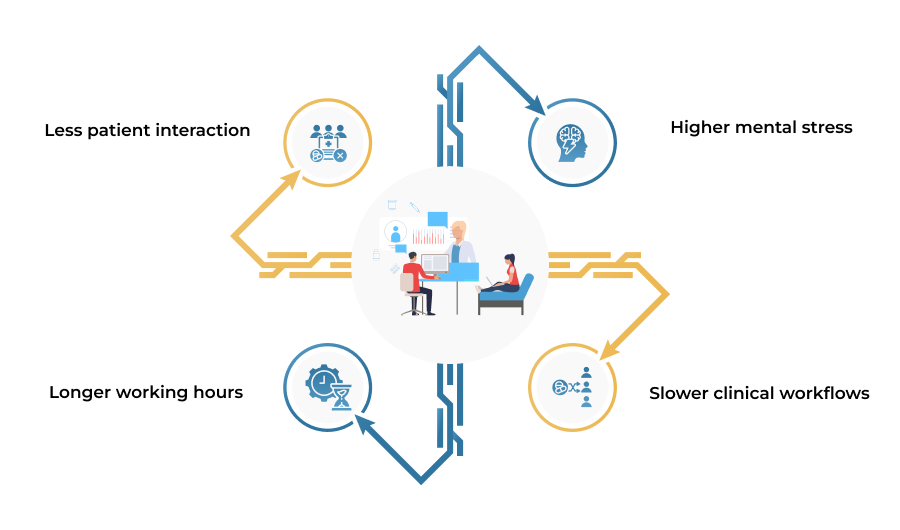
How AI Reduces the Documentation Burden in Healthcare
1. Less Patient Interaction
Time spent documenting is time not spent listening. In the University of Pennsylvania ambient-scribe study, freeing clinicians from real-time typing translated into roughly two additional minutes of face-to-face patient interaction per visit.
2. Longer Working Hours
Doctors end up doing unfinished post-visit documentation, which extends the workday and cuts into personal time.
3. Higher Mental Stress
The combination of clinical cognitive load, information overload, and documentation requirements drives exhaustion. In the Sutter Health pilot, measures of note-writing difficulty, hurried pace, and overall mental demand all decreased statistically significantly after ambient AI was introduced.
4. Slower Clinical Workflows
Documentation and data entry required for every aspect of the healthcare process delays a multitude of important clinical workflow tasks.
Systems that do documentation and workflow automation dramatically cut down documentation tasks and allow clinicians to work at optimal pace.
The cumulative cost of daily paperwork across the system is substantial. Estimates of U.S. administrative spending range from 15–30% of national health expenditure, with roughly half of that — $285 billion to $570 billion annually — considered wasteful, meaning it doesn’t contribute to health outcomes in any discernible way. (
The landmark JAMA waste analysis put administrative complexity at roughly $265 billion per year, the single largest waste category in U.S. healthcare.summarized by Peter G. Peterson Foundation, 2025
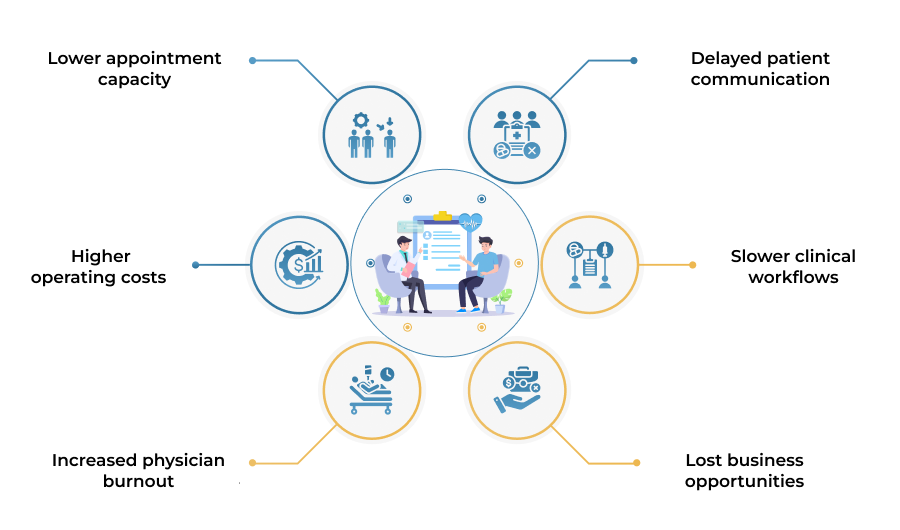
1. Lower Appointment Capacity
Doctors spend a significant amount of time on paperwork, limiting the time they have available to attend to patients.
2. Higher Operating Costs
Extra bureaucracy leads to increased overtime for doctors and drives the need for more administrative staff and ultimately greater costs for running health care operations.
3. Increased Physician Burnout
Documentation takes time and leads to notes, forms, and EHR tasks; this leads to fatigue, stress, and overall frustration for health care professionals.
4. Delayed Patient Communication
Having system documentation that is filled in manually creates delays for communication for follow-up, referral, test results, and even prescriptions.
5. Slower Clinical Workflows
When tasks have additional time constraints, documentation will increase the time required for all of the processes for the care teams and departments.
6. Lost Business Opportunities
repetitive administrative work is time lost for clinical work that could be consulting with patients.Paperwork may be a money drainer for health care systems, but the time lost for health care professionals is far greater as they cannot focus on their patients.
How AI, Automation, and Digital Workflows Reduce Documentation Burden
AI and automation can reduce the time doctors spend on repetitive paperwork, helping them focus more on patients and clinical decisions.
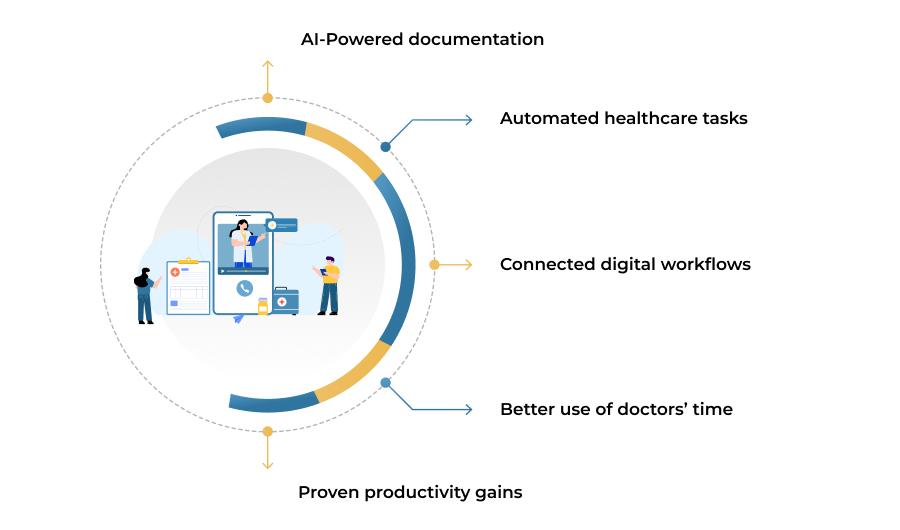
AI-Powered Documentation
Ambient AI can capture doctor-patient conversations and create draft clinical notes. Doctors can review and approve them instead of typing everything manually.
Automated Healthcare Tasks
Digital workflows can automate patient intake, appointment reminders, referrals, forms, follow-ups, and data entry, reducing repetitive administrative work.
Connected Digital Workflows
Connecting AI with EHRs, scheduling systems, and patient platforms allows information to move smoothly between systems with less manual effort.
Better Use of Doctors’ Time
The goal is not simply to add AI. It is to use AI where it can remove repetitive work and give doctors more time for patient care.
Proven Productivity Gains
A JAMA Network Open study found ambient AI was linked to 20.4% less note-taking time per appointment and 30% less after-hours work time.
Technology will enable doctors to make better use of their time and spend more time with their patients. Rather than writing notes at the consultation, they will devote more attention to the patient’s verbal concerns and will be able to create a better dialogue and ask better questions.
AI powered documentation will be able to record relevant information in the consultation and draft the notes post consultation. This will enable doctors to review the information, make corrections and sign off on the documentation thereby eliminating the need for repetitive typing.
AI will take over routine documentation, while the doctors will have more time to focus on the care of their patients. Healthcare professionals will have more time to focus on their patients and the efficiency of the organizations will improve as a result.
The automation of workflows using AI allows healthcare systems to eliminate paperwork, streamline operations, and enables clinicians to spend more face to face time with patients.
The AMA has reported that in the year 2024, the average physician overall work week was 57.8 hours, with an average of only 27.2 hours, or about one-half of the work week, devoted to patient care.
AI can ultimately help clinician document sooner, enhance the clinician’s patient care experience, and can automate reminders and follow-up calls. Intake and referral forms can be processed electronically.
Clinician well being is further enhanced as repetitive administrative tasks are eliminated.
AI will diminish the need to fill out forms in the future, but healthcare companies must first resolve a number of problems. 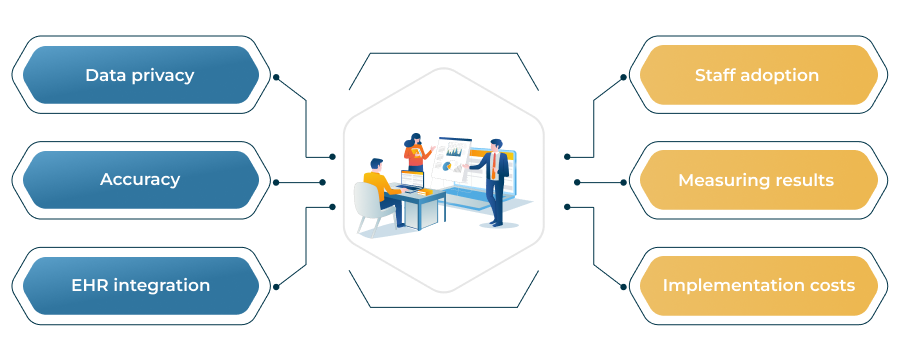
1. Data Privacy
Healthcare AI collects patient data and, therefore, must prioritize security and be HIPAA compliant.
2. Accuracy
AI-generated notes require clinician review. In the Penn study, clinicians reported that substantial editing and proofreading sometimes offset the time saved, and the tool received a net promoter score of 0 as many clinicians would not recommend it as would.
3. EHR Integration
AI systems must work seamlessly with existing EHR, as then the expected benefits for the system will be realized. One 2025 study of 8,740 encounters reported a 28% decrease in required documentation for employees during their shifts.
4. Staff Adoption
AI systems must be introduced slowly, with ample time for training and gradual adoption. One 2025 study of Sutter Health reported an increase in full, undivided attention from physicians towards patients from 58% to 93% after a pilot amalgamating 100 physicians.
5. Measuring Results
When introducing AI, companies must track measurable outcomes in documentation time and the overall satisfaction of employees.
6. Implementation Costs
AI must generate time savings and productivity increases for companies with additional benefits. Companies must consider their new capacity to provide care to patients.
AI is no longer limited to repetitive, menial tasks in healthcare. Healthcare companies use AI to make clinician workflows more efficient and help them spend more time seeing patients.
In one study of 1,547 clinicians in 2025, participants noted less time spent on clinical note writing and fewer post-work hours required for documentation with the use of ambient AI. Because writing clinical notes is one of the most time-consuming parts of a clinician’s day, this is particularly significant.
Healthcare organizations are using AI to do more than automate simple, note writing tasks. They are looking to AI technology to assist them with tasks, such as, reading and summarizing communications, prioritizing important information, and organizing data. AI can be used to automate mundane work for staff.
The biggest impact of AI will be eliminating the clinical paperwork burden, not replacing the clinician. When AI does the paperwork, clinicians can do the work that technology cannot, such as listening, reasoning, deciding, and caring.
The best way to achieve this is less paperwork = more focus on clinical work = optimal efficiency of healthcare professionals.
Healthcare doesn’t have a ‘paperwork’ issue. Healthcare has a time issue. Every minute a doctor spends on documentation is a minute they can’t spend on patient visits or clinical decisions.
Documentation will always be necessary but can be repetitive and simple. AI, workflow automation, and other intelligent digital systems reduce the documentation time for doctors and decrease the repetitive documentation needed.
For healthcare leaders, the goal is simple: Less time spent doing administrative activities and more time spent doing clinical activities and quality care.
AI and other technologies of the like can help doctors do more of what is important, which is caring for patients.

08 Oct 2026
05 Oct 2026
01 Oct 2026