How Can AI Help Fintech...
08 Oct 2026

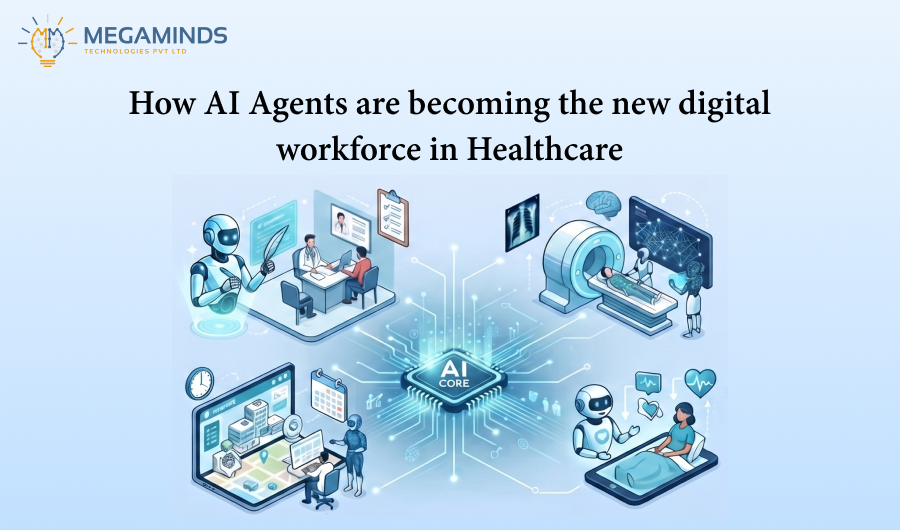
More healthcare organizations are implementing AI agents within their systems to address issues pertaining to automation of redundant tasks, development of clinical decision support systems, enhancement of patient interaction, reduction of operational costs, and empowerment of healthcare providers to offer value-added services. Traditional automation has its limits, and tends to fail when systems become more complex. AI agents understand system context and analyze large amounts of data. In addition, they continuously learn through recommendations and interactions.
Healthcare operations continue to be revolutionized by AI agents by addressing an urgent need in the industry; these AI agents solve the most financially burdening and least clinically demanding aspect of administrative burden. Unlike traditional chatbots that only answer isolated queries, AI agents process and reason through entire workflows. These workflows include the verification of eligibility and the status of claims, denial management, and the escalation of exceptions to the human operators.
The financial case is substantial. IDC predicts that by 2027 the healthcare industry will save up to $382 billion by optimizing clinical, operational, and administrative workflows through intelligent automation.Regionally, IDC projects up to $110 billion in savings across Asia/Pacific alone over the same period.
Buy-in from executives is now measurable. In a February 2026 Deloitte Center for Health Solutions study of 100 US healthcare technology executives (50 health systems, 50 health plans):
Deloitte’s 2026 US Health Care Outlook Survey reinforces this: over 80% of healthcare executives expect agentic and generative AI to deliver moderate-to-significant value across clinical, business, and back-office functions in 2026
A major issue in healthcare is that patient-facing time for staff is being lost as a result of the time needed for staff to engage in administrative tasks. The introduction of AI in the healthcare domain means that these tasks can begin to be addressed via automation, including scheduling, billing, and administrative compliance. AI in healthcare provides an opportunity to reduce the administrative burden on staff and improve and refine workflows. 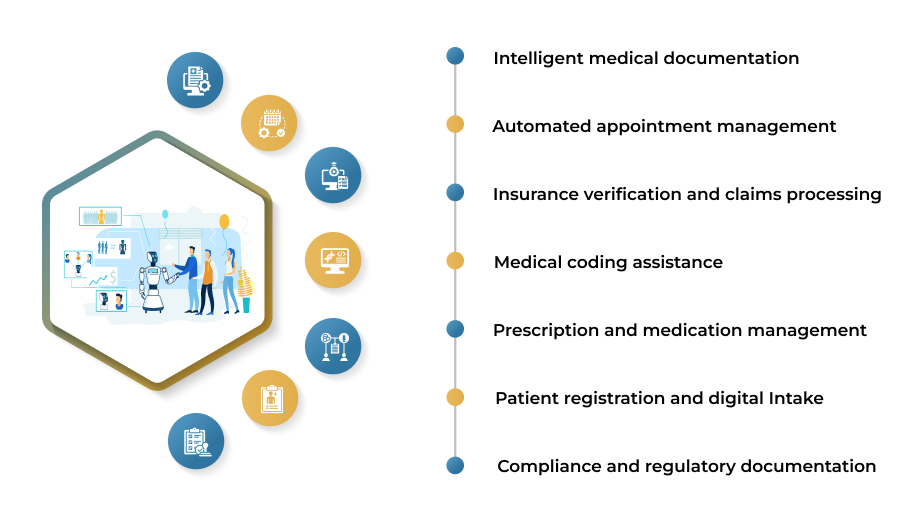
Intelligent Medical Documentation
Ambient AI turns conversations between doctors and their patients into clinical notes on its own. It is very easy to see why this is so. One of the studies done by the JAMA Network Open was conducted in 2025 in six healthcare systems among 263 clinicians and showed that burnout rates went down from 51.9% to 38.8% in only 30 days of ambient AI scribes being used. In The Permanente Medical Group, over 2.5 million ambient scribes were used in one year.
Automated Appointment Management
AI offers automation to task management ideas that can help with record reminders for scheduled appointments as well as those that have been canceled for re-scheduling, and thus help mitigate no shows.
Insurance Verification and Claims Processing
In AI, we can have trust that the automation of verification and validation of health claims accuracy and the identification of documentation errors will improve the speed of reimbursement.
Medical Coding Assistance
AI has the ability to scan medical record documentation and be able to assign medical billing codes with a reduced amount of errors.
Prescription and Medication Management
AI can help to mitigate healthcare provider concerns around patient safety with the automation of refill reminders and checks for medication interactions.
Patient Registration and Digital Intake
The task of patient registration via digital automation for the collection of personal and insurance information as well as medical history can be done prior to the patient appointment.
Compliance and Regulatory Documentation
Automation of record retention and compliance reporting will improve the healthcare organization’s efforts of accurately fulfilling compliance and regulatory requirements.
Healthcare Workers face a growing array of challenges when it comes to managing difficulty patient cases, complicated by newly emerging volumes of medical data. AI can help by analyzing complicated medical data, developing a theory, and giving Clinicians insight based on evidence. This capability helps clinicians recognize risks, develop and improve diagnostics, and develop treatment interventions and make decisions more rapidly.
The impacts of AI on clinical decision-making have begun to materialize.
McKinsey & Company estimates that generative AI could create $60 billion to $110 billion in annual value for the healthcare industry. It can also improve clinical decision support, streamline workflows, and increase productivity.
Meanwhile, the U.S. Food and Drug Administration (FDA) has authorized more than 1,000 AI-enabled medical devices. Many support healthcare fields such as radiology, cardiology, neurology, and pathology.
This enables clinicians to diagnose and identify medical disorders much faster and more efficiently.
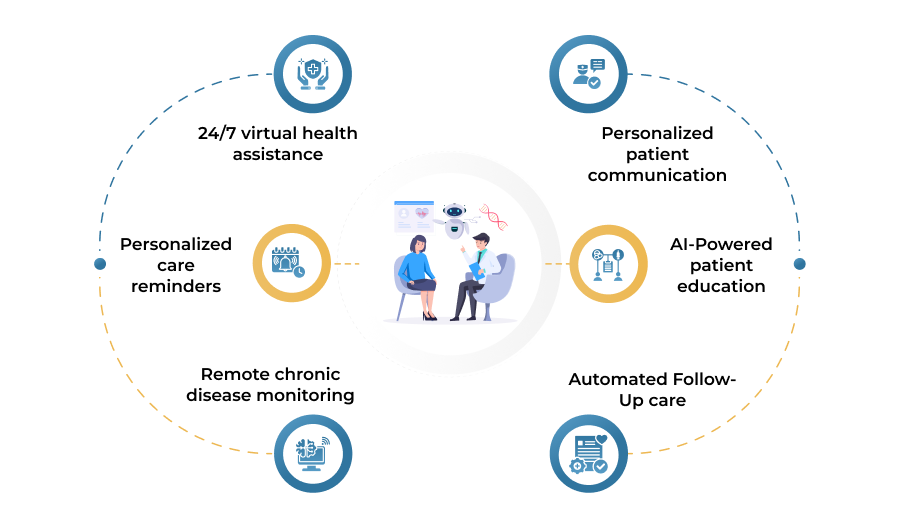
Modern healthcare services are expected to have a fast, easy, and personalized approach. AI agents allow healthcare organizations to enhance patient engagement. This technology provides patients with timely communications and supportive, personalized care. The use of AI agents increases satisfaction and support of treatment, leading to positive health outcomes.
Healthcare organizations collect huge volumes of data every day. This data comes from patient admissions, bed management, staffing, medical equipment, and supply chain operations. Managing these processes manually can be difficult and time-consuming. However, AI agents can analyze real-time data and automate routine processes. As a result, healthcare organizations can improve operational efficiency and make faster decisions.
By continuously monitoring hospital workflows, AI agents can optimize patient flow, forecast resource requirements, balance workforce schedules, and identify operational bottlenecks before they become critical issues. Their ability to process large volumes of data in real time enables healthcare leaders to make faster, data-driven decisions, improve service delivery, reduce unnecessary costs, and ensure that staff, equipment, and facilities are used more efficiently. As a result, hospitals can provide higher-quality care while maintaining smoother and more resilient day-to-day operations.
Although the deployment of artificial intelligence agents in health care is changing the way that health care operates, the successful deployment of artificial intelligence systems will take more than just the development of new technologies. Organizations within the health care industry have to deal with certain barriers.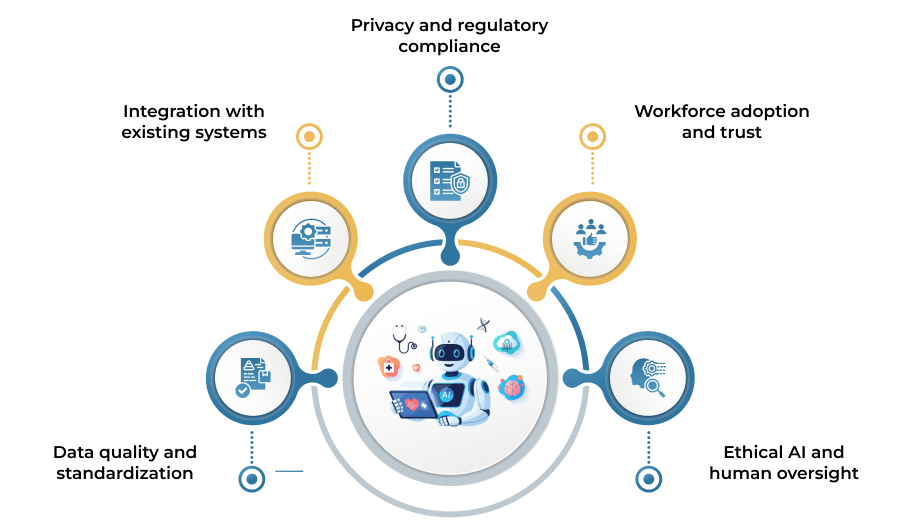
1. Data Quality and Standardization
AI agents need good and standardized data from healthcare organizations. Incomplete patient health information and fragmented Electronic Health Records could lower the accuracy of findings made using the AI systems.
2. Integration with Existing Systems
Most hospitals still rely on outdated systems, thus posing the challenge of integrating the AI systems with existing EHR platforms, laboratory, billing, and medical device systems.
3. Privacy and Regulatory Compliance
Healthcare organizations must protect the privacy of patient information through measures such as encryption and access control while ensuring HIPAA and GDPR compliance.
4. Workforce Adoption and Trust
The adoption of AI agents should be based on the trust of healthcare providers in recommendations provided by the AI solution.
5. Ethical AI and Human Oversight
AI-driven solutions ought to enhance, not replace, clinical know-how. The organizations should make sure that AI-driven solutions stay unbiased, accountable, understandable, and, above all, be supervised by healthcare professionals.
>
A note of realism on evidence quality: a JMIR AI review in October 2025 screened more than 1,400 studies on ambient scribes and found only six met rigorous real-world evidence criteria. A randomized trial at UCLA published in NEJM AI across 238 physicians and roughly 72,000 encounters found one tool reduced note-writing time about 10% while another showed no statistically significant decrease. Results vary by tool and by deployment.
Healthcare facilities that have implemented AI agents have experienced an improvement in clinical practice and performance. AI agents automate repetitive tasks and accelerate decision-making. They also optimize resource allocation across healthcare facilities. As a result, healthcare professionals can focus more on delivering quality patient care.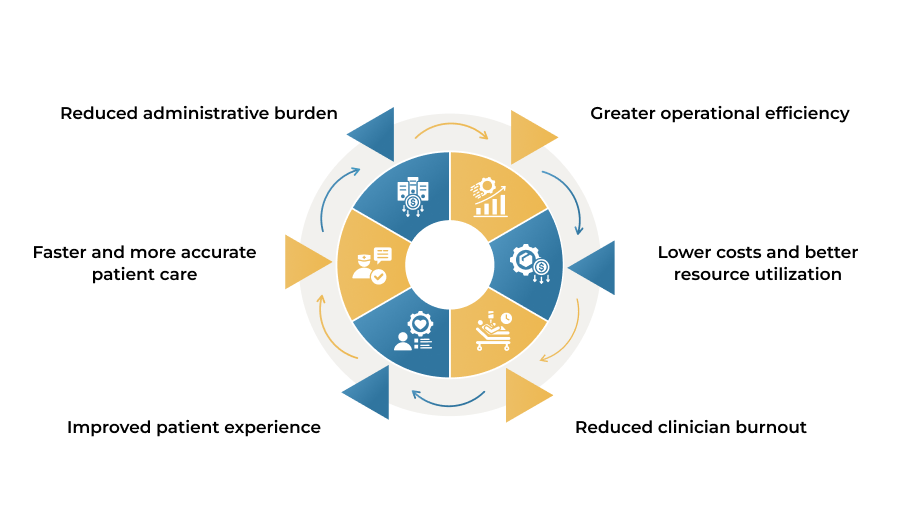
1. Reduced Administrative Burden
AI agents automate routine tasks such as documentation, scheduling, billing, and claims processing. As a result, clinicians can spend more time providing quality patient care.
2. Faster and More Accurate Patient Care
By providing real-time insights and clinical support, AI agents help healthcare teams make faster, more informed decisions that improve patient outcomes.
3. Improved Patient Experience
AI agents enhance patient engagement through personalized communication, automated reminders, virtual assistance, and continuous support throughout the care journey.
4. Greater Operational Efficiency
AI agents optimize hospital workflows, workforce scheduling, patient flow, and resource allocation, reducing delays and improving overall productivity.
5. Lower Costs and Better Resource Utilization
Predictive planning and workflow automation help healthcare organizations reduce operational expenses while making better use of staff, equipment, and medical resources.
6. Reduced Clinician Burnout
In addition to lowering the burden of work and cognitive strain caused by routine administrative tasks, AI agents allow healthcare professionals to concentrate on complex care delivery and patient interactions.
Finally, rather than replacing healthcare professionals, AI agents are empowering them. In this way, human and machine working together allows healthcare institutions to create a more efficient, robust, and patient-focused system of care.
Agents are becoming standard infrastructure rather than experiments. Gartner forecasts that 40% of enterprise applications will be integrated with task-specific AI agents by the end of 2026, up from less than 5% in 2025 though Gartner also notes that heavily regulated industries like healthcare are likely to move more cautiously than retail or telecom.
The market is scaling to meet demand. The broader AI in healthcare market was valued at $36.7 billion in 2025 and is projected to grow from $50.7 billion in 2026 to $505.6 billion by 2033, a CAGR of 38.9%. North America held 54% of 2025 revenue.
Expect three major trends: multi-agent systems handling complex cases, deeper EHR integration via FHIR standards, and payers adopting agents faster than providers.
Conclusion: The Rise of AI-Powered Healthcare Teams
AI agents are creating a fully functional digital workforce that will work side by side with clinicians and staff. They recover the time lost to documentation by staff and protect lost revenue from billing errors. AI will extend the capabilities of staff who are already overextended.
The AI workforce is projected to save the healthcare industry hundreds of billions of dollars, and 85% of the industry is expected to adopt it. Rational healthcare administrators will not ask if they should build an AI workforce; they will ask how fast they can build it responsibly. The first to build these workforces will dominate healthcare for the next decade.

08 Oct 2026
05 Oct 2026
01 Oct 2026