How Can AI Help Fintech...
08 Oct 2026

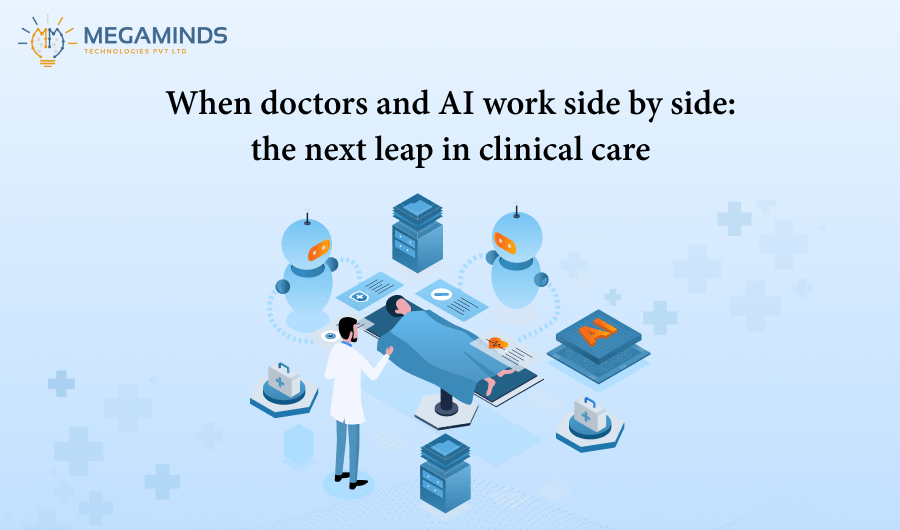
The next big step in clinical care is when doctors and AI work together. AI helps doctors sort through huge amounts of medical data, spot risks sooner, and make decisions faster and with more accuracy. Doctors, on the other hand, provide judgment, empathy, and final clinical authority. This partnership leads to better patient outcomes, less paperwork for doctors, and more efficient, data-driven healthcare.
An AI co-pilot in healthcare refers to advanced technology that assists physicians in decision-making, diagnosing illnesses, and streamlining workflow. These systems offer useful in-the-moment advice to doctors by analyzing large amounts of data, including patient reports, clinical and research guidelines, test results, and data from other physicians.
Unlike conventional healthcare software, AI co-pilots are capable of interpreting and adapting to clinical scenarios. They process clinical data, provide diagnostic suggestions, flag atypical presentations, and provide impromptu citations from the recommended evidence-based literature.
Some of the main features of AI clinical co, pilot systems are: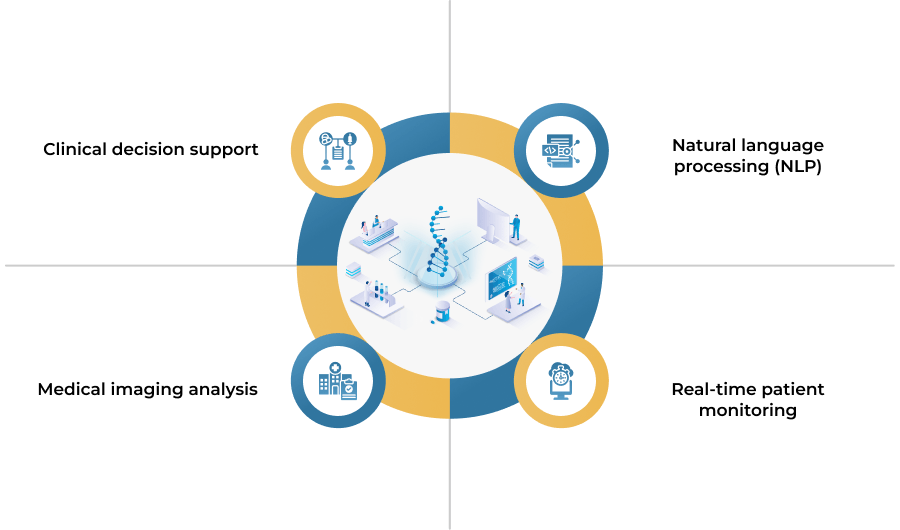
AI co, pilots serve as a smart layer over existing healthcare IT systems of enterprise health providers. They effectively connect clinical data and clinical actions, thus, enabling doctors to pay more attention to patient care and less to data interpretation.
Electronic health records, lab reports, imaging scans, genomic data, and data from remote monitoring devices of patients are only some of the huge volumes of health, related data that modern health care systems generate daily. The International Data Corporation (IDC) pointed out that the healthcare sector produced over 2, 300 exabytes of data in 2020, and as digital health technologies continue to develop, the figure is going up rapidly.
Even though this information has the potential to significantly enhance patient care, on the other hand, it also poses a big challenge to clinicians because of the overload of information. In addition, a research published in the Annals of Internal Medicine pointed out that doctors spend nearly 49% of their work hours on electronic health records and administrative systems, thus reducing the time for in, person patient care.
With the help of AI, this problem can be tackled efficiently as it can convert vast amounts of healthcare data into valuable clinical insight.
AI-powered analytics systems help clinicians by: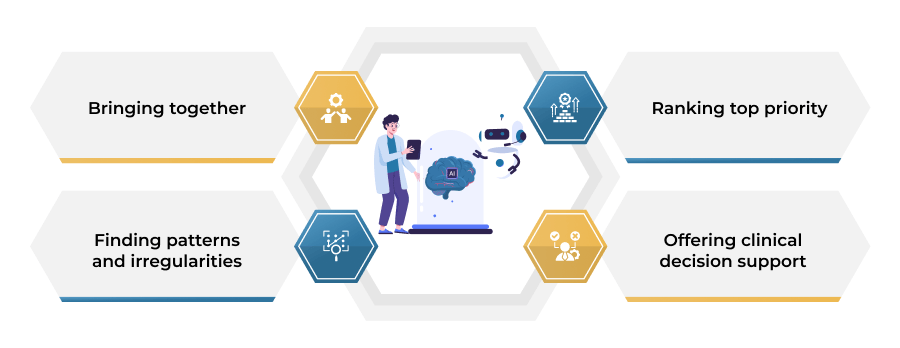
An example of this is AI, based predictive models which can go through medical records and spot potential sepsis cases even 48 hours before the traditional methods of detection, thus, the patients can be helped quicker and the result be better.
One of the biggest challenges of healthcare is the rising amount of administrative work that clinicians have to endure. In fact, research shows that a majority of the doctors’ time is spent on digital systems and paperwork rather than on direct patient care.
According to a study published in the Annals of Internal Medicine, physicians spend nearly half (49%) of their professional time on direct patient care. They also devote about 49% of their time to administrative tasks. This administrative burden creates inefficient workflows and contributes to physician burnout.
Another American Medical Association (AMA) survey found that doctors spend almost two hours on documentation and EHR-related activities. They spend this time for every hour dedicated to patient care.
Healthcare providers are leveraging AI, powered automation for increasing the operational efficiency and simplifying these processes.
AI-powered tools support healthcare teams in several ways: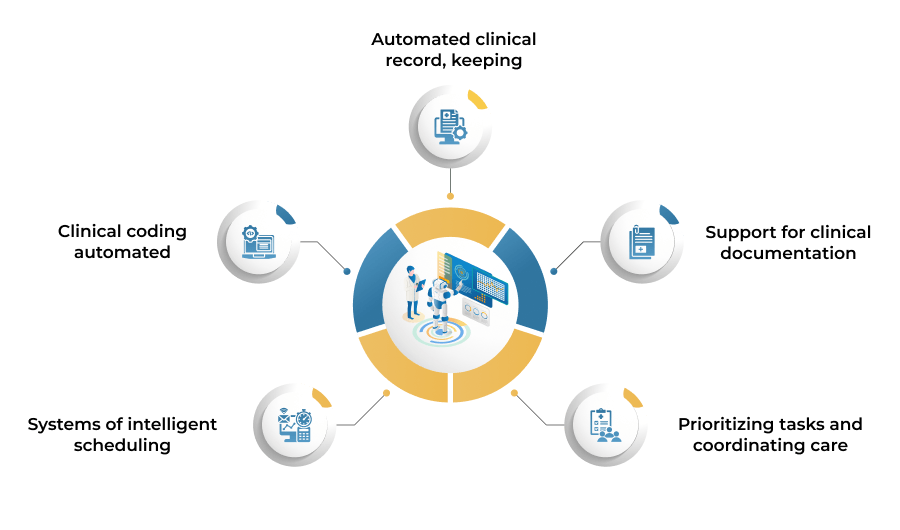
According to a McKinsey healthcare automation report, AI and automation technologies can automate around 36% of healthcareadministrative tasks. This can significantly improve productivity across healthcare organizations.
AI reduces doctors’ paperwork and gives them more time to care for patients. This improves healthcare efficiency and reduces staff fatigue. It also helps hospitals operate more effectively.
AI has beneficial prospects in healthcare; nonetheless, it should be integrated responsibly. It is vital for healthcare organizations that AI systems are transparent, trustworthy, and respect ethical concerns.
Trust is especially important when technology is involved in clinical decision making. Clinicians should be able to understand the rationale behind the AI suggestions, and, in the end, should always have the final decision in the clinical decision making process.
Some of the main governance issues are: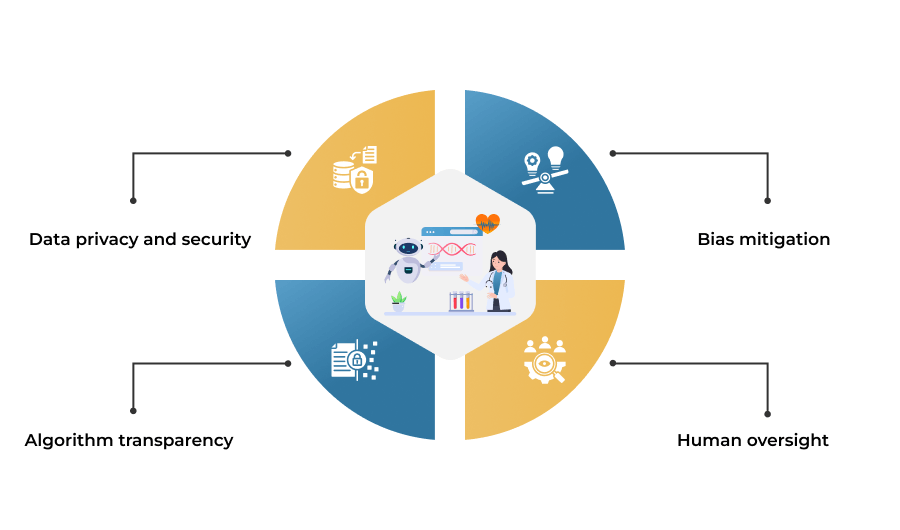
Data Privacy and SecurityHealthcare data is extremely sensitive. To this end, organizations must be responsible for making sure that AI systems are in line with the most stringent data privacy laws and that they keep patients’ information confidential.
Algorithm TransparencyClinicians need to understand how AI models process data and produce recommendations if they are to trust and use the outputs effectively.
Bias MitigationAI systems that are learned on biased datasets may provide inaccurate and unfair results. It is necessary to monitor constantly and have diverse datasets in order to be fair.
Human OversightAI in clinical environments should always be a support tool, not a completely independent decision, maker.
Future, ready healthcare enterprises are setting governance frameworks that incorporate regulatory compliance, ethical AI practices, and strong data management policies. These frameworks make it possible for clinical care to be facilitated through AI, at the same time patient trust and safety being maintained.
Leading healthcare organizations are no longer seeing AI as a technology on which they experiment but are already embracing it as a strategic capability.
These hospitals are channeling their resources into digital transformation efforts that leverage AI not only in clinical but also in operational and administrative processes.
Among the key strategies that forward, looking healthcare enterprises have embraced are: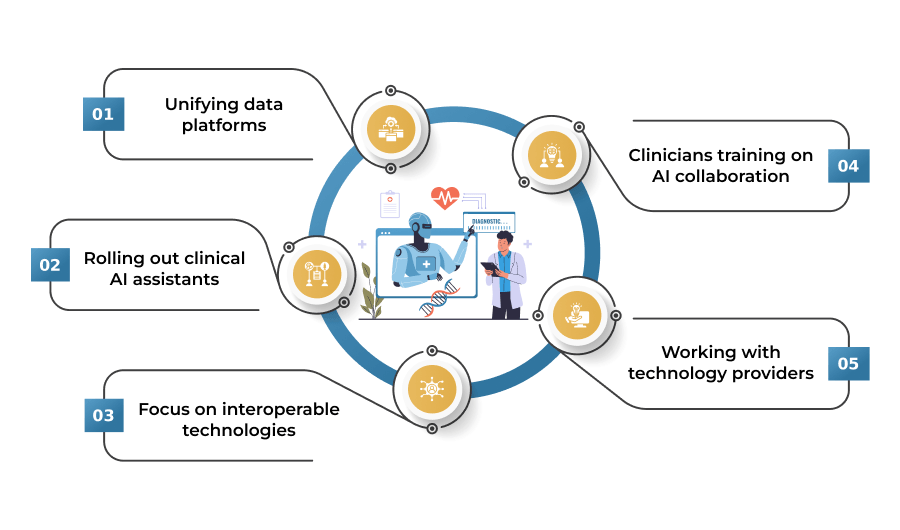
Unifying Data PlatformsAt present, hospitals are integrating data from different sources such as EHRs, imaging, lab and wearable devices into single data ecosystems which enable them to run AI analytics.
Rolling out Clinical AI AssistantsDecision support tools powered by AI are here to help physicians in real, time by being part of the clinical workflow.
Focus on Interoperable TechnologiesTodays healthcare companies are emphasizing the importance of platforms that will allow the AI tools to be integrated seamlessly into the existing healthcare systems.
Clinicians Training on AI CollaborationToday, healthcare companies are highlighting the significance of platforms that will enable AI tools to be incorporated without any trouble into the current healthcare systems.
Working with Technology ProvidersHealth care businesses are leveraging the expertise of AI technology vendors, cloud platforms, and research institutions to innovate more quickly.
Healthcare providers may lead the future of medicine by making the AI shift easy and thus unlocking a whole bunch of new opportunities in healthcare that will result in better patient care, more efficient operations, and continued innovation in healthcare from now on.
The future of healthcare is not an issue of machines replacing doctors. It is about intelligent collaboration between human experts and advanced technology. Clinical co-pilots powered by AI are allowing doctors and other healthcare professionals to comprehend complex medical facts, optimize work processes, and at the same time, help patients better.
If healthcare organizations increase their reliance on AI, driven solutions, they should remember that the main objective of the music is to enable clinical capabilities, not to replace clinicians. Doctors have empathy, ethical judgment, and contextual understanding that technology will not be able to mimic.
In combination with AI’s capability to process huge datasets and identify minute patterns, this sort of human-technology collaboration sets up a powerful new healthcare delivery model.
Healthcare institutions and the entire medical industry today must make this human + AI collaboration their new normal if they are to effectively deal with the challenges of and prepare the system for more efficient healthcare.
The communication between a doctor and AI being the key to a smarter and more resilient healthcare world, the next step in clinical care is here. Both of them together are taking it to the next level.

08 Oct 2026
05 Oct 2026
01 Oct 2026