Why Today’s Customers Expect Insurance...
12 Oct 2026

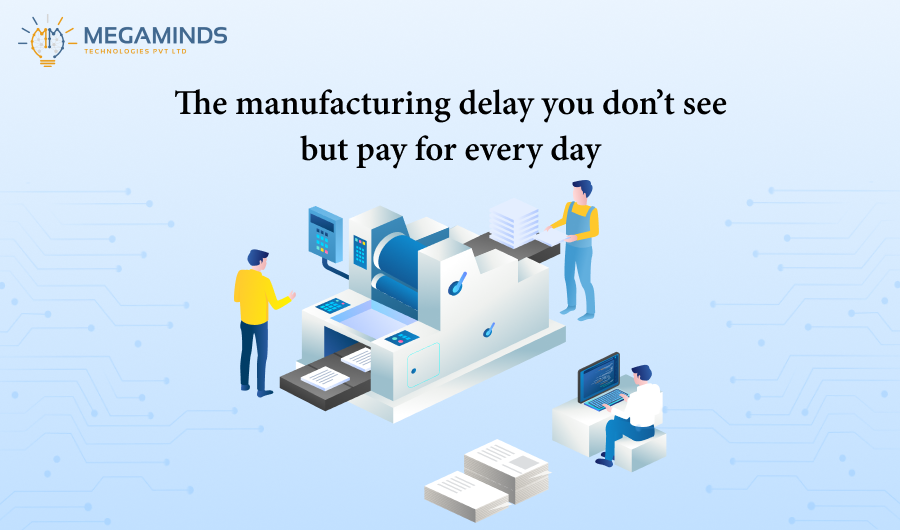
Minor issues such as equipment breakdowns, delays in decisions and communications, and workflow interruptions appear harmless, but contribute to costly and hidden delays in manufacturing. Disruptions to workflows individually stop work, but collectively, they extend delays to production and delivery, which increases orders and inventory. This results in unhappy customers. Identifying and eliminating inefficiencies will greatly increase the overall productivity and profitability of the manufacturing process.
The numbers make the stakes clear. Unplanned downtime alone costs U.S. industrial manufacturers an estimated $50 billion every year. Globally, the world’s 500 largest companies lose roughly $1.4 trillion annually about 11% of their total revenue to unplanned downtime, up 62% from $864 billion. And those are only the visible stoppages. The smaller, hidden delays underneath them are rarely measured at all.
Not all delays are as extreme as full production halts. Most interruptions lead to losses from “micro-delays” which are costs associated with small interruptions that ultimately snowball into something bigger.
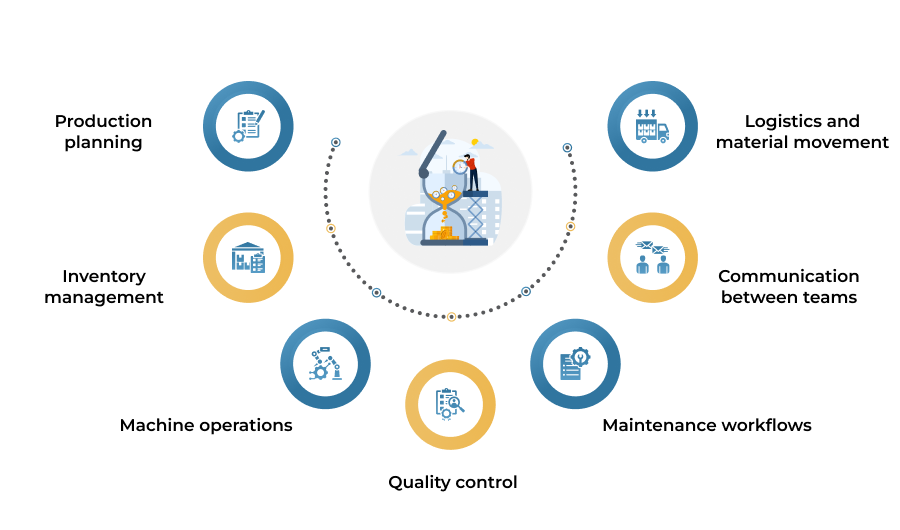
Examples of micro-delays are:
It’s estimated that micro-delays averaging just 2 minutes a day can culminate in many hours of lost productivity per week. To put scale on it: the average manufacturer absorbs roughly 800 hours of equipment downtime annually more than 15 hours every week. In a large manufacturing setting, this raises overtime costs, increases energy consumption, and pushes orders out later than scheduled.
Traditional manufacturing systems are efficient at recording full halts. But small, continuous inefficiencies are tricky to manage, often resulting in an underestimation of their hidden costs. In fact, over 80% of companies cannot accurately calculate their true downtime costs, which is exactly why these losses accumulate unnoticed.
Production processes are interconnected such that delays can compound across the system, increasing operational pressure and reducing efficiency. Although the effects of delay caused by a lack of timely communication are individually small, the repeated adversely impacts the bottom line.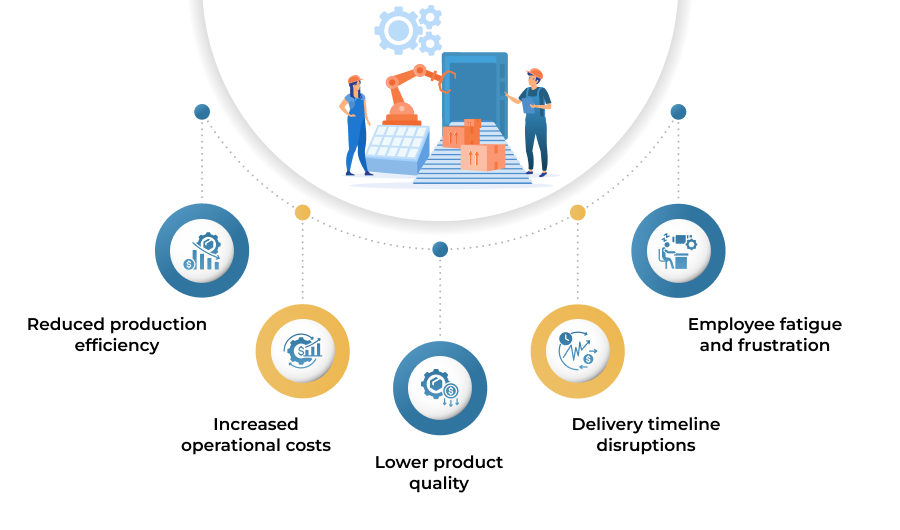
Reduced Production Efficiency
Reduced efficiency results from the accumulation of small delays. A lack of timely communication increases idle time for both personnel and equipment, and low productivity of personnel and equipment.
Increased Operational Costs
Hidden inefficiencies lead to unexpected operational costs: increased overtime, emergency maintenance, higher energy use, expedited shipping, and increased inventory handling. Notably, emergency repairs typically cost 4 to 5 times more than the same repair performed during planned maintenance. More resources go toward recovering from disruptions than toward normal operations.
Lower Product Quality
Delays lead to an inconsistent workflow, and the need to work faster creates a low quality workflow. This results in a poor quality product, and increases the need to repeat work and to failure inspections. This adversely impacts reliability and customer satisfaction.
Delivery Timeline Disruptions
Delays lead to disruptions in the entire workflow including assembly, packing, shipping, and even the fulfillment of customer orders. This creates disruptions in the supply chain and increases the unReliability of the entire workflow.
Employee Fatigue and Frustration
The lack of a workflow creates a low morale environment and increases frustration among the employees. This leads to poor communication and a lack of coordination.
Manufacturing enterprises normally focus on large operational issues while small issues are resolved. The resolution of small issues leads to increased operational stability, improved cost management, and improved manufacturing operations.
There are multiple opportunities for hidden delays in a given manufacturing operation. Because these issues are incorporated into the routine flow of the operation, they are difficult to detect. These slow compounding issues ultimately result in decreasing productivity, increasing costs, and diminishing overall performance.
The consequences of concealing manufacturing delays can transform from short-term buildup to long-lasting damage. Unnoticed inefficiencies can destroy profitability, reduce customer confidence, and and diminish the performance of the business. Reports say that unaccountable downtime costs the manufacturing industry $50 billion, and even minor delays result in a productivity drop of 5%-20%.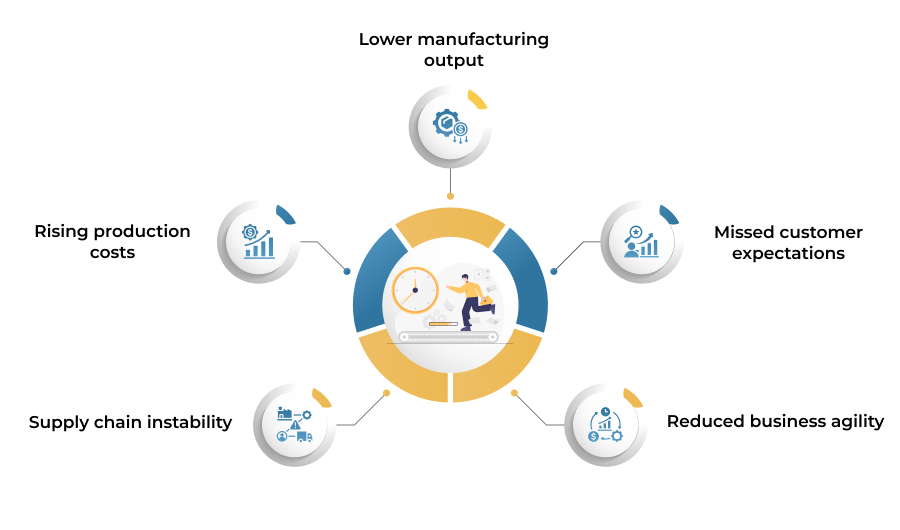
Lower Manufacturing Output
Continuous disruptions translate to production lines losing 10%-15% of their output. Minor delays and disruptions during the day significantly decrease throughput and operational efficiency.
Rising Production Costs
Subtle inefficiencies and disruptions lead to increased labor costs, consumption of energy, resources, and materials. Reports indicate that companies can lose up to 20% of their operational costs from inefficiencies and disruptions.
Supply Chain Instability
Delays in production can result in the inability to meet procurement schedules and disruptions in supplier coordination, inventory, and logistics. If there is a delay in one of the production stages, there is a disruptive effect on the entire supply chain.
Missed Customer Expectations
70% of customers expect that services should be offered at a higher frequency and be delivered at predetermined times. Once delays become commonplace, customers’ satisfaction, service-level agreements, repeat business, and the business’s brand and reputation suffer.
Reduced Business Agility
Delays in production reduces the business’s ability to respond to demand changes, losses due to economic changes, and unforeseen disruptions. The business’s ability to compete in a dynamic environment suffers.
The demand for rapid and efficient production systems grows with the increase in global competition. Manufacturing companies that can meet the production targets gain both operational and financial advantages over their competitors.
Many manufacturers discover that automation alone cannot eliminate hidden operational weaknesses without better visibility and connected intelligence. Traditional manufacturing practices look for big breakdowns. They ignore quotidian inefficiencies that eventually lead to major breakdowns. Because of this, unobserved hidden delays will lead to an increase in operational costs, an increase in the cost of productive work, and a delay between the end of productive work and its delivery to the customer.
Real-time visibility is imperative. When operational data is fragmented, and when policies are not proactive but rely heavily on post-operation reports, it becomes impossible for the manufacturer to correct machine slowdowns and identify workflow and processing bottlenecks in a timely manner. It is further complicated by process reporting systems.
To reduce hidden delays in manufacturing, you must first increase visibility in production and operational workflows. Manufacturers can identify inefficiencies and gain better control over warehouse and factory operations, labor, and production by monitoring them.Connected IoT devices and Power BI dashboards provide manufacturers with real-time visibility into production performance.
Visibility in real-time can help teams identify bottlenecks before they become disruptions. The continuation of workflow helps minimize downtime and allows production to flow more efficiently.
Connected systems can improve coordination across the production, logistics, maintenance, and quality control teams. Communication that has more clarity can reduce the number of delays that approvals create, reduce workflow disruption, and operational confusion between functions.
More efficient manufacturing operations are the result of advanced analytics, intelligent dashboards, Industrial IoT sensors, systems for predictive maintenance, and AI monitoring systems.
AI-driven smart factories are enabling manufacturers to respond faster to disruptions while reducing production downtime. Manufacturers need real-time visibility, smart workflows, and proactive business strategies to eliminate hidden production delays. The use of smart monitoring and predictive systems enables manufacturers to lessen their operational inefficiencies and realize a reduction of 15% to 30% in operational downtime losses.
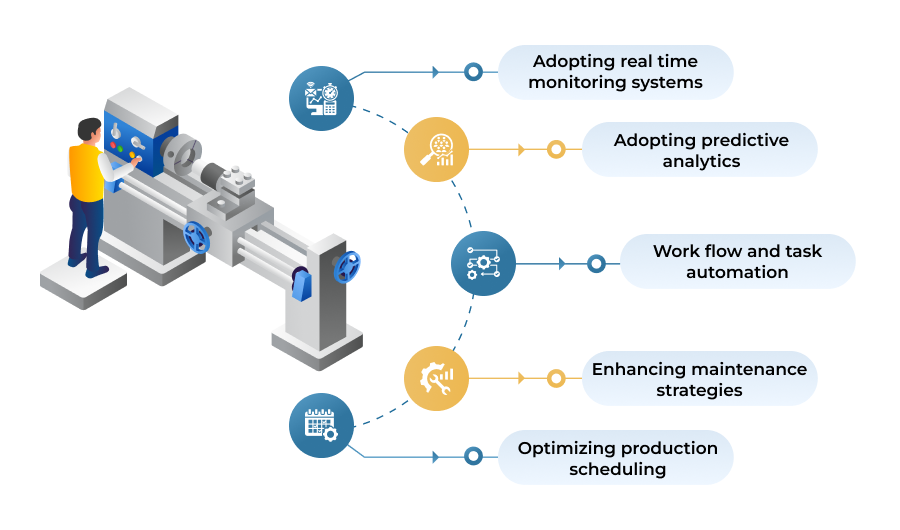
Today’s manufacturing hinges on how quickly a company can respond to operational disruptions, challenges, and shifts in the needs of the customer. Systems that are quicker and more responsive improve manufacturing efficiency, lower operational delays, and create more consistent performance in production. AI-driven smart factories use predictive intelligence to reduce downtime and improve production responsiveness.
Real-Time Visibility and Decision-Making
Intelligence that focuses on gathering data and operations in real time lets a business spot disruptions earlier. Decision making can happen quicker, and disruptions can be averted before they affect productivity and operational deadlines. Visibility in the production operation further improves the continuity of the workflow and gives a manufacturer control over the work of the production systems.
Flexible and Adaptive Manufacturing Operations
Improves the continuity of the workflow and gives a manufacturer control over the work of the production systems. Improving responsiveness is aided by flexibility in operations. Manufacturing systems that are connected with flexible work control systems and production systems that are adaptive are able to manage previously unmanageable disruptions with little to no major delays. Disruptions in workflow and production can be managed by connected decision making in the systems of production, maintenance, inventory, logistics, and quality control. Better and more connected systems see faster operational disruptions and more continuous production.
Technologies That Enable Responsive Manufacturing
Making operations more data-driven, efficient, and flexible in manufacturing are Industrial IoT, AI analytics, predictive maintenance, and smart dashboards.
Manufacturers that invest in responsive manufacturing gain greater operational visibility, improve production efficiency, and strengthen supply chain resilience. By combining real-time data, AI-powered analytics, and connected manufacturing systems, organizations can reduce downtime, optimize workflows, and make faster business decisions. These capabilities help manufacturers remain competitive while supporting long-term operational growth and digital transformation.
What Are the Benefits of Eliminating Invisible Delays?
If businesses can identify and remove hidden manufacturing delays, they can utilize resources to enhance productivity, better manage risks, and streamline their manufacturing. Little improvements to a workflow can have a dramatic effect in controlling manufacturing costs, improving on-time delivery, and increasing overall productivity.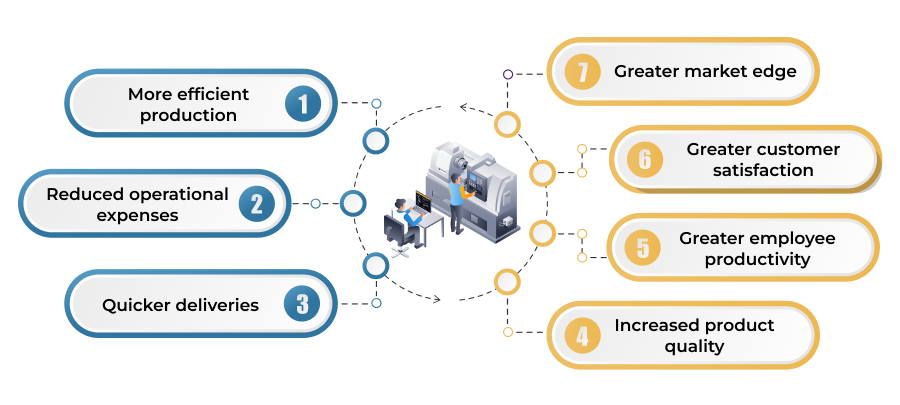
More Efficient Production
It is much easier to grow your business and increase your production when you have clear and systematic work processes to eliminate bottlenecks that slow down production and keep your machines busy.
Reduced Operational Expenses
Reducing waste, downtime, and unnecessary resource consumption also supports long-term sustainability goals in manufacturing. Hidden manufacturing deficiencies, like needing to work overtime to catch up on production, idle equipment to be salvaged and repaired, energy costs, managing too much inventory, and a lot of other avoidable operational costs, can be eliminated to increase profitability.
Quicker Deliveries
The ability to see and manage your operations in real time can help you increase your ability to meet scheduled production, shipments, and customer orders.
Increased Product Quality
Working on manufacturing processes that help you reduce interruptions in production, help you lower your defects, and reduce the need for rework can strengthen your quality standards.
Greater Employee Productivity
Sustainable operational improvements require both modern technology and a culture focused on continuous improvement. Your employees will be able to focus their time on productive processes rather than on interruptions, confusion, and the need to follow up on tasks.
Greater Customer Satisfaction
When your operations help you improve your delivery time and the quality of your product, you will improve customer confidence and long-term relationships and retention.
Greater Market Edge
Having the ability to improve your manufacturing processes helps you respond quickly to new manufacturing demands in the marketplace.
The focus to improve operational efficiency and profitability from better manufacturing processes will strengthen operational performance.
No matter how minor hidden manufacturing delays appear to be, they become burdensome over time in the way they affect productivity, increase operational costs, and damage timely delivery. The cumulative effect of minor disruptions in workflows, communication, maintenance, and production creates significant difficulties in operations over time.
Connected digital workflows improve collaboration between production-maintenance, and field teams. Like most traditional systems, it is impossible to detect invisible delays in workflows due to the limited real-time visibility and disconnected operational data. Therefore, many businesses suffer from slow workflows, high costs, and low manufacturing efficiency.
For sustainable growth and profitability, businesses can achieve operational improvements, faster manufacturing operations, and delays reduction through real-time monitoring, AI analytics, predictive maintenance, and connected manufacturing systems.

12 Oct 2026

08 Oct 2026
05 Oct 2026