The world of healthcare is always burdened with the problems of untimely access to care, global coverage gaps, shortage of care providers, and disorganization leaving millions unattended. The pandemics focused attention on telehealth and telemedicine services which now stand as a major solution. Hospitals in the U.S have started to offer virtual care services. However, these solutions are not sustainable until there is solid and flexible technology infrastructure in place. Microsoft PowerApps enables healthcare organizations to develop custom tailored telehealth platforms that fill the systemic gaps while improving patient outcomes. In this blog, we discuss how PowerApps can be leveraged to build transformational telehealth tools that address the requirements of contemporary healthcare.
The following are still gaps in telehealth that remain unaddressed despite the technology’s many possibilities and prospects:
Geographic Disparities: 20% of Americans live in rural areas and there is also a lack of specialists and even telemedicine service facilities. Simply obtaining a telehealth solution consultation can take several hours of travel, and this can greatly delay care that is time sensitive.
Provider Resistance: Most clinicians consider the use of telehealth to be an inferior substitute to traditional face-to-face consultations, especially when it comes to diagnosis capability. Many also feel heightened risk of malpractice when using telehealth services.
Fragmented Systems: Administrative silos caused by outdated EHR systems and billing software that do not communicate with one another block the flow of telehealth data.
Regulatory and Reimbursement Issues: Variations in telehealth regulations and reimbursement policies across regions create uncertainty for providers and patients.
Regulatory Compliance: It is essential and can be very difficult to ensure strict regulation compliant telehealth solutions, for example with HIPAA in the States. Breaches safeguard regulations can cause legal challenges and erode valuable patient trust.
The Role of Telehealth in Modern Healthcare
The use of telehealth services goes beyond serving as a care model only during the pandemic. The technology has fundamentally transformed the delivery of care services.
Enhanced Accessibility: With telehealth services, patients residing in rural areas or those belonging to medically underserved populations can receive medical care at their location through remote consultations, eliminating the need for travel. This development results in the saving of costs, time, and physical resources.
Improved Integration: Telehealth services, telemedicine services, and telehealth systems make possible the integration with existing EHR systems so that patient data flows without hindrance. Access to integrated comprehensive patient data enables healthcare providers to make informed decisions and significantly improve patient outcomes.
Increased Patient Engagement: Where such telehealth solutions exist, patients can be easily educated about their illnesses and diseases right at the comfort of their homes. Such education along with available reminders greatly improves habits, thus increasing patient adherence.
Regulatory Compliance: Telehealth solutions can be adjusted in ways that all prescribed regulations are duly met, especially with regards to personnel privacy and the issuing of data. Their compliance enhances the level of trust required for allowing a wide acceptance of telehealth services.
Cost Efficiency: Telehealth reduces healthcare expenses by decreasing the frequency of hospital readmissions and visits to the emergency department.
Continuity of Care: Telehealth makes it easier for patients and providers to communicate, which allows for proactive management and timely interventions.
How PowerApps Enhances Telehealth Platforms?
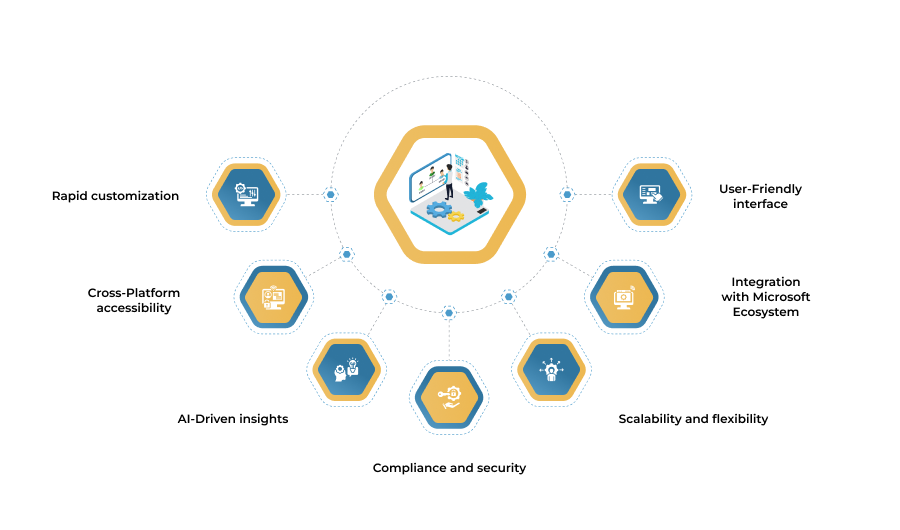
Microsoft PowerApps permits the creation of custom telehealth applications through the agile configuration of Microsoft Cloud services by healthcare providers with no to little coding skills. The major benefits are:
1. Rapid Customization
Creating custom patient portals that integrate automated appointment reminders, pre-visit intake forms, and connections to EHR systems.
Building provider dashboards where lab results and visit notes along with applicable billing codes are consolidated into a single view dashboard.
2. Cross-Platform Accessibility
Microsoft PowerApps is responsive, and therefore, its functionalities are available on mobile, tablet and desktop devices which is helpful for reaching patients residing in low connectivity regions.
3. AI-Driven Insights
Implementing Azure AI to evaluate patient data and flag patients that need proactive interventions for high-risk cases. For instance, predictive analytics can help reduce readmission rates.
4. Compliance and Security
Telehealth service concerns are eliminated by 68% through the built-in telehealth security features such as automatic encryption of audit trails and data in auditable reusable records.
5. Scalability and Flexibility
A pilot program for chronic disease management can be expanded with virtually no structural changes required to infrastructure for other specialties such as mental health or post-operative care.
6. Integration with Microsoft Ecosystem
Microsoft PowerApps has seamless integration with other Microsoft services of Azure, Dynamics 365 and even Office 365 for a secure telehealth ecosystem.
7. User-Friendly Interface
PowerApps provides a visually appealing interface which simplifies the development process. Non IT professionals find it simple to create and administer telehealth applications which lessens the burden on IT support.
ROI and Strategic Benefits of PowerApps Telehealth Solutions
The strategic proposition offered by Microsoft PowerApps telehealth offers investment in telehealth solutions and telemedicine services for health care organizations in achieving their long-term financial and operational goals. This is how your institution can thrive:
1. Cost Efficiency
Reduce Development Costs: PowerApps low-code tooling environment for speedier and cheaper app development – no need for the expensive developer resource.
Lower Operational Overheads: Automate repetitive actions like patient onboarding and billing so that more time can be spent on value-laden care delivery.
2. Revenue Expansion
Attract New Patient Demographics: Provide virtual access for underserved people living outside town lines or encumbered in busy urban centers.
Maximize Appointment Utilization: free up provider time by decreasing appointment no-shows through automated reminders and self-scheduling tools.
3. Improved Patient Loyalty
Integrate seamless personalized journeys via intuitive patient portals to build trust at the ground level for continued association.
Appreciate commitment to care by demonstrating proactive practices such as remote monitoring integration for care coordination.
4. Future-Ready Scalability
Start with specific targeted solutions, such as post-discharge follow-up, and scale seamlessly to support multi-department workflows without going through the complex process of reconstructing.
5. Market Differentiation
Forge ahead in the rapidly changing field marketplace by making way to adopt flexible technologies to offer virtual care to appropriate patients and incorporate them into evidence-based practices.
Challenges and Considerations
While PowerApps offers significant advantages, healthcare organizations should consider the following:
User Training: It is important for patients and healthcare providers to be trained on the new applications for an effective adoption process.
Regulatory Compliance: Applications have to be HIPAA-compliant and healthcare regulations regarding patient information.
Infrastructure Requirements: Sufficient IT infrastructure must exist to deploy and maintain PowerApps solutions.
Custom vs Standardized: Good app customization solution and standardized processes can be a tough balance.
Conclusion
Telehealth is no longer optional, it’s essential for competitive, patient-centric care. Microsoft PowerApps provides the agility, security, and cost-efficiency healthcare organizations need to close accessibility gaps and future-proof their services.
Contact us today, we specialize in delivering custom PowerApps telehealth solutions that align with your operational goals. From concept to compliance, we’ll help you build a platform that patients trust and your team loves.
Why should a healthcare provider consider a custom telehealth app over off-the-shelf software?
Custom apps built with PowerApps can be tailored to your exact workflow, branding, and compliance needs, offering better flexibility and long-term ROI than one-size-fits-all software.
Is PowerApps secure enough for handling patient data?
Yes. PowerApps leverages Microsoft's enterprise-grade security, enabling HIPAA-compliant app development when implemented correctly.
What kind of telehealth features can we build using PowerApps?
Common features include video consultation booking, symptom checkers, patient portals, real-time chat, appointment reminders, and analytics dashboards.
How does PowerApps support remote patient monitoring?
You can build apps that collect patient vitals, manage wearable device data, and send alerts for abnormal readings, all integrated with your existing systems.
What platforms are supported by PowerApps telehealth solutions?
PowerApps apps are cross-platform and can run on iOS, Android, and web browsers, ensuring accessibility for both patients and healthcare staff.
Can we add AI or chatbot features in our PowerApps telehealth app?
Yes. With Power Virtual Agents and Azure AI integration, you can embed chatbots for patient triage, FAQs, or appointment scheduling.
Quickly scale your development capabilities by hiring pre-vetted tech experts who align perfectly with your project goals, timeline, and company culture.
What to expect after you reach out?
1. Share Your Requirements
Tell us your project goals, tech stack, and resource needs for a perfect talent match.
2. Talent Shortlisting
We screen and shortlist top-tier professionals based on your exact technical and cultural fit.
3. Interview & Selection
You interview the candidates and select the ones that align with your expectations and company values.
4. Onboard & Integrate
Seamless onboarding process to ensure smooth collaboration with your in-house team from day one.
5. Monitor & Scale
We assist with performance tracking and help you scale the team as your project evolves.