How Does AI Help Leaders Make Better Decisions in a Data-Overloaded World?
AI assists leadership in decision-making by creating shorter, clearer insights about data it sorts. It provides leadership with consolidated data that enables confidence in making swift decisions, using less conceptualized reports.
The Real Challenge Leaders Face: Uncertainty, Not Lack of Information
Leaders in the corporate world of today are not short of information, rather, they are drowned in it. The incessant reports, charts, and metrics flow from the different departments like a river. Executives are literally buried under the data of everything from customer engagement rates to revenue predictions but they are still at a loss for a way out. The issue is not that they can get hold of the data, rather, it is the doubt. The trust in making decisions becomes weak when every analytic platform has a slightly different interpretation of the facts.
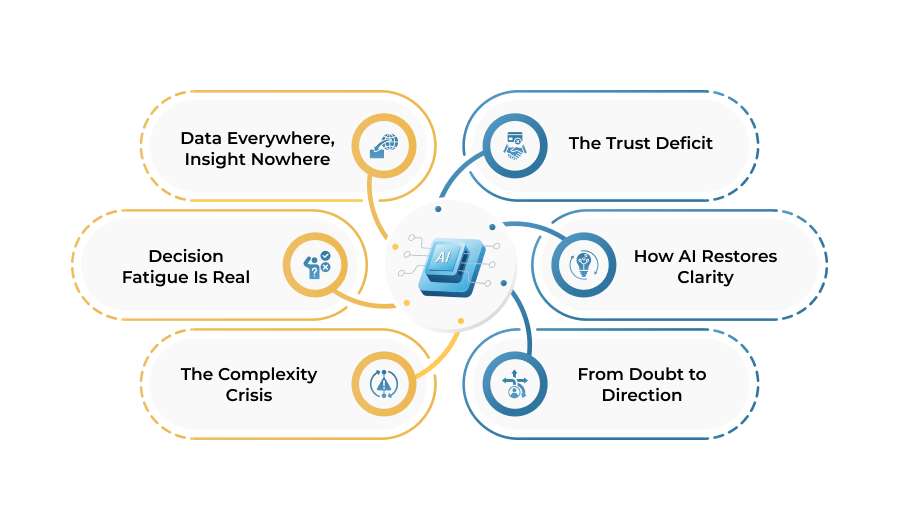
Data Everywhere, Insight NowhereMany organizations discover that technology alone doesn’t solve decision challenges it often exposes deeper operational gaps. Fewer insights emerge despite growing volumes of business data. Although measurement is widespread, most decision makers lack clear guidance on what moves outcomes. Important patterns frequently disappear within stacks of dashboards and KPIs.
Decision Fatigue Is RealLeaders suffer from decision fatigue due to ongoing information overload. Executives argue over which version of the data to believe during protracted meetings. Overanalyzing results in delayed reactions and lost chances.In many organizations, decision delays often originate from internal decision-making structures rather than lack of data.
The Complexity CrisisOver 57% of business executives cite “decision complexity” as their biggest obstacle, according to a Harvard Business Review CEO survey. Instead of making things clearer, the deluge of analytics frequently makes things more confusing.
The Trust DeficitDifferent tools yield different outcomes, such as CRM versus finance dashboards and marketing data versus sales reports. The difficulty lies not in gathering data but in having faith in it. Instinct takes the place of insight when trust is lost, and judgments revert to conjecture.
How AI Restores ClarityAI frees leaders, not replaces them. AI quickly provides a clear picture by removing noise, connecting patterns, and emphasizing pertinent insights. In order to help leadership make quicker, more intelligent decisions, it transforms disorganized data into meaningful direction.
From Doubt to DirectionLeaders who integrate AI-based intelligence with human intuition make balanced decisions that are neither mechanical nor emotional. Clarity, assurance, and the capacity to take decisive action in the face of uncertainty are the outcomes.
Why Experience and Gut Instinct Alone Aren’t Enough Anymore
For many years, strong leadership was based on instinct, experience, and judgment. Although the business environment has changed significantly, those qualities still matter. AI algorithms, digital consumers, and constant data flows shape today’s real-time markets. Because industries are changing so quickly, instinct is no longer sufficient.
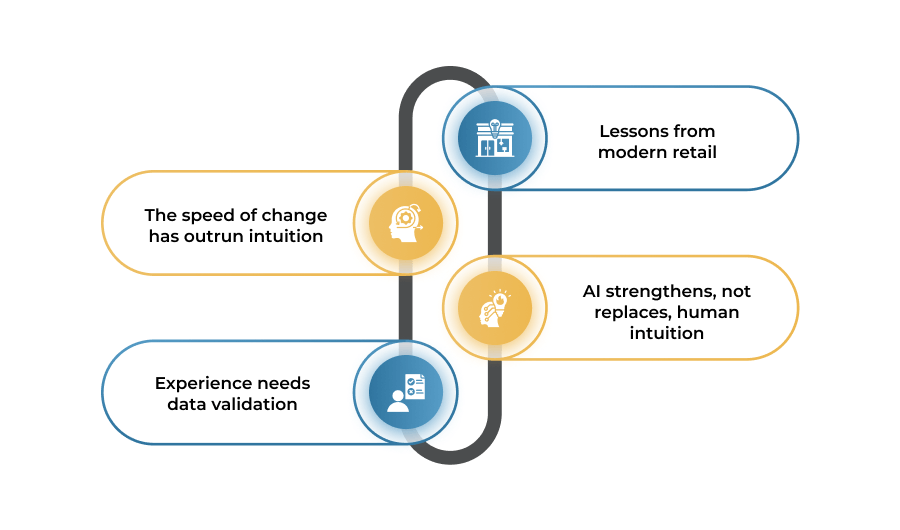
The Speed of Change Has Outrun Intuition
Change arrives by the hour, not on a calendar schedule.
The choices people make often follow what’s popular at the time, shaped by suggestions from artificial intelligence systems or reactions they get right away.
A single past result means little once numbers shift by the second. Success now depends on fresh signals, not old habits.
When decisions lack data, momentum might be misunderstood – this applies even to seasoned leaders.
Experience Needs Data Validation
When choices rely only on gut feeling, they often carry hidden preferences that slow progress.
AI helps leaders test and confirm assumptions before making big moves.
Beyond past events, forecasting methods show probable future outcomes. What might unfold becomes clearer through advanced data analysis.
Knowing where to go comes from practice. Evidence checks whether that path makes sense.
Lessons From Modern Retail
Folks with decades in stores used to guess what shoppers wanted just by instinct.
Faster than a trend spreads, it vanishes – driven by shifts on digital networks where attention moves in hours.
When live data is absent, experienced workers might overlook key changes in how people act or what they want.
When gut feeling guides choices, reality may shift just as fast.
AI Strengthens, Not Replaces, Human Intuition
From scattered information, AI reveals clear trends that decision makers trust. Patterns emerge where once there was noise, guiding choices with quiet precision.
Frequently, tools such as predictive modeling make estimation less necessary. Sentiment tracking often shifts decisions away from assumptions. Scenario simulation replaces uncertainty with structured exploration.
Focused clarity sharpens a leader’s thinking, yet creativity still guides their choices. Confidence grows not from guesswork, but from consistent direction. Precision enters the picture when experience meets intent.
How AI Turns Overwhelming Data into Clear Direction
Today’s business world runs on endless streams of information – choices customers make, numbers from sales, shifts in money markets, day-to-day performance signals. Getting access to facts is not the problem anymore. Making sense of them is what holds decision makers back. Here, tools powered by machine learning help most – they turn tangled inputs into clear direction.
Patterns often go unnoticed by people simply because there is too much data to sort through. Yet machines handle this easily, spotting trends across scattered pieces of information. When fed inputs from customer databases, economic indicators, public conversations online, shipping routes, or monetary flows, algorithms make sense of chaos. What seems random turns meaningful once processed. Leaders gain clarity without needing to dig through endless reports themselves.
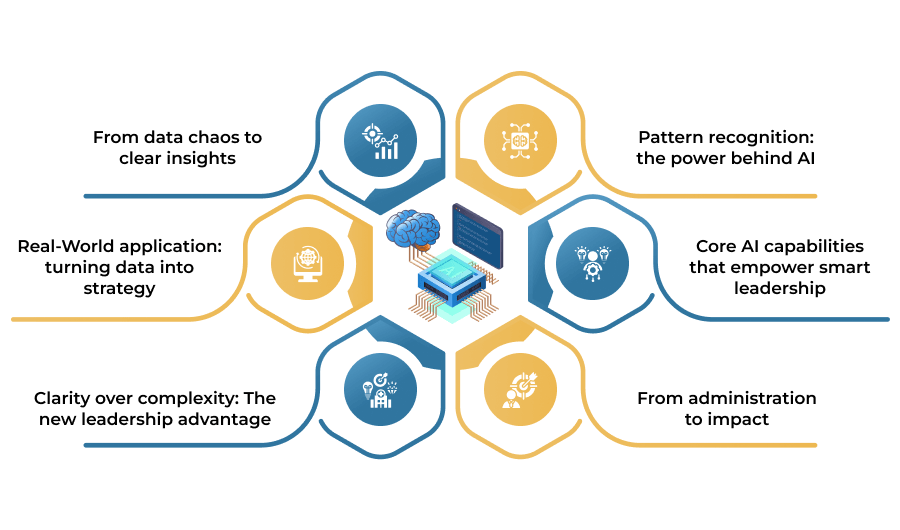
From Data Chaos to Clear Insights
Marketing numbers sit apart from operations, while sales insights follow their own path. Data divides teams, each tracking performance in isolation.
Fragments once scattered across systems now connect through artificial intelligence, forming one clear picture. Leaders gain insight into overall operations when information flows without gaps. A unified version of events emerges where confusion used to live.
Now, leaders see only what counts – distilled by artificial intelligence from reams of data. Not buried in pages, but surfaced where decisions happen.
McKinsey finds firms using AI in decisions see a boost in accuracy – up to 30- 40%. This link between clear insights and stronger performance stands out clearly.
Pattern Recognition: The Power Behind AI
Where human gut feeling stops, pattern recognition kicks in – silently, steadily. Machines notice what people miss: tiny shifts, faint signals, almost nothing at all.
Finding patterns in vast amounts of information happens constantly, as machine learning examines countless details each second – linking how people act, what prices are set, and how much gets produced.
By spotting trends early, decision-makers can act ahead of time instead of responding after problems arise – staying ahead of shifts that might otherwise interfere with workflow.
A signal appears when AI monitors surroundings, guiding decisions through shifting conditions. From patterns emerges a way forward, shaped by continuous observation. Direction changes not by guesswork, but by what the system detects moment by moment.
Real‑World Application: Turning Data Into Strategy
What happens when machines learn to interpret information? Platforms such as Salesforce Einstein, IBM WatsonX, and Microsoft Azure AI shift beyond mere number crunching. These systems turn unstructured inputs into insights prepared for real-world choices. Instead of simply storing facts, they reshape them into usable understanding. Intelligence emerges not from volume, but from transformation. Decisions gain clarity because data gains purpose.
They help organizations:
Beyond early signs, problems can grow quietly. Catching them shifts outcomes ahead of damage.
Favored steps emerge through likelihood analysis.
By handling routine choices automatically, management gains time for high-priority planning tasks.
Imagine different business outcomes using hypothetical situations instead of actual assets.
A fresh angle emerges when companies blend these tools with managerial judgment – suddenly, each metric shifts from clutter into clarity. What looked like noise turns into direction.
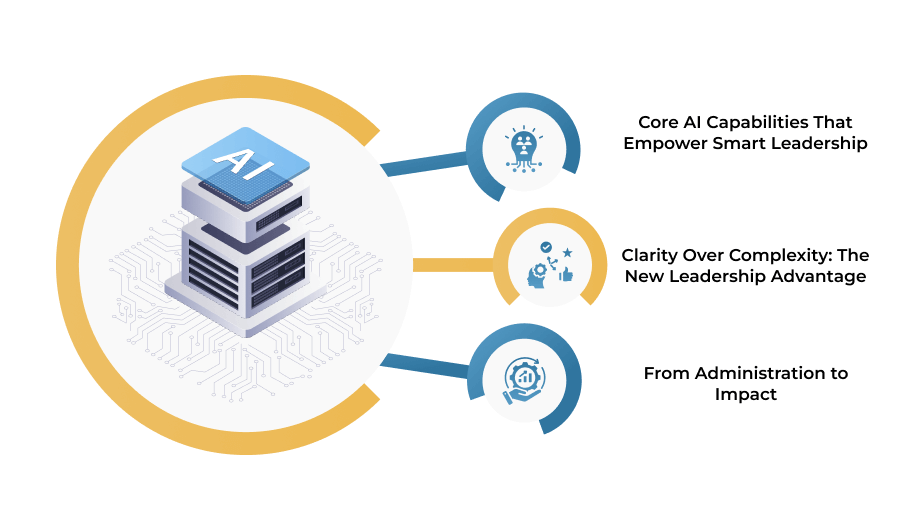
Core AI Capabilities That Empower Smart Leadership
AI tools provide clarity through a set of high‑impact capabilities that turn information into direction:
Fueled by historical records, predictive analytics shapes future estimates – guiding decisions through emerging patterns instead of guesswork. Leaders use these insights to position teams and materials where they’re likely needed most.
Processing human language: Breaks down complicated documents quickly, pulling key insights from vast amounts of text almost instantly.
Automated decisions take care of standard requests, simple jobs, or minor suggestions – freeing up time for leaders to explore new ideas.
Facing future outcomes? Models sketch virtual versions of possible plans, showing their likely impact on income, spending, and results.
Turning piles of digits into graphs, screens full of metrics, or color-coded maps helps clarity arrive fast. Visuals turn complexity into something graspable at a glance.
What happens next depends on how systems begin to choose paths without human input. A shift occurs when patterns replace programming.
Clarity Over Complexity: The New Leadership Advantage
Focused insights matter more than noise for today’s leaders. Because artificial intelligence removes distractions, meaningful patterns emerge faster – right when decisions are due.
Instead of reacting to yesterday’s results, leaders now act on today’s live intelligence.
What emerges is decision-making rooted in data, carried out swiftly, yet closely tracked for accuracy. Ultimately, clarity shapes every step taken.
With machines managing complex data tasks, leadership gains space to emphasize direction, creativity, among team relationships instead of manual reporting. What changes is where attention goes – away from routine tracking toward bigger-picture thinking.
From Administration to Impact
With AI handling intricate tasks, attention shifts toward generating meaningful outcomes. Leaders now channel efforts into innovation rather than coordination.
What catches the eye on AI dashboards are signals demanding response – unusual patterns, openings to act on, potential pitfalls.
By cutting down hours once lost to hand-coded analysis, effort shifts naturally toward getting things done.
Executives can move beyond handling data, shaping meaningful outcomes instead.
Still, artificial intelligence does not take over decision-making by leaders – it sharpens their thinking through clearer insights, steady patterns, because future risks come into better view.
Removing Guesswork Without Removing Human Authority
Surprisingly, many executives worry artificial intelligence might weaken their control. In reality, it does quite the reverse – cutting through uncertainty while leaving authority intact.
Decisions rest with people, not machines. Though insights come from artificial intelligence, choice remains a human task. Judgment shaped by experience guides what data alone cannot: values, social nuance, long-term vision. Algorithms suggest paths; humans decide direction. Context matters more than code. Trust grows where logic meets leadership.
Decisions come quicker – forty percent faster, according to MIT Sloan – with artificial intelligence supporting executives, without losing control of strategic outcomes. Accuracy climbs thirty percent when systems assist rather than replace. One handles computation; the other shapes intent. Uncertainty fades under algorithmic analysis, leaving room for judgment instead of argument about facts. Direction remains human, even as data clears the fog.
Real-Time Insights That Strengthen Leadership Confidence
Real-time monitoring systems powered by IoT are enabling organizations to act instantly on critical signals. Faster insights shape smarter moves – resilience grows where delays shrink. Seeing patterns as they form helps choices become clear, not guessed.
Take a look at how goods move from place to place. Weeks ahead of any hiccup, smart systems spot potential delays, then quietly recommend new paths or different vendors.
A leader’s focus turns toward building certainty, not just handling emergencies. Instead of responding after issues arise, attention goes to stopping troubles before they start.
This flexibility shows up everywhere – each area adapts as events unfold
Mid-campaign adjustments come naturally to marketing leads when real-time interaction metrics shift. Data flows shape how teams refine their messaging on the go.
Financial executives anticipate liquidity or profitability shifts proactively.
Facing turnover risks, HR leaders step in early to stabilize team spirit.
Faster decisions emerge when insights lead straight to action, thanks to AI smoothing the path. Leadership gains confidence, not just speed, by closing gaps in response time. What once felt like risk now fuels better outcomes, simply because delays fade. Performance rises where hesitation used to linger.
From Reactive Decisions to Proactive Leadership
When things happen, old-style decisions follow behind. Now artificial intelligence shifts the whole approach. By using prediction plus guidance models, companies gain vision ahead of time. Outcomes stop being something to react to – they become something built on purpose.
Consider predictive maintenance within manufacturing settings. Rather than reacting after machines fail, artificial intelligence anticipates deterioration by analyzing sensor information – this enables supervisors to arrange upkeep proactively, avoiding interruptions. Extend this logic further, applying it to decision-making roles. Systems driven by algorithms monitor shifts in markets, actions taken by rivals, along with broader economic trends, signaling executives well ahead of potential disruptions.
What changes is how leaders act – before problems arise, not after. Using AI insights, some prepare ahead of time rather than respond too late. These individuals do more than keep pace – they reshape what winning means by seeing openings few notice.
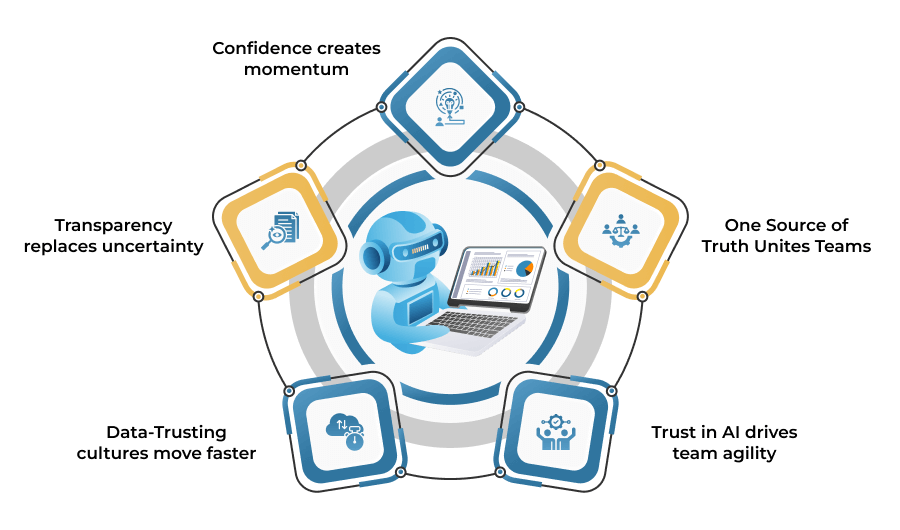
Shared truth simplifies decision‑making across teams.
Reduced conflict leads to higher productivity and faster innovation.
Trust in AI Drives Team Agility
Leaders who trust AI send a clear message: “Our decisions are built on facts, not feeling.”
This confidence gives teams permission to move quickly and take initiative.
AI turns uncertainty into coordinated, confident execution.
Conclusion: Confident Leaders Don’t Fear AI — They Use It
Leadership isn’t threatened by artificial intelligence – it shifts shape because of it. Those who thrive are not resisting code, instead they’re using systems to cut through guesswork. As information becomes tangled, sureness needs to grow – and smart tools make that possible.
With clarity born from data, decisions gain strength because uncertainty fades. Leaders find space for purpose once confusion lifts, their direction shaped by evidence rather than guesswork. Machines do not take control; they hand back time, attention, reason. Human judgment rises when noise disappears, standing firm on firmer ground.
How does AI help business leaders make better decisions?
AI instantly analyzes complex data, transforming overwhelming information into useful insights that boost business outcomes, leadership clarity, and confidence.
Can AI replace human leadership roles entirely?
No, AI helps make decisions quickly and accurately, but human judgment, empathy, and strategic vision are still essential leadership traits.
Why is leadership uncertainty increasing in data‑driven businesses?
Due to the overwhelming amount of data that leaders must deal with, it is challenging to swiftly find accurate insights without the use of AI tools or intelligent data systems.
What is the biggest benefit of AI in leadership?
AI speeds up analysis, eliminates unnecessary data, and offers trustworthy insights that enable leaders to take decisive action with assurance and accuracy.
How does AI enhance organizational trust and alignment?
By providing teams with real-time data and ensuring that everyone bases decisions on the same trustworthy information, artificial intelligence (AI) fosters transparency.
Is intuition still important in an AI‑powered organization?
Indeed, human instinct is enhanced by AI. Data is used by leaders to support their intuition, fusing evidence and experience to produce quicker, more intelligent results.
How does AI improve business decision speed?
Indeed, human instinct is enhanced by AI. Data is used by leaders to support their intuition, fusing evidence and experience to produce quicker, more intelligent results.
What industries benefit most from AI‑driven leadership?
Every sector benefits — retail, healthcare, finance, and manufacturing all use AI to forecast trends, reduce risk, and increase decision accuracy.
Quickly scale your development capabilities by hiring pre-vetted tech experts who align perfectly with your project goals, timeline, and company culture.
What to expect after you reach out?
1. Share Your Requirements
Tell us your project goals, tech stack, and resource needs for a perfect talent match.
2. Talent Shortlisting
We screen and shortlist top-tier professionals based on your exact technical and cultural fit.
3. Interview & Selection
You interview the candidates and select the ones that align with your expectations and company values.
4. Onboard & Integrate
Seamless onboarding process to ensure smooth collaboration with your in-house team from day one.
5. Monitor & Scale
We assist with performance tracking and help you scale the team as your project evolves.