
From Manual Processes to Smart...
22 Oct 2026


In the rapidly evolving healthcare industry, electronics have taken on a greater significance in the development of novel technologies. These eHealth elements, which can be found in everything from wearables to brain stimulation gadgets, are revolutionizing healthcare and improving human life. The growing prominence of medical electronics and associated fields such as telemedicine, eHealth, and the Internet of Medical Things (IoMT) is beneficial to patients globally.
This blog will explore the realm of eHealth and highlight five widely used medical technologies that use electrical components and cutting-edge biotechnology to enhance patient health.
The way the advanced electronic and digital technologies are integrated has significantly altered the overall look of the healthcare system. We’ll discuss fascinating details about how technology is changing healthcare.
Medical Wearables like smartwatches, spectacles, rings, and even clothing items are at the forefront of contemporary healthcare technology.
The incorporation of biomedical sensors into these devices has aided the expansion of the Internet of Medical Things (IoMT) by tracking physiological metrics like-
Manufacturers give highly priority features, including patient convenience, energy economy, and compact design.
Medical wearables have not only made it possible for people to monitor their health while they are on the go, but they have also played a significant role in enabling telemedicine, particularly in the wake of the COVID-19 outbreak.
There is a long history of using stimulation devices that deliver low-voltage electrical pulses to the brain to treat mental health conditions.
Innovative technologies like portable headphones can help improve the use of biomedical sensors for depression and cognitive performance.
A growing number of clinically developed medical devices with CE markings and approval are becoming available in the field of health informatics, and neurostimulation has demonstrated promise in enhancing mental health.
Telehealth innovations have led to the development of smaller, more discrete hearing aids than in the past.
Numerous features, such as lower power consumption, smartphone connectivity, and new functionalities like call handling and audio streaming, have improved the user experience in telehealth.
To improve hearing, some hearing aids make use of deep neural networks and microphones.
The most significant benefit of mHealth Apps is that they speed up patient visits and treatment. mHealth apps have replaced the inefficient and slow phone access to physicians and healthcare providers by enabling patients to send secure messages instantaneously, schedule appointments, and connect with doctors for telemedicine visits around-the-clock.
Precision and control are essential in using robotics in healthcare, which calls for innovative electronics.
Two benefits of robotic surgery are-
Advanced electronics in devices and skeletal systems are the future wave, while AI-powered robots help healthcare professionals with daily duties.
Through the integration of computer circuits with flexible substrates, stretchable electronics presents novel medical opportunities.
Among the potential uses are implantable patches for in-body data collection, biosensors for ongoing health monitoring, and artificial skin.
Keeping track of patients and their information can be simple with the help of electronic health records (EHR). We’ve selected the top seven must-haves.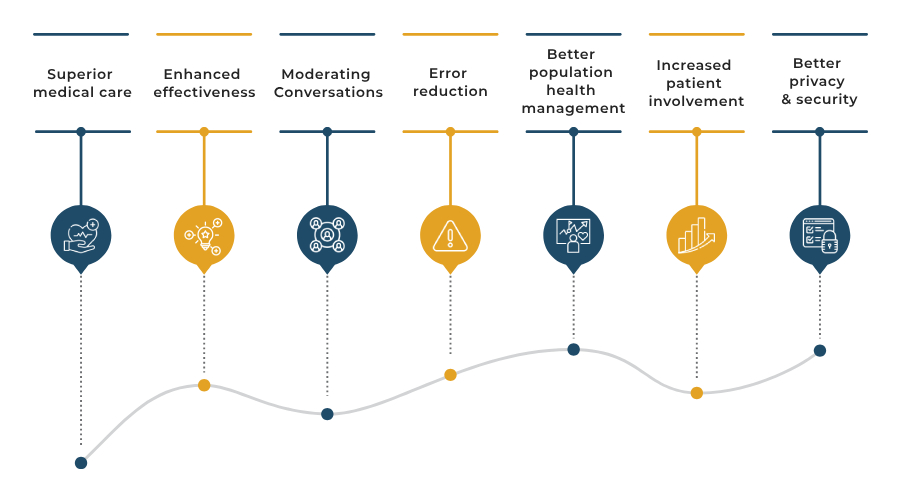
Thanks to electronic health records (EHRs), physicians can now promptly access their patients’ most recent medical history, enabling them to give better care.
Electronic health records, or EHRs, reduce duplicate data entry, retrieval, and distribution, making patient record management easier.
Better patient care results from physicians being in constant communication with one another and exchanging pertinent patient data in real time thanks to electronic health records, or EHRs.
A few instances of how electronic health records (EHRs) can help lower the risk of errors and enhance patient safety are alerts for possible drug interactions, allergies, and other crucial information.
Doctors can identify patterns and trends that could result in more effective treatment by using electronic health records (EHRs) to track and analyze population health data.
Patients can take a more active role in their health by having access to their medical records and care management tools through electronic health records, or EHRs.
Strict safety procedures can be incorporated into the design of electronic health records (EHRs) to protect patient data and personal information.
Because these developments make it simpler to incorporate medical sensors into wearables, patient care may be enhanced.
The medical industry has seen tremendous change as a result of technology’s integration with medical advancements. These technological advancements are creating the foundation for a more just and healthier future. They include wearables that give patients access to their health data, sophisticated brain stimulation devices, and robots.
05 Oct 2026
21 Sep 2026
10 Sep 2026