Why Can’t Legacy Systems Support Modern Enterprise Needs?
Legacy systems are designed for stability, but that makes them incompatible with the ever-changing, highly connected requirements of modern enterprises. They create data silos which hamper innovation, increase costs, and limit scalability. Enterprises of today need the cloud capabilities of Azure so that they have real time visibility and integrated systems with AI-driven insights, and the rapid adaptability that the modern business environment requires.
The Shift from On-Premise Systems to Cloud-First Strategy
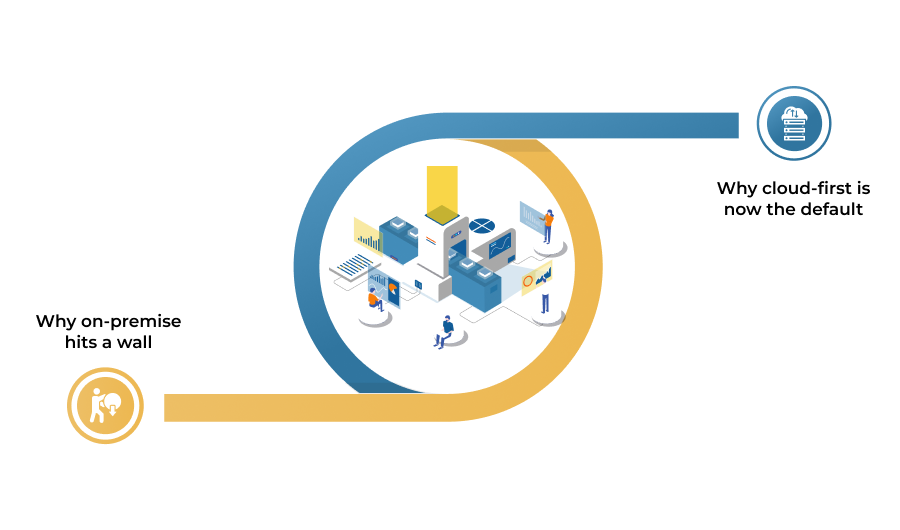
Why on-premise hits a wall
As digital demands grow, on, premise environments are reaching their technical and economic limits. Common pain points are:
Investing overly in hardware, licenses, and data centers that are rigid is one of the issues.
Innovation is slow because of difficult upgrade and patching cycles which not only increase threats, but also lead to the company risking more unnecessary situations.
Having the infrastructure scattered in various regions leads to an inconsistent performance and governance as well.
Not enough capacity for AI, advanced analytics, and real, time integration at scale.
Such a situation leads to an innovation bottleneck where IT is mainly occupied with keeping the lights on activities rather than enabling new digital capabilities.
Why cloud-first is now the default
A cloud, first strategy turns the traditional way of thinking on its head by making the cloud the default platform for new workloads and modernized applications. So, for enterprises, cloud, first typically implies:
From day one, designing for elastic scalability, high availability, and global reach.Considering infrastructure as an operational expense (OPEX) and therefore utilizing pay, as, you, go consumption.
Going with managed services for databases, integration, security, and AI rather than building everything in, house.
It means making sure that resilience, backup, and disaster recovery are part of the architecture and are not treated as bolt, on projects/features.
In reality, Microsoft Azure supports this cloud, first mindset through its all, round platform, worldwide footprint, and a wide range of enterprise tools, from Azure Migrate and Azure Site Recovery to Azure Policy and the Cloud Adoption Framework.
Why Enterprises Choose Microsoft Azure as Their Digital Backbone
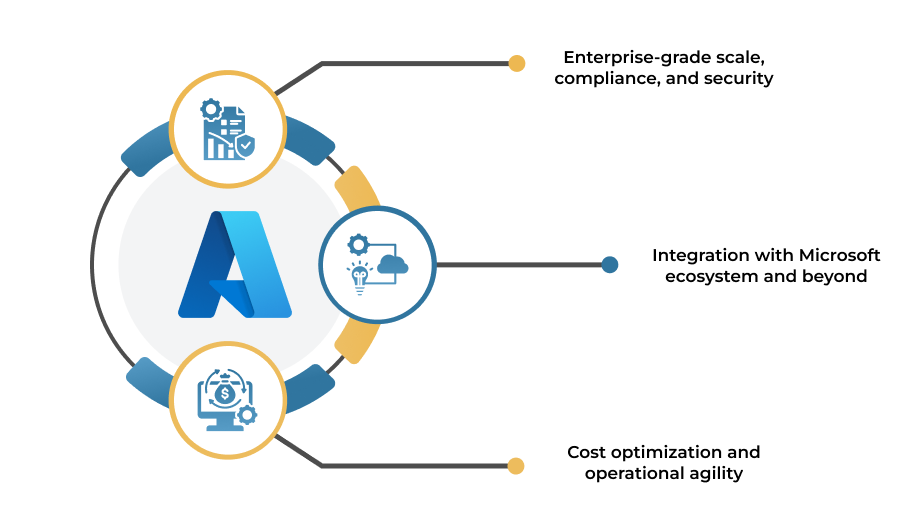
Enterprise-grade scale, compliance, and security
Being fundamentally designed for tightly regulated, global, and mission, critical environments, Azure has become the digital backbone of numerous enterprises.Global regions and availability zones for low, latency, resilient deployments close to users and data.
Built, in high availability and disaster recovery with options such as Azure DRaaS and geo, redundant storage.
A robust set of compliance capabilities and proven audit capabilities across different sectors (financial services, healthcare, government, etc.)
Security is embedded at multiple levels: data is encrypted when stored and during transmission, Zero Trust, Azure Security Center, Sentinel, and advanced threat analytics.
CIOs and CISOs see this as less work for them in terms of infrastructure management, patching, and baseline security, while at the same time, regulatory compliance is not compromised.
Integration with Microsoft ecosystem and beyond
In fact, most companies are already using Microsoft products such as Windows Server, SQL Server, Active Directory, Microsoft 365, and Dynamics 365 within their operations.
Azure has been made to effortlessly continue this stack and also to establish secure connections with non, Microsoft systems.
Hybrid identity through Azure Active Directory for unified access control whether in cloud or on, premises.
Azure enables you to continue using your existing Windows and SQL Server licenses with hybrid benefits without ending their validity.
Microsoft 365, Power Platform, and Dynamics 365 are essentially interconnected tools that cover all aspects of business processes.
Use any connectors, APIs, and integration services (Logic Apps, API Management, Service Bus) to SAP, Salesforce, custom ERPs, and industry systems. When you add these to Azure, it becomes more like the conductor of the whole digital estate’s orchestra instead of merely another hosting environment.
Cost optimization and operational agility
On moving to Azure, businesses frequently report saving money, utilizing their resources more effectively, and having quicker deployment cycles. Here are some instances:
Protocall case: 45% cloud infrastructure cost savings with a well, designed and, managed architecture.
A European multi, site Azure migration led to 100k savings and better scalability.
A shift to Azure services resulted in lower electricity bills as well as the elimination of on, prem and third, party tools.
Azure has several features like the pay, as, you, go model, autoscaling, and automation (e.g., Azure DevOps, ARM templates, Bicep) that give the ability for teams to match their capacity with the demand and speed up the releases by as much as 74% in some cases.
Building a Unified Data Platform with Azure
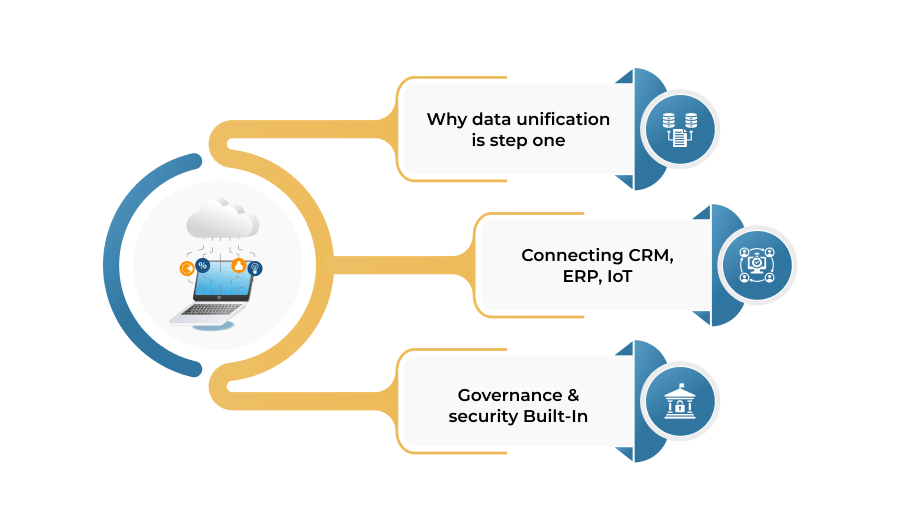
Why Data Unification is Step One Data silos are the biggest obstacle in the digital transformation process. The different teams have different data, there are different numbers from CRM, ERP, and spreadsheets. Azure is a platform that brings together AI, analytics and real, time decisions, breaking silos and creating only one source of truth.
Azure Data Lake Storage: Make a central, cheap and large, scale storage of everything.
Azure Synapse: Mix data warehouse + big data into a single service.
Azure Data Factory: Coordinate your data flow coming from ERP, CRM, IoT, SaaS.
SQL DB + Cosmos DB: A single data store for both operational and analytical data.
Connecting CRM, ERP, IoT Real power: Customer + ops + finance data together.
Case: CRM + SAP → Azure Data Factory → Power BI dashboards. Self-service insights, no IT wait.
Governance & Security Built-In
Microsoft Purview: Auto-classify PII, enforce encryption.
Azure Policy + RBAC: Role/geo access control.
Data lineage: Track origins, fix quality, ace audits.
Result: Trusted data fast—for AI, analytics, business. No chaos, no control loss. Data unification = transformation foundation.
Turning Disconnected Systems into Real-Time Business Visibility
From batch reporting to live operations Traditional reporting is often done in overnight batches and static reports that are old news even before executives get to see them. Azure creates the possibility of real, time visibility by:
Azure Event Hubs and IoT Hub for the intake of a large volume of events, telemetry, and logs.
Azure Stream Analytics for real, time processing, anomaly detection, and generating alerts on streaming data.
This means that operational teams can track KPIs, inventory, SLAs, and customer behavior at the moment when they happen rather than later.
Use cases: supply chain, operations, and customer experience Many companies are leveraging Azure to build seamless dashboards that span systems and regions. Here are some examples:
Using Azure IoT and analytics to track supply chains in real, time and provide visibility to customers in the food and utilities sectors.
Manufacturing and utilities on Azure use centralized monitoring and billing that help them to respond quickly to anomalies.
Unified transaction flows connect SAP, CRM, shipping providers, tax engines, and payment gateways to provide efficient customer experiences. This is achieved through Azure Logic Apps and BizTalk.
In all the scenarios, the teams come up with less reactive problem, solving and more proactive management, which is supported by a real, time operational view.
Role of Azure Analytics, AI, and Cloud Intelligence
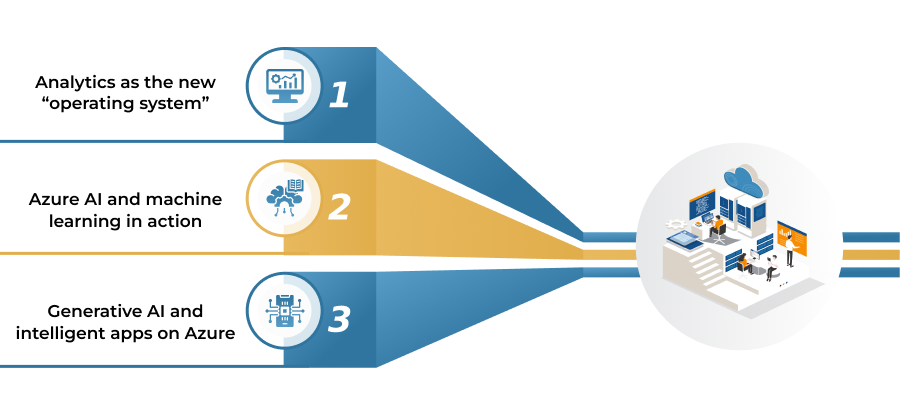
Analytics as the new “operating system”
Azures analytics platform (Synapse, Data Lake, Power BI) converts raw data into usable decision intelligence for every function. This is far from just BI dashboards:
Business users enjoy self, service access to curated data and KPI models through Power BI.
Data teams execute batch and real, time analytics workloads using SQL, Spark, and integrated pipelines in Synapse.
Executives review role, based scorecards and drill, through analytics that are aligned to strategic priorities.
This transforms analytics into a daily operating rhythm rather than a quarterly reporting exercise.
Azure AI and machine learning in action
Azure AI services continue to be at the center of most innovations by enterprises. Some of the capabilities include:
Azure Machine Learning is used to create, train, and implement predictive and optimization models
Azure Cognitive Services offer features that relate to language, vision, speech, document understanding, and conversational AI.
Decision intelligence and agentic workflows help enterprises extend the automation of complicated decisions and processes to a larger scale.
Impact examples:
Enhancement of decision, making accuracy which resulted not only in better marketing but also in more efficient production and customer strategies
.Business processes were simplified and more tasks that require repetitive work were automated thereby staff was made available for work of a higher, value.
Among several organizations, one recorded a 25% increase in productivity of its data science teams and more than $1 million in savings through AI, powered document processing.
Generative AI and intelligent apps on Azure
The latest wave involves AI-powered apps built on Azure’s foundation of data and models. Organizations are:
Building intelligent apps that augment knowledge work and customer service using Azure AI and related services.
Embedding AI within current line, of, business apps for suggestion, personalization, and anomaly detection.
Leveraging prebuilt AI services to shorten time, to, value instead of developing everything from the ground up.
This is the reason why Azure’s role as a cloud and AI platform simultaneously gets on a strategic edge for enterprises.
From Operational Data to Intelligent Decision-Making
Why enterprises fail: 80% collect data. <5% turn it into daily decisions. Azure builds the endless decision engine.This shift reflects how enterprises are moving toward decision intelligence, where data, AI, and systems work together to drive faster decisions.
Turbocharged Loop
Capture → Event Hubs + Data Factory ingest ops/customer/IoT data to Synapse Lakehouse.
Fraud Detection: Banks catch 95% fraud in ms, 60% loss reduction. [Azure Synapse AI]
Churn Prediction: Telecoms +15% retention via targeted interventions. [Azure ML customer 360°]
Data Culture: Chaos → Clarit
Before: 50 Excel wars, shadow BI
After: 1 Azure stack, self-service everywhere
Business Impact: Scalability, Security, and Speed
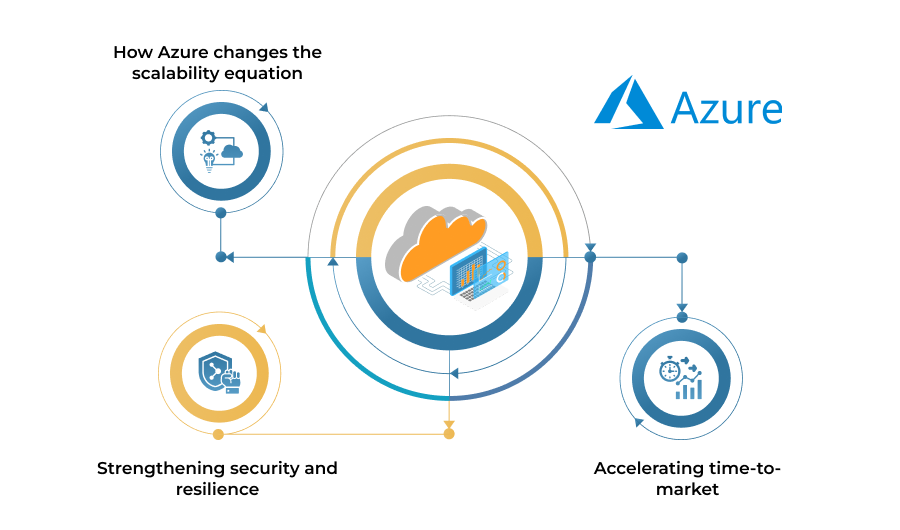
How Azure changes the scalability equation
One of the most apparent advantages for businesses in Azure is scalability. Enterprises don’t have to overprovision for peak load any longer; they can:
Autoscaling can be used to dynamically allocate and deallocate compute and storage resources in real time based on the demand.
You can rapidly deploy into new regions without having to build data centers, which essentially helps you globally expand and enter new markets.
You can easily manage seasonal or event, driven spikes like campaigns, product launches, regulatory deadlines, etc., and continue to provide your services without having any interruptions.
This has a direct effect on factors such as revenue growth, customer experience, and the capability to try out new digital offerings.
Strengthening security and resilience
Security and resilience have become topics for discussion by the board, not just concerns of the IT department. To meet the needs of these areas, Azure provides:
Security measures like regular threat monitoring, super, advanced threat analytics, and security posture management.
Backup, high availability, and disaster recovery functionalities that are completely integrated with very fast failover.
Identity and access management that spans cloud, on, premises, and SaaS environments.
Those organizations that went for Azure have got better security standards and lowered their risk more than if they had disjointed on, premise environments solely with features like best practices and governance frameworks, which is a powerful mix.
Accelerating time-to-market
Speed is now the new competitive currency. Enterprises that leverage Azure have the advantage of delivering new capabilities, products as well as channels to their customers in a shorter period of time. How? Via:
Azure DevOps along with CI/CD (Continuous Integration/Continuous Delivery) pipelines that streamlining and automate build, testing, deployment functions.
Infrastructure, code, and templates that significantly cut down the carbon footprint and make it faster to create an environment.
Managed services (databases, integration, AI, messaging) that allow teams to focus on what matters most instead of doing heavy lifting.
What Enterprises Can Learn from Large-Scale Azure Transformations
Patterns from real-world transformations
Analyzing a few actual Azure transitions gives an insight into the typical fingerprints of success that might even be transformational components of the journeys. These are:
Instead of merely refreshing the technology, an emphasis should be placed initially on a strong business case (cost, risk, growth) for the initiative.
Developing a phased roadmap by first grabbing the quick wins, then the core systems, followed by advanced analytics and AI.
A Cloud Center of Excellence (CCoE) is formed to identify and standardize patterns, governance, and enablement.
Initially, one’s attention ought to be at the core capabilities like identity, networking, security, data platform, and landing zones.
Those entities which try to go cloud without following these steps would probably run into the problems of cloud sprawl and their benefits will be severely limited.
Case story highlights
Multiple case studies provide evidence that Azure transformation leads to tangible results:
A European organization, by unifying its fragmented on, premises systems spread across five countries in Azure, not only achieved consolidated operations and enhanced scalability but also realised a 100k cost savings.
A payment gateway after moving from the old infrastructure to Azure has recorded a 99.95% uptime with zero data loss, thus increasing reliability and customer trust.
An enterprise lowered its legacy costs by $57, 000 and through AI, driven process optimization on Azure saved over $1M.
Such cases make it clear that an Azure transformation goes way beyond a technology refresh; it is a powerful tool for financial performance improvement and risk mitigation.
Common pitfalls to avoid
Enterprises frequently encounter problems that could have been avoided during Azure adoption. Some common mistakes are:
Treating the cloud as “one more data center” and just lifting and shifting without modernizing.
Not giving enough importance to governance, tagging, cost management, and security from the very beginning.
Neglecting change management and upskilling and thus leaving teams incapable of cloud, native environments.
Disjointed efforts without a clear enterprise architecture or data strategy.
Addressing these issues ahead of time can significantly raise the ROI and lessen transformation exhaustion.
Why Cloud Transformation Is a Business Decision, Not Just IT
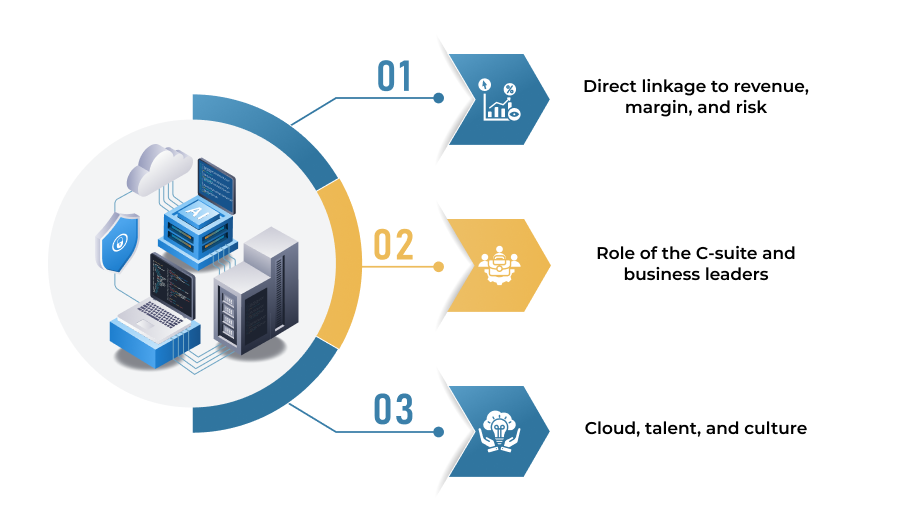
Direct linkage to revenue, margin, and risk
Cloud decisions are now the core of strategy, finance, risk, and technology. Azure projects change:
Turnover: Accelerated product launches, new digital channels, customized experiences, and data, backed cross, sell/upsell.
Profit: Deep cuts in infrastructure and operations costs, increased productivity, and more intelligent distribution of resources.
Risk: Lower risk level through better security, increased agility, and tighter regulatory compliance.
For CEOs and CFOs, Azure is a tool to change the business model, not just the technology stack.
Role of the C-suite and business leaders
Successful Azure, based transformations have a strong element of business sponsorship and cross, functional ownership. Most of the time:
CEO and board set the transformation ambition and outline business outcomes (e.g., new revenue streams, CX metrics, cost targets).
CFOs bring financial models, chargeback, and investment frameworks in line with cloud economics.
COOs, CHROs, and heads of sales or operations share the responsibilities for process modernization, analytics adoption, and KPI redesign.
CIOs and CTOs are the main architects of the systems, platforms, and delivery, however, they decide not be the only ones deciding.
This business, led approach makes Azure a strategic asset that is integrated into the operating plans and OKRs.
Cloud, talent, and culture
Cloud transformation changes the working, collaboration and innovation culture of teams as well. Azure adoption pretty much leads to:
Change from project, based teams to product teams, adoption of DevOps practices, and closer business-IT alignment.
Technology alone does not drive transformation organizational culture plays a key role in enabling speed and innovation.
People learning cloud, native development, data engineering, and AI skills in both IT and business functions.
Makes teams more willing to try out low-code tools (e.g., Power Platform) which are supported by enterprise-grade Azure services.
Enterprises that see Azure as a platform for culture and talent transformation in addition to infrastructure get an exceptional return on their investment.
Conclusion: Azure as the Foundation for Intelligent, Future-Ready Enterprises
Enterprises can no longer count on legacy systems alone to be their source for growth, resilience, and innovation, especially in the world where everything is defined by real, time data, AI, and global competition. Microsoft Azure provides a full, fledged platform to help rebuild the core systems, unify the data, incorporate AI, and create secure, scalable digital experiences all along the value chain. Organizations that leverage Azure as their core digital platform are now witnessing real benefits. These include lowering costs, getting products to the market faster, increasing system availability, and making the most productive decisions across all the functions.
For business and technology executives, the next wave of digital transformation is not simply about cloud migration. It entails creating, with Azure, an intelligent and future, ready enterprise capable of continuous adaptation, innovation, and competition.
Why is data unification critical for Azure analytics?
Data silos lead to contradictory insights. Azure's integrated platform (Synapse, Data Lake) guarantees a single reliable source for AI, analytics, and decision, making real, time at the enterprise level.
How does Azure's decision loop work?
Capture (Data Factory) → Understand (Synapse ML) → Decide (Power BI) → Act (Logic Apps). Continuous cycle turns raw data into automated business outcomes.
What's predictive maintenance ROI on Azure?
20-40% downtime reduction, $50M+ annual savings (GE/Dow cases). IoT + ML predicts failures before they occur, auto-scheduling repairs.
Can Azure handle real-time fraud detection?
Yes, 95% fraud caught in milliseconds via Synapse AI + Sentinel. Banks report 60% loss reduction vs. batch processing.
How does Azure improve demand forecasting?
Retailers now achieve 80-90% forecast precision, 3-7% more in revenue. Synapse helps analyze sales/IoT/competitor data for more accurate inventory planning.
What's Azure churn prediction success rate?
Telecoms achieve +15% retention. ML models on customer 360° data trigger targeted interventions before cancellations occur.
How does Azure democratize data access?
Power BI + Fabric enables citizen analysts. Self-service dashboards with governance prevent shadow IT and number conflicts.
Quickly scale your development capabilities by hiring pre-vetted tech experts who align perfectly with your project goals, timeline, and company culture.
What to expect after you reach out?
1. Share Your Requirements
Tell us your project goals, tech stack, and resource needs for a perfect talent match.
2. Talent Shortlisting
We screen and shortlist top-tier professionals based on your exact technical and cultural fit.
3. Interview & Selection
You interview the candidates and select the ones that align with your expectations and company values.
4. Onboard & Integrate
Seamless onboarding process to ensure smooth collaboration with your in-house team from day one.
5. Monitor & Scale
We assist with performance tracking and help you scale the team as your project evolves.