From Manual Processes to Smart...
22 Oct 2026


The key moment of the digital revolution has arrived when innovation is no longer the exclusive preserve of those speaking the language of code. In the business landscape changing at such rapid speed, companies are teaching this, that the power to build, automate, and transform no longer rests squarely on the shoulders of traditional developers but on every single worker who understands his business process. This shift is fundamentally democratizing innovation and giving businesses historic opportunities to accelerate their digital transformation journey.
Traditionally, for the past several decades, digital innovation had solely been the domain of highly skilled software developers and IT departments. The whole process was skin-chillingly aggravating with respect to long development cycles, complex coding languages, and an overreliance on a special set of technical skills. From idea to final implementation, a company with an invasive mind would face all sorts of challenges, among which were:
The no-code and low-code platforms provided aren’t meant to be intimidating to the user interface with drag-and-drop elements, the pre-built tools, etc., to allow application development by people who have no background in programming.
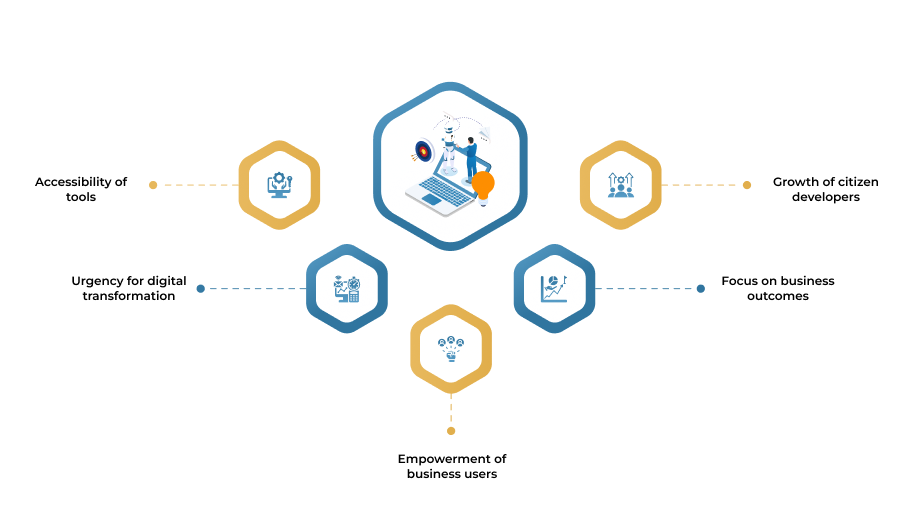
Companies are under pressure to digitize their operations, enhance customer experiences, and react to shifting market trends. Digital makers can quickly prototype and put the solution into practice, thus quickening the digital transformation of an organization.
Who better to build a solution for a business problem than the person who experiences that problem on a day-to-day basis? Digital makers, unlike the IT teams, are closer to the issues thus can develop applications that are massively relevant to meet their needs with shorter cycles toward communication and feedback
Without code/no code tools, the focus has shifted from the onerous task of coding toward obtaining business outcomes. Digital makers can concentrate on solving problems and delivering value instead of getting mired in technicalities.
This movement has birthed such a concept as the citizen developer, a business user able to create new business applications for other consumption with a development and runtime environment sanctioned by corporate IT.
Low-code/no-code platforms allow non-technical users to create applications leveraging their domain knowledge for solutions that they see as being user-centric and relevant from their perspective. This decentralization creates an innovative environment for both, whereas technicians can focus on complex and high-value assignments and strategic business initiatives.
No-code/low-code platforms provide a better environment for collaboration between IT and business. The business users design and build the application visually and undertake solution governance, while IT provides security and integrates the solution into the general enterprise architecture.
Many of the no-code platforms automate typical processes such as data entry, report generation, client onboarding, workflow management, and so forth. If an organization manages to automate such mundane processes by a human, it can capitalize on the workers’ talents for higher-level, creative or value-added activities, which essentially yields productivity and innovation.
The low level of comfort and speedy development that these platforms provide makes them natural for experimentation. Businesses can develop new ideas, MVPs, and proof-of-concepts fast and test them without committing to large investments.
Set up frameworks and guardrails to enable safe development, ensuring that applications adhere to enterprise architecture, security standards, and compliance policies.
Complex integrations with legacy systems, third-party APIs, and databases are engineered to allow data flows and scalable low-code/no-code ecosystems.
Any critical systems requiring high performance and complicated data models or algorithms that are beyond basic proficiency are kept on the developer’s side, forming primary infrastructure for the business.
Developers create reusable modules, components, and templates that help attain rapid citizen development with consistent application quality.
They help foster skills among citizen developers through guiding and assisting with best practices, architectural perspectives, and methods of resolution so as to create a community of empowered digital creators.
Developers will now have to work on advanced solutions such as AI, ML, and blockchain, which will provide more power to low-code/no-code platforms.
While no-code platforms offer tremendous opportunities, businesses must navigate several important considerations to ensure successful implementation:
Research indicates that successful implementation requires addressing these challenges through comprehensive governance frameworks and user education programs.
If an organization wants to tap the full potential of no-code and low-code platforms, it has to shift its mindset at a fundamental level to embrace design thinking principles. Design thinking, being a human-centered approach to innovation, stresses on empathy, ideation, prototyping, and testing phases. Together with rapid prototyping through digital makers, a very powerful combination is born:
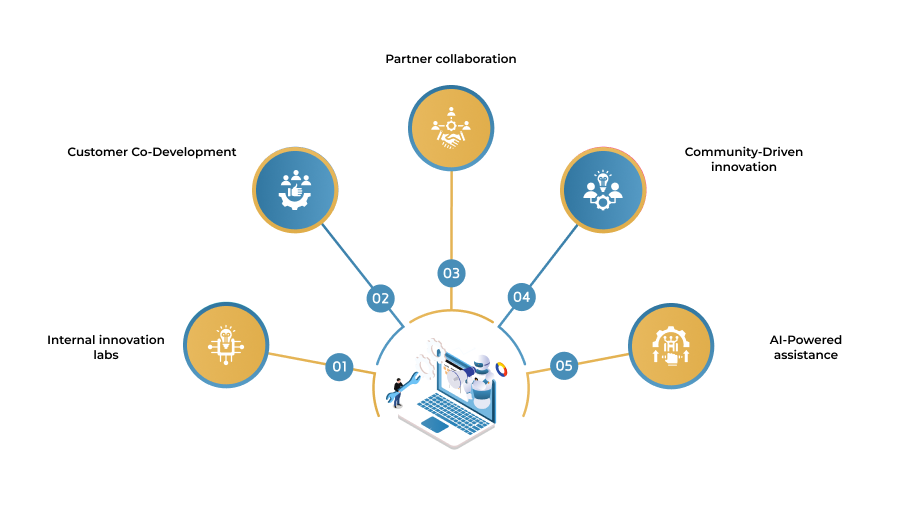
In the future, the realm of business innovation will primarily exist in collaborative ecosystems wherein different stakeholders play their parts in solution development. These environments are where value would be co-created using the collective intelligence of employees, customers, partners, and technology platforms.
This change into a maker culture is beyond a mere technological shift and challenges the basic traditional approaches through which organizations view and appreciate innovation and problem-solving. Companies that join in this revolution will set themselves up for competitive advantages that are sustainable as the market becomes more and more digital.
Innovation is no longer confined to code-heavy development cycles or elite technical teams. With no-code and low-code platforms, businesses of all sizes can empower their teams to ideate, build, and launch digital solutions faster and smarter. This new era of digital makers is reshaping how organizations think about problem-solving, creativity, and scale. Whether it’s automating content scheduling or streamlining internal workflows, the opportunity to innovate is now democratized.
Ready to transform your digital vision into action, without the code? Contact us today and explore how we can help you lead in the low-code revolution.

13 Apr 2026

06 Apr 2026

09 Mar 2026