Why Does Business Speed Still Depend on IT Availability?
Business speed is still dependent on IT availability because most enterprises rely on centralized IT teams for application development, data access and process changes. This causes delays that impact decision-making and innovation. When requests sit in IT backlogs for weeks or months, organizations lose agility, miss opportunities and reduce overall operational efficiency.
The Dependency Loop Explained: How Good Intentions Create Bottlenecks
The root of the “waiting on IT” problem is not incompetence or ill will; rather, it is a structural dependency loop that results from historically sound priorities. Maintaining stability, security, and compliance across the organization’s technological landscape has historically been the primary duty of IT. Every request for a new application, data access, or process modification must be thoroughly examined, ranked, and developed by a central team of experts due to this “control first” mentality. This approach lowers risk, but it produces a slow, linear process.
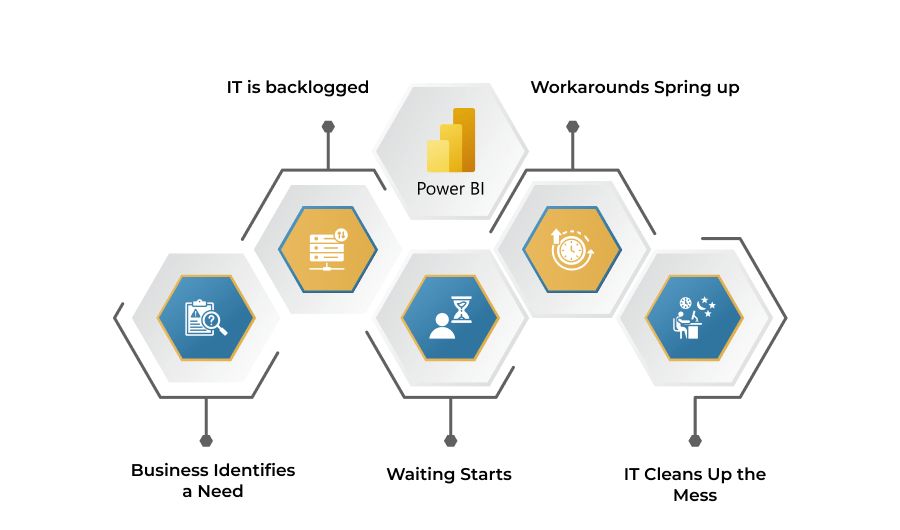
Such a loop is created in the following way:
Business Identifies a Need: The department sees an opportunity to improve the process or gain new value. A Request is Submitted: The business submits a ticket or a formal request to the IT department.
IT is backlogged: IT, which is already engaged in critical enterprise-wide projects, adds the new request to an ever-increasing backlog.
Waiting Starts: The business unit waits. The time period turns from days to weeks and usually to months. The original urgency is forgotten.
Workarounds Spring up: Being delayed, the business unit gets frustrated, and hence, they turn to “Shadow IT” which literally means solving problems with unauthorized use of, new or consumer-grade applications and manual methods.
IT Cleans Up the Mess: Using these workarounds leads to creation of data silos, security vulnerabilities, and integration chaos, all of which IT eventually have to fix, thus using more of their time and reinforcing the need for tight controls.
This endless loop keeps IT always one step behind the business, which is always in a state of waiting. The whole set, up that was meant to safeguard the enterprise actually ends up limiting its capability for change and development.
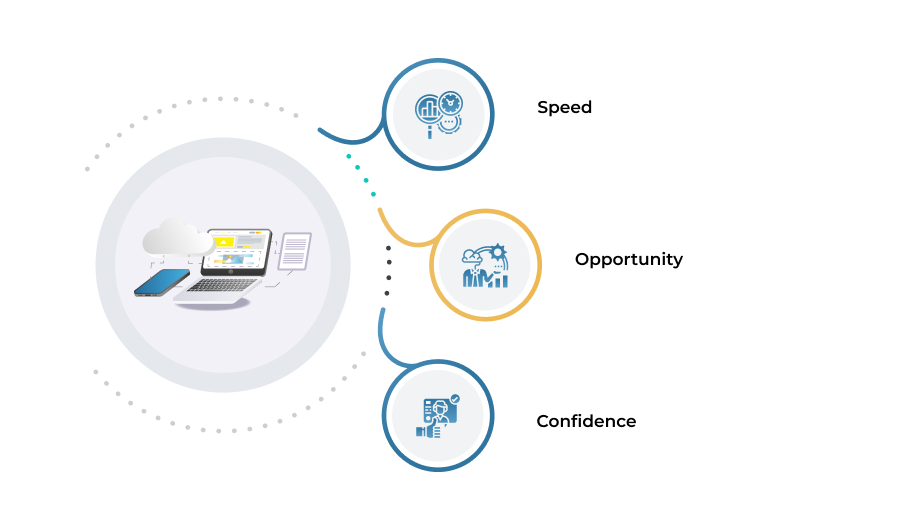
What the Business Loses While Waiting: Speed, Opportunity, and Confidence
The true cost of waiting is more than just a minor nuisance. It weighs heavily on the entire organization, often silently, to the point where it consumes the most valuable assets.
Speed: Speed is money in the digital economy. Missing the market by even a day with product launch, a delayed reaction to a customer trend, or an unresponsive campaign implementation may give the competitors the market share. Time going to waiting for IT is time that the competitors take to win.
Opportunity: Opportunities don’t last forever. The “wonderful idea” that three months ago was great may already be irrelevant today. When you wait on IT, that is the time when market gaps are closing, customer needs are changing, and possible sources of revenue are lessening. The firm will become reactive instead of being proactive, always following one step behind.
Confidence: The most harmful loss resulting from this situation is probably the decrease in employee’s trust and their engagement. Constantly telling “no” or “wait” to the talented and motivated employees, their desire to do more will diminish. They will feel that they have no power and might even decide that the company does not really care about innovation. This culture leakage is almost impossible to measure,, but its consequences are so severe that the company loses its best employees and the environment becomes stagnant and risk-averse.
The true business cost isn’t the hours an IT ticket sits in a queue; it’s the compounded loss of competitive advantage, market relevance, and an empowered workforce.
Why Traditional IT-Centric Models Can’t Keep Up Anymore
Think of IT teams back in the ’90s as gatekeepers: The Waterfall model was king with tightly locked phasesrequirements design code test deploy. Releases every 6 months. Mainframes are stable? That’s the only case they fit. In 2026? None of these will exist.
Agile is essentially oxygen now. Markets change so fast that new AI features can be launched while you are still discussing specs. Legacy stacks are the biggest bottleneck: inflexible servers, manual deploys, old code. 67% of CTOs agree that legacy technology is the number one obstacle to agility [Gartner, inspired forecast].
Market Explosion: Low-Code Takes Over
Boom: Low-code/no-code powers 80% of new apps – by non-devs. Marketing builds lead-gen. Sales crafts dashboards. HR automates onboarding. Zero IT tickets.
Brutal Cost Comparison:
Old Way (Custom)
New Way (Low-Code)
9-12 months
2-6 weeks
$300K-$1M
70% cheaper
5+ devs needed
Drag-drop by business
Changes? Rewrite
Edit visually
Proof: CRM rebuild? Old: $750K/year. Low-code Power Apps: $50K/3 weeks.
Azure DevOps Reveals the Gap
Azure shines: AI predicts failures, auto-scales, deploys 100x faster via GitHub. Traditional IT? Manual approvals, outage firefighting.
The Shift from Control to Enablement in Modern Enterprises
The main point of traditional IT models was strict control, which often caused bottlenecks because of long approval cycles and disconnected operations. By 2026, innovative companies shift their focus to enablement, treating IT as a business partner that not only ensures proper management but also drives business results faster.
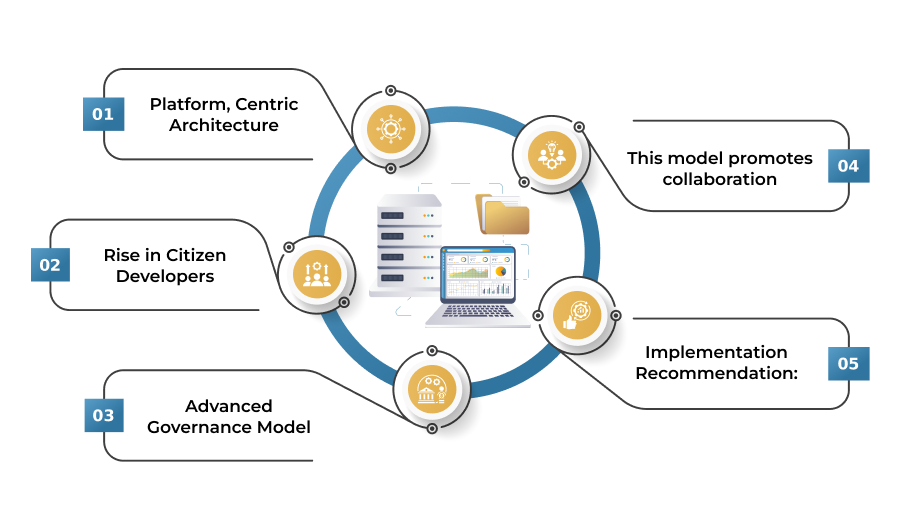
Platform, Centric Architecture: Enterprises merge various tools into a single platforms such as Microsoft Power Platform combined with Azure. This lowers the complexity of operations by as much as 40%, thus facilitating the development of apps, automation, and AI at any time without any hassle. Cloud, native flexibility gets rid of the limitations of the infrastructure during periods of high demand, whereas DevOps methodologies enable the continuous, iterative releases, thus doing away with infrequent deployments.
Rise in Citizen Developers: According to Gartner, citizen developers, such as business professionals in sales, marketing, and HR, will outnumber professional developers 4:1 by 2026 and will hence be responsible for 80% of new enterprise applications. These users rapidly provide highly targeted solutions, for example, a real-time sales dashboard or an automated HR process, without depending on IT queues.
Advanced Governance Model: Low-code Centers of Excellence (CoEs) offer a structured way to help through standardized templates, automated security validation, and simplified review processes. IT changes its role to focus only on security, scalability, and integration oversight; thus, 15- 20% of the budget can be saved when the cost of maintenance is reduced from 70–90% to 30-60% of the app lifecycle.
This model promotes collaboration: “IT changed from being a limitation to becoming a driving force, thus removing the risks of shadow IT,” say the enterprise IT leaders.
Implementation Recommendation: Set up a CoE and use a few pilot projects to demonstrate ROI before scaling to the whole enterprise.
Low-Code as the Bridge Between Business Agility and IT Governance
If helping with enablement is the strategy, then low-code platforms are the main means of the company’s implementation. Low-code development platforms feature tools that enable users to create applications and automate workflows through visual, drag-and-drop interfaces and with pre-built components, thus significantly lessening the requirement for intricate, hand-coded programming.
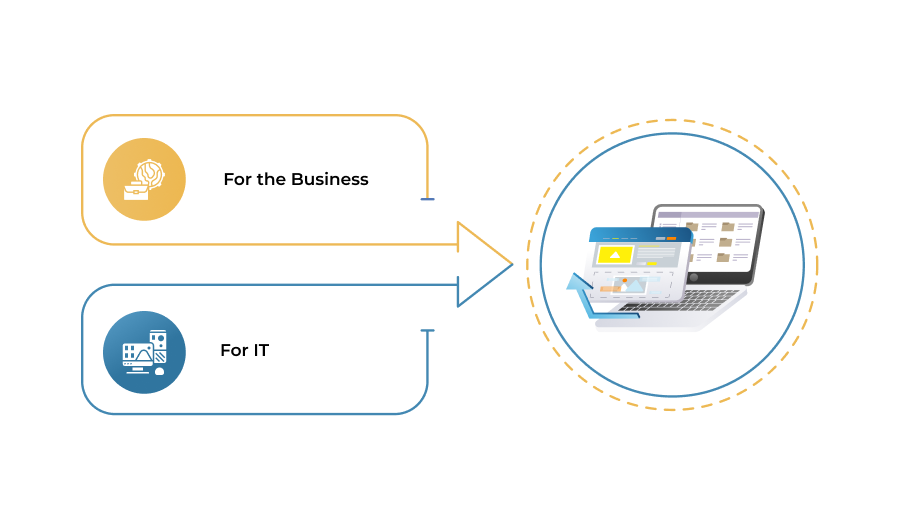
Low-code platforms serve as an excellent means to connect business agility with IT governance, as they facilitate a “controlled innovation” setting.
For the Business: It allows “citizen developers” business analysts, process owners, and other non, technical usersto develop applications, workflows, and dashboards that meet their needs, whenever they want. This significantly reduces the development time from several months to just days or even hours, thus directly solving the speed and opportunity gap issue.
For IT: It provides a centralized, controllable platform. IT maintains final authority over the component library, data connections, security permissions, and physical infrastructure. They have the power to monitor all applications created on the platform, choose which components are used, and ensure that everything conforms with enterprise standards.
Importantly, low-code does not replace professional developers. It frees them up to work on the most complicated, mission, critical systems that require their deep knowledge and expertise instead of getting sidetracked by minor departmental requests. Gartner predicts that official low, code developers will be at the helm of most of the new application development in large enterprises by 2026, thus emphasizing their key role in the future of work.
How Data, AI, and Automation Reduce Decision Friction
Waiting on IT often isn’t about software—it’s about decision friction.
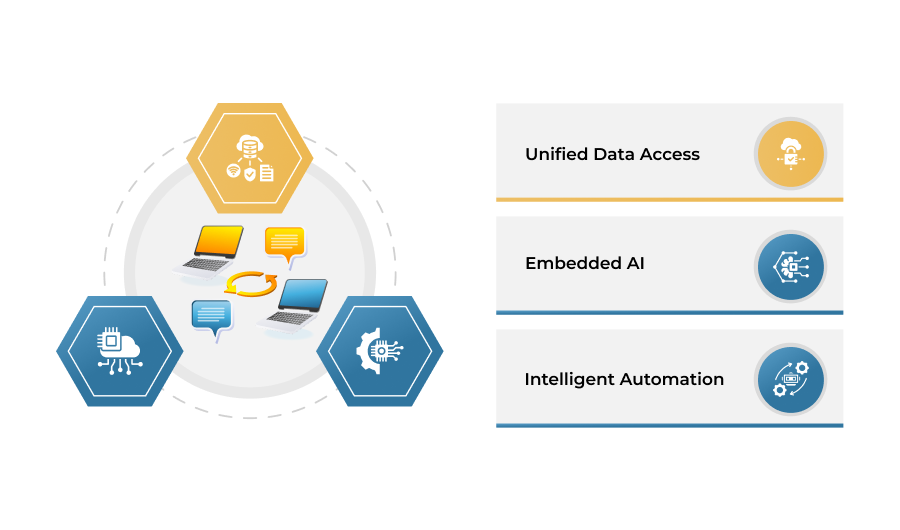
Modern enterprises reduce friction through three pillars:
Unified Data Access Platforms like Microsoft Fabric integrate data across systems, enabling business teams to generate real-time insights without requesting custom extracts.
Embedded AIPrediction analytics models help the team to make decisions based on facts alone without still having to wait for a manual analysis. AI, generated suggestions not only improve precision but also allow for quicker responses.
Intelligent Automation Repetitive approval delay problems become a thing of the past with the use of workflow automation and robotic process automation (RPA). Rules lead to decisions being made automatically, where in the past, they would have required manual routing.
The result?
Reduced dependency.
Faster decisions.
Higher operational confidence.
Redefining Roles: What Business Builds vs What IT Governs
A critical success factor in ending the dependency loop is role clarity.
What the Business Builds (with IT-provided tools):
Applications for a department or specific team (for instance, a project tracking app for the marketing team).
Simple to moderate workflow automations (for example, an automatically approved process for expense reports).
Dashboards and reports for internal use only.Customer, facing forms and easy portals.
Prototypes and MVPs (Minimum Viable Products) to rapidly test new ideas.
What IT Governs and Builds:
The core technology architecture and infrastructure.
The low, code/no, code platform itself, including security and governance.
Enterprise, wide data models, master data management, and data governance policies.
Complex, mission, critical systems that integrate deeply with the core of the business (e.g., core banking systems, ERP customizations).
APIs and the enterprise integration strategy.
Advanced cybersecurity and compliance frameworks.
This clarity is essential. While IT keeps control of the core, business users are empowered to innovate at the edge. This collaboration enables speed without compromising security or stability.
What High-Performing Enterprises Do Differently in 2026
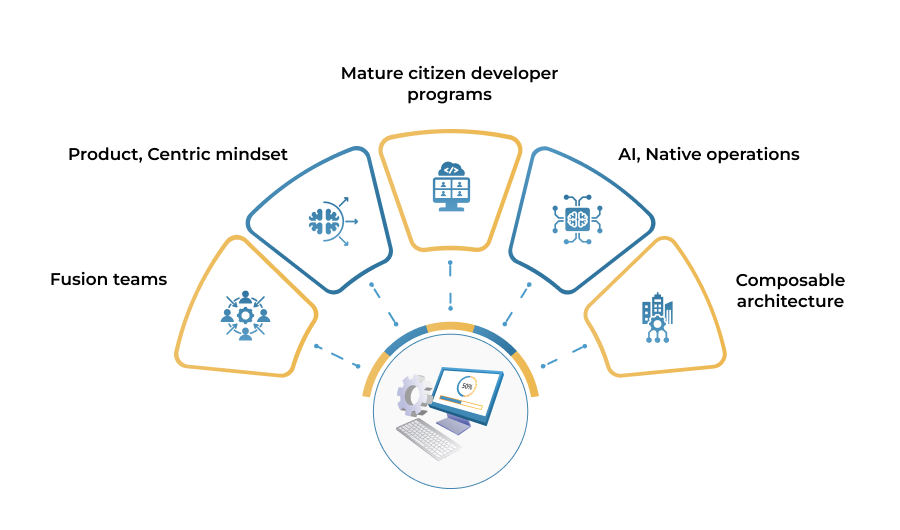
Looking ahead to 2026, the firms leading their sectors will be those that have thoroughly restructured their business models and have come to the realisation of IT as the enabler of their next move rather than the next move itself. Tomorrow’s leaders exhibit several characteristics in common:
Fusion Teams: They have done away with segregated “IT” and “business” departments. Instead, to drive a common product or outcome, they form cross, functional “fusion teams” comprising technologists, business analysts, and subject matter experts, and the teams report to a business leader.
Product, Centric Mindset: They treat everything from internal tools to customer, facing products as products. In essence, instead of doing one, off “projects, ” they keep improving their products based on user feedback and usage data.
Mature Citizen Developer Programs: They have developed and publicly supported citizen developer programs which encompass a range of features such as certification, training, and open governance. The program is seen not as a risk but as a valuable strategic asset.
AI, Native Operations: AI and automation are not just extras; they form the core of their operations. Decision, making is aided, workflows become smart, and workers get relieved of routine chores.
Composable Architecture: They say their IT architecture is “composable, ” i.e., it consists of APIs and microservices at its very core. Hence, they can put together and take apart their capabilities swiftly to adapt to new business needs in the same way as they play with Lego blocks.
These companies view technology as the primary source of business value rather than a cost center, and they have set up their entire organization to optimize its velocity.
Conclusion: Breaking the Loop Without Breaking Control
The conclusion of “Waiting on IT” does not suggest the elimination of IT authority. Instead, it is about changing its role. The winners of 2026 will be those that move away from centralized control towards model changes that allow for enablement, thereby a living ecosystems where governance and agility are balanced.
With the introduction of low-code platforms, unified data systems, AI, powered insights, and clear role definitions, companies can reduce the resistance in decision, making while still being fully compliant and secure.
It used to be that speed was a luxury, but now it is a necessity for competition. The advantage will be with those organizations that figure out how to eliminate dependency bottlenecks, since they will be the ones continuously innovating, gaining team trust, and instantly reacting to market changes.
Getting out of the loop does not have to mean disorder. It is about having a well-organized empowerment system.
What does waiting on IT mean to modern enterprises?
It is generally understood that business teams rely on the centralized IT departments to make software changes, produce reports, automate, or integrate, thereby resulting in operational delays and less agility.
Waiting on IT is a business problem because...
When decisions are delayed, the firm becomes less responsive to the market and more internally strained; the entire chain will eventually affect growth in revenue, the customer experience, and the competitive position.
What is the dependency loop in enterprises?
The dependency loop is a situation in which the business raises IT requests and waits for them to be prioritized then the requests get implemented after a long time, thereby making the business lose incentive to innovate.
Why cant traditional IT models keep up in 2026?
In fact, todays enterprises need being adaptable almost instantly, having capability to use AI and fast implementing of automations, which centralized, ticket, based IT systems without the right resources can hardly deliver.
How can AI help in dismantling IT bottlenecks?
AI executes the tasks of dissecting the information, forecasting the results, and suggesting the measures to be taken, which considerably downsizes the need for human interference and thus helps to break the dependence on IT for performing analytical tasks over and over again.
Is low, code safe for the enterprise?
Enterprise, grade low, code platforms allow for role, based access controls, compliance frameworks, and centralized governance so that they can be used securely and in a controlled manner for application development.
What risks shadow IT introduces?
When business teams use unauthorized tools without governance oversight, shadow IT poses a risk like security breaches, data silos, and non, compliance with standards.
Quickly scale your development capabilities by hiring pre-vetted tech experts who align perfectly with your project goals, timeline, and company culture.
What to expect after you reach out?
1. Share Your Requirements
Tell us your project goals, tech stack, and resource needs for a perfect talent match.
2. Talent Shortlisting
We screen and shortlist top-tier professionals based on your exact technical and cultural fit.
3. Interview & Selection
You interview the candidates and select the ones that align with your expectations and company values.
4. Onboard & Integrate
Seamless onboarding process to ensure smooth collaboration with your in-house team from day one.
5. Monitor & Scale
We assist with performance tracking and help you scale the team as your project evolves.