From Manual Processes to Smart...
22 Oct 2026


The U.S. healthcare system is currently changing, with 95% of healthcare organizations using HL7 standards to break data silos and improve operational efficiency. Interoperability, however, is another persistent problem costing the industry $30 billion every year due to added inefficiencies. For healthcare providers, payers, and IT leaders, HL7 integration is more than a technological improvement; it is also a strategic stance to improve patient care, cut costs, and secure operations for the foreseeable future. Understanding the market potential of this technology is very important. The worldwide healthcare data integration market was valued at $1.21 billion in 2023, according to Grand View Research. The market is expected to see significant growth at a CAGR of 14.5% during the forecast period (2019-2032) and is anticipated to reach $3.11 billion by the year 2030.
Health Level Seven (HL7) is an international standard for exchanging healthcare data. It enables EHRs, laboratory systems, pharmacies, and telehealth platforms to communicate seamlessly. This standardized approach breaks down data silos, improves interoperability, and supports better care coordination.
When for example the lab results of a patient get sent automatically from the Laboratory Information System to the EHR, HL7 standards provide a means of setting up the data in a way that both systems will understand it correctly. 95% of U.S. healthcare organizations make use of HL7 V2.x, which in effect establishes its position as the foundation of healthcare IT.
HL7 encompasses a variety of standards tailored to different aspects of healthcare information exchange:
Despite the advancements in HL7 standards, data exchange in health markets experiences numerous hurdles:
HL7 integration delivers measurable ROI:
Facilitates seamless communication between disparate systems, ensuring that patient data is consistently accurate and up-to-date.
Timely and accurate data exchange enables healthcare providers to make informed decisions, leading to better patient outcomes. And Real-time data access reduces duplicate tests and medication errors.
Streamlines administrative processes, reducing redundancies and operational costs.
Meet HIPAA, 21st Century Cures Act, and CMS mandates effortlessly with standardized audits.
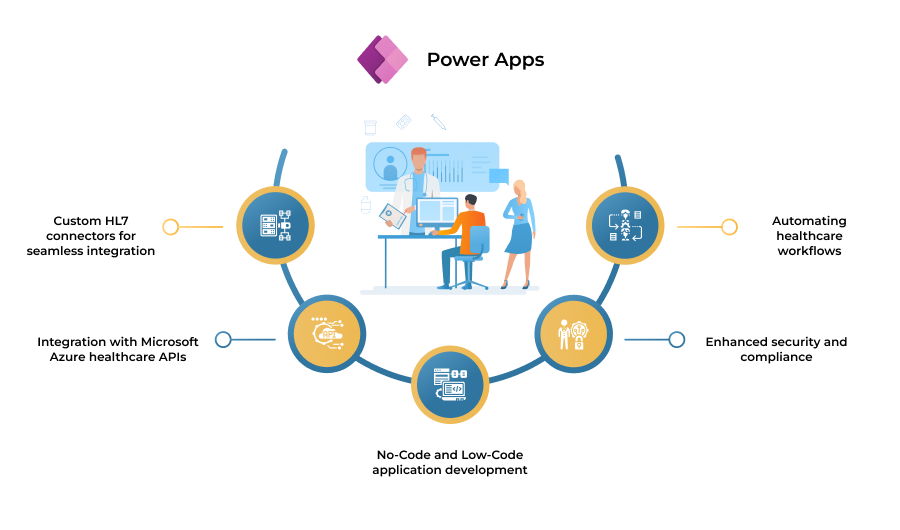
Microsoft Power Apps is a robust low-code platform for every healthcare organization to build applications and implement HL7 into them. Its user-friendly interface, extensive connectors, and cloud integration improve interoperability. The platform simplifies healthcare workflows and protects sensitive patient data.
Power Apps also has custom connectors created by developers that use HL7 messages to communicate between healthcare systems. The connectors exchange real-time patient findings, lab results, and medication information exchanged between these health systems to ensure that no data is left out.
Power Apps lets you integrate with many Microsoft Azure healthcare capabilities: Azure API for FHIR, for example, enhances interoperability according to Fast Healthcare Interoperability Resources (FHIR) compliance standards and levels. Such access allows healthcare providers to read, write, and store appropriate healthcare data on patients while still being compliant with HIPAA and other regulatory compliance in the U.S.
Power Apps empowers healthcare professionals to create and modify applications without extensive coding skills. Features like online awareness drag-and-drop allow an organization to create workflows that ease the entry of patient data, help automate administrative duties, and communicate between departments seamlessly.
Security is a major concern in healthcare data exchange. Power Apps uses Microsoft’s security framework, including role-based access control (RBAC) and multi-factor authentication (MFA), to guarantee integrity and confidentiality of data. These attributes help protect sensitive patient information and enable compliance with industry regulations.
Power Apps integrates with Power Automate to automate key HL7 processes. These include patient admissions, discharge notifications, and appointment management. The integration reduces manual work, minimizes errors, and improves operational efficiency.
Application of HL7 in the healthcare domain is massive to ensure that operational efficiency is gained, improved patient care is delivered, and supported in data exchange. Here are the real-world use cases concerning HL7:
Hospitals have many software systems with which they manage patient care like EHR, RIS, and PMS. HL7 integration then provides seamless data communication while minimizing manual data entry and reducing errors in entry.
With the HL7 system, medical test results can be delivered into EHR assets in real time. Diagnosis is speeded up, made accurate, and totally obviated by saving test results by manual data entry.
Increasing release of telehealth, HL7 joined such virtual consulting platforms with the hospital EHR for keeping the details of remote patients. Thus, with enhanced access to real-time history, doctors can provide better patient care.
HL7 allows linking between pharmacy management systems with hospital EHRs providing the basis for accurate prescription orders and dosage monitoring and then updating the real-time inventory. This helps avoid maximum error and ensures patient safety.
By integrating HL7 with Revenue Cycle Management (RCM) systems, healthcare providers can automate insurance verification, claims processing, and billing. This reduces administrative burdens and accelerates reimbursements.
Moreover, public health institutions and government agencies use HL7 to collect data and feedback from several providers of health services. This, in turn, becomes a good instrument for early recognition of outbreaks, tracking vaccination coverage, and modeling appropriate responses to public health emergencies.
With HL7 integration among all of the above applications, healthcare organizations will achieve immense leaps in data interoperability, be able to provide better care in less time, and even enjoy excellent operational excellence.
HL7 integration is a game-changer for modern healthcare systems, ensuring seamless data exchange, improved patient care, and compliance with industry standards. By integrating HL7 with Power Apps, healthcare providers can automate workflows, enhance interoperability, and securely manage patient data. This not only improves operational efficiency but also reduces manual errors and administrative burdens. Contact us today, we specialize in custom HL7 integration solutions to help healthcare organizations streamline their digital infrastructure. Whether you need seamless EHR integration or automated healthcare workflows, we’ve got you covered.
05 Oct 2026
21 Sep 2026
10 Sep 2026