From Manual Processes to Smart...
22 Oct 2026

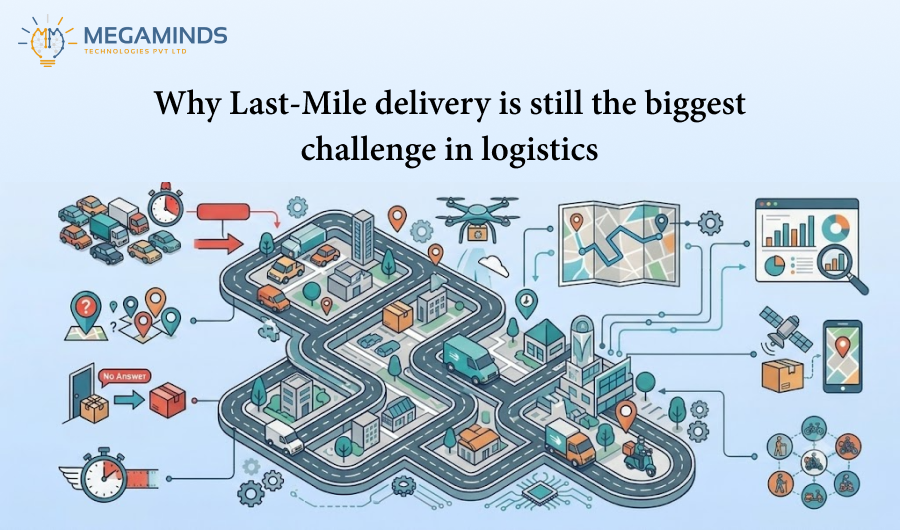
Last-mile delivery represents the final physical segment of a product moving from a distribution center to a customer. Although this segment represents the shortest distance in the delivery journey, it is the most expensive and difficult segment to cover. Challenges along last-mile segments include traffic, frequent unsuccessful delivery attempts, and increasingly unpredictable customer expectations.
It is estimated that freight costs for last-mile segments represent approximately 53% of total transport expenditures (2026 industry report), an increase from approximately 41% in 2018. The last-mile delivery market, which was valued at $177–184 billion in 2025, is anticipated to reach $278 billion by 2030.
Multiple challenges make up the final segment of the delivery process that effect delivery speed, cost, and customer satisfaction. A snapshot of some challenges includes the following. 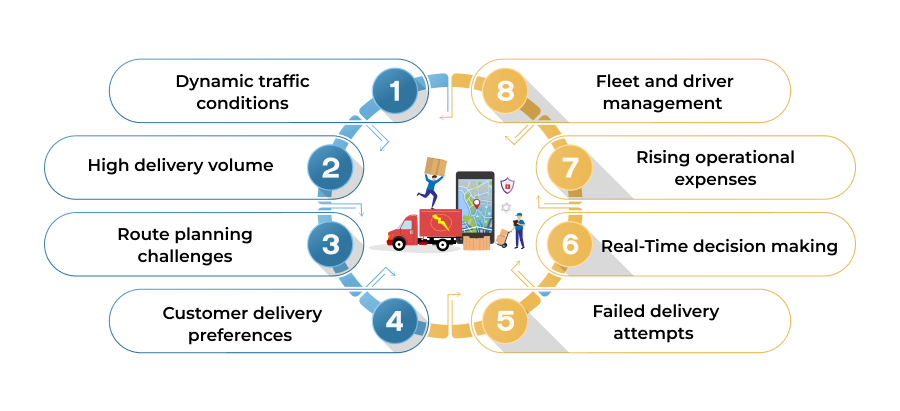
1. Dynamic Traffic Conditions
Road closures and unexpected traffic congestions disrupt delivery time estimates.
2. High Delivery Volume
More deliveries add complexity and strain to every part of the system. Americans shipped an estimated 22.37 billion parcels in 2024, and volumes continue to climb.
3. Route Planning Challenges
More stops require exponentially more complex routing. For last-mile operations, the gap between a well-planned route and a poor one is often 15–25% in miles driven — which translates directly into fuel, driver hours, and vehicle wear.
4. Customer Delivery Preferences
More failed deliveries, demands for specific delivery times, address changes, and delays, add more complexity to final segment logistics.
5. Fleet and Driver Management
Delivery demands require more balancing the priorities, staff, and vehicles.
6. Rising Operational Expenses
Staffing, fuel, vehicle upkeep, and multiple deliveries all increase the cost to deliver.
7. Real-Time Decision Making
Changing weather, more urgent orders, and/or disruptions cause delays unless immediate changes are made.
8. Failed Delivery Attempts
Missed deliveries, unavailable customers, incorrect addresses, and repeated delivery attempts increase costs, delay fulfillment, and reduce overall operational efficiency.
Digital buying has trained customers to expect more. One report indicates that nearly 90% of shoppers will not mind waiting between 2 to 3 days for a delivery if they are able to save on the overall purchase and shipping is reliable. In addition, over half of consumers prefer shipping with schedules and returns that are simple and straightforward. Clarity and reliability are now as important, if not more than, speed of delivery.
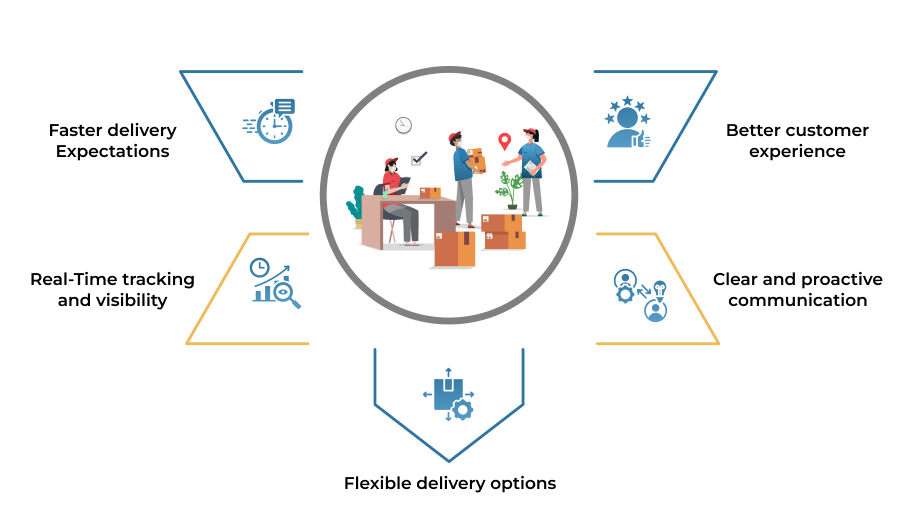
According to the World Economic Forum, the cost of last-mile delivery makes up about 53% of the cost of shipping. It is the costliest step in the logistics chain. Inefficiencies in the logistics chain such as failed deliveries and route planning, and traffic, can contribute to lost profits.
The combination of manual launches, lengthy and repetitive delivery attempts burdens logistics with increased cost and delivery delays. According to McKinsey and Company, the cost of goods delivery can be reduced by 10-15% by using AI to enhance delivery route optimization.
Additionally, the expense of returned goods is a growing concern. The global e-commerce return rate is between 20-30% according to Statista. This return rate places a burden on logistics in the form of increased transportation and advanced delivery costs. Optimizing last-mile delivery can decrease costs, while increasing customer satisfaction.
McKinsey’s research on AI in distribution operations (November 2024) quantifies the opportunity: embedding AI can deliver reductions of 5–20% in logistics costs, 20–30% in inventory, and 5–15% in procurement spend. The range is wide because the gain depends on how inefficient the baseline is — operations running manual routing see the largest improvement.
Real deployments back this up. DHL’s Greenplan dynamic routing algorithm achieved a 20% reduction in delivery costs, while Tesco’s AI-powered routing saved 11.2 million miles and cut fuel consumption by 8% per order.
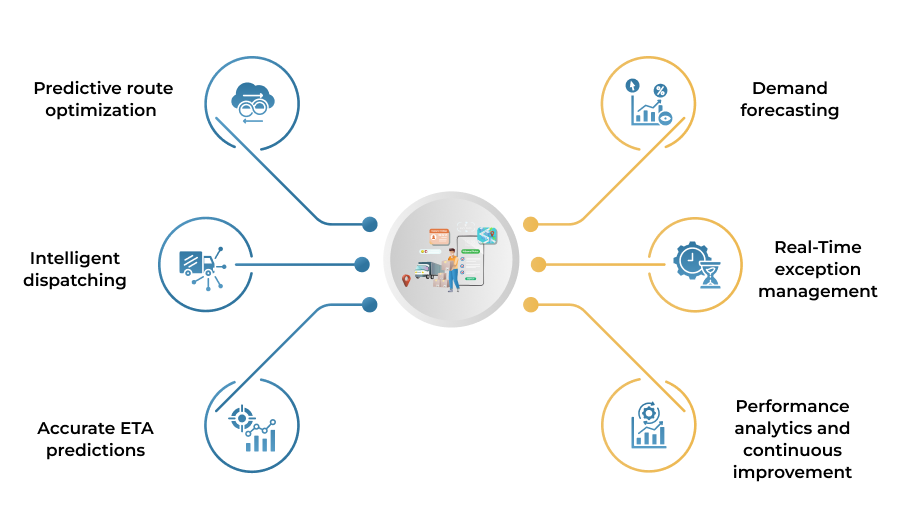
1. Predictive Route Optimization
Using traffic data, delivery history, and the current weather, AI will select the best route to travel for the delivery.
2. Intelligent Dispatching
AI takes driver locations, delivery priorities, customer preferences, and the available space in vehicles, fully optimizing vehicle usage.
3. Accurate ETA Predictions
Through data science, machine learning will generate delivery ETA’s, and help companies give delivery updates to customers.
4. Demand Forecasting
Patterns of the past can help AI predict the delivery needs of the future. Companies can schedule driving and delivery resources accordingly.
5. Real-Time Exception Management
If delays are likely (traffic, deviations from a planned route, mechanical issues), AI will help logistics teams prevent impacted deliveries.
6. Performance Analytics and Continuous Improvement
AI will help predict delivery performance and the productivity of a driver, and identify key performance indicators. Where there is a gap, last-mile operations will be streamlined.
It’s not enough to simply deliver packages quickly anymore. Customers want to know when their goods will arrive, have the ability to track their packages, and expect communication with the delivery company during the transport. Companies which manage the transport and delivery of goods are investing in new technologies to increase and improve the reliability of the service they offer.
These services offer real-time location tracking of each transport unit and the cargo so delays can be addressed as soon as they are identified.
The early phase of any journey is the most exciting, but also the most difficult, and the phase that takes the most effort to complete, is the final mile. And, considering that it accounts for 50% of a shipment’s total cost (according to some estimates), the most expensive part. So it goes without saying that making Logistics and delivery services more efficient is an area that the application of AI and Analytics is rapidly advancing and is in great demand.
Speed and efficiency in logistics and delivery services translates to an advantage and increased customer satisfaction.
Businesses that reinforce reliable, efficient and consistent delivery practices are rewarded with increased customer satisfaction and, ultimately, increased brand loyalty.
Businesses that reinforce reliable, efficient and consistent delivery practices are rewarded with increased customer satisfaction and, ultimately, increased brand loyalty.
With the increasing reliance on AI, automation and business processes that incorporate AI and Analytics, the logistics and delivery industry and, in particular, the final-mile delivery services, is one of the most customer-centric, advanced and efficient industries.
Challenges in Urban and High-Density Delivery Environments
Urban landscapes amplify every last-mile cost driver, and the pressure is intensifying. The World Economic Forum’s white paper Transforming Urban Logistics, produced with Accenture, projects that on a business-as-usual path, emissions from urban deliveries will rise 60% by 2030, accounting for 13% of cities’ total carbon emissions — while adding roughly five minutes to every daily commute and more than half an hour of extra road time for delivery vehicles.
Major urban constraints include: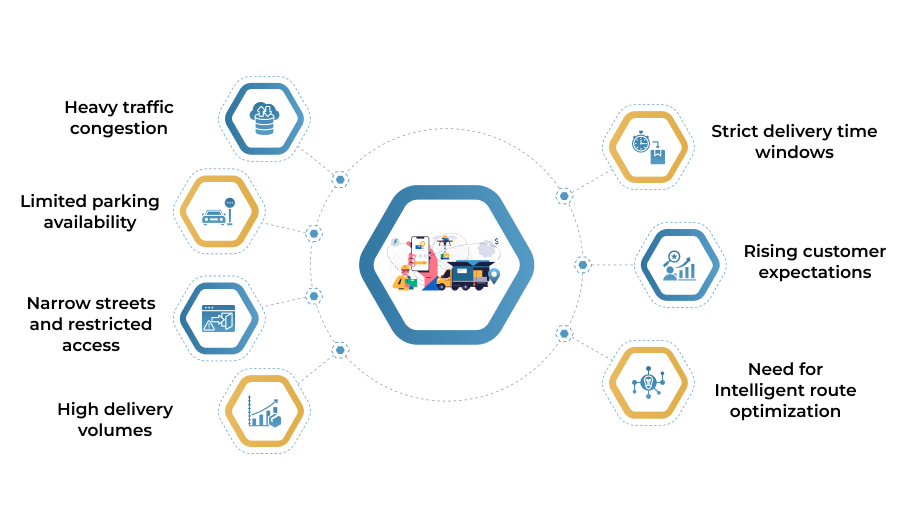
Organizations adopting intelligent last-mile delivery solutions gain advantages that extend beyond logistics operations.
Some of the most significant benefits include:
Perhaps the greatest benefit is improved decision-making.
Instead of relying on assumptions, logistics leaders can make informed operational decisions using real-time analytics and predictive insights.
This creates more resilient and customer-centric supply chains.
AI, automation, and predictive analytics are shaping what comes next. Autonomous vehicles, drones, and decision-intelligence platforms are improving route efficiency, cost per drop, and delivery accuracy. In the global market, the autonomous vehicles segment is projected to grow at a CAGR of 23.8%, the fastest-expanding technology category in last mile.
Out-of-home delivery is scaling alongside it. The automated parcel terminal market is projected to grow from $318.8 million in 2025 to $824.9 million by 2035, as lockers and pickup points move from convenience feature to core network design.
Companies are also investing in hyperlocal fulfillment centers, predictive maintenance, and intelligent routing to raise fleet efficiency and reduce failed attempts. In fast-growing markets the shift is especially sharp: the India last-mile delivery market was valued at roughly $7.4–7.5 billion in 2025 and is forecast to grow at a CAGR above 12–13%, driven by quick-commerce platforms normalizing sub-15-minute delivery windows in metro catchments.
Early adopters of these technologies will be best positioned to build delivery networks that are both responsive and resilient.
Last mile delivery is an issue for logistics due to customer demands and supply chain complexities paired with increasing last mile delivery costs. Traditional delivery systems fail to satisfy the demands of modern supply chains.
AI, Predictive Analytics, Internet of Things (IoT), and real time data can be used to optimize delivery routes and deliver faster while maintaining high quality at a reduced cost and increasing customer satisfaction. Smart last mile logistics become a sustainable source for long term growth and customer satisfaction by delivering faster, smarter and providing a more reliable customer experience.
19 Oct 2026
15 Oct 2026